
Cho U collected his fifth title ...

By Rob Van Zeijst

Cho U collected his fifth title when he won the NHK hayago (speed go) title for the second time. In the finals he beat Gosei titleholder Norimoto Yoda, the man he defeated last year to capture the Meijin title. The NHK title is a knockout tournament broadcast on NHK-E every Sunday from 12:20 p.m. to 2 p.m. It is exciting because only 30 seconds are allowed per move. Before play starts, a top pro gives an instructive 20-minute lecture.

We have been studying the crosscut. This week we look at two pro games in which the crosscut appeared.

Kisei title match

This is the final game in the best-of-seven match between Kisei title holder Naoki Hane (Black) and Satoshi Yuki.

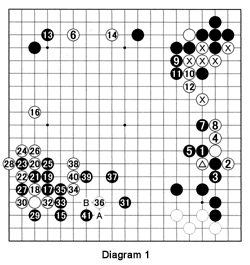
Diagram 1: The problem was how should White respond after Black crosscuts with 1. White has to be careful, as the stones marked with X's are not fully alive yet. He, therefore, chooses the combination 2-4--prompting Black to answer with 3 and 5 to bottle up the stone marked with a triangle--before switching to the top with 6. Since Black cannot invade on the right side, he strengthens his own stones with 7 through 11 and without worrying about White strengthening his position in this area, too. Black then plays 13, forcing White to extend to 14, which has no impact on Black's already strong stones. This way, Black can develop the lower side with 15 through 31. White makes a halfhearted invasion with 34 and 36, but black 41 threatens to connect with A or cut with B. White's stones 34-38 may come under attack later, too. Black is leading and in the end won the game by 4! points. In successfully defending the Kisei title, Hane took home \42 million in prize money.
NEC Cup Final

Diagram 2: This is the third game of the NEC Cup finals between Ryu Shikun (White) and Cho U. White has just played the marked stone in the center. Black is unable to play at 2 because the sequence white A, black B and White connecting at 1 would result in Black losing this stone. Black's only recourse is at 1. With 3, Cho shows his fighting spirit. The game then becomes more serious as Black seems to have taken on too much. With 16, White appears to be launching a lethal attack on Black's center group. However, the exchange 11-12 proves valuable when Black pulls a surprise with 17 (see Reference 1).
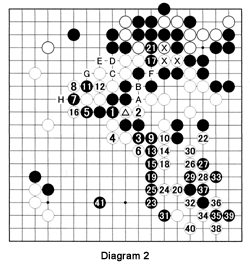
White then starts a large-scale attack on Black's stones with 18 and 20, but Black captures the three marked stones while ensuring that he will stay alive in his corner in the lower left and safeguarding his lower center group with 41. In the end, White resigned.

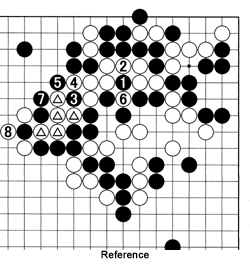
Reference: (black 9 captures 6 at 1) After black 1 (17 in Diagram 2), if White connects at 2, this would be followed by black 3, white 4, black 5, white 6 (which would capture the ko), black 7, white 8 and black 9, which would recapture the ko. White could not win the ko and would, therefore, lose the game. Note that after Black plays at 3, White's marked stones are in danger too.
Solutions to last week's problems

Solution 1: When Black crosscuts with 1 (as in Diagram 1), White can resist with 2 through 8. However, after black 9, White's best option is cutting off the marked black stone, but this would not amount to much. After 12, Black has good moves at A and B, and even if he plays elsewhere, White will be handicapped with the cutting point at A. White's position is not good at all.

Solution 2: In response to Black's crosscut, White can also play 2 and 4. White seems to have succeeded with 6 and 8, but if Black plays at A, White's marked stones could come under attack. Black may also connect at B later, which would lead to a large-scale battle.
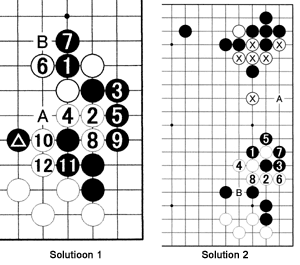
Solution 3: For alternatives after Black's crosscut, see Diagram 1, Solutions 1 and 2 and Problems 1 and 2.

New Problems

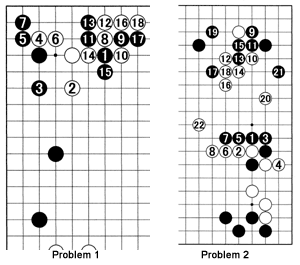
Problem 1: Lee Changho (Black) is playing his teacher, Cho Hunhyun. Because of the presence of 7, Lee chooses a very aggressive variation with 11 and 13. To ensure that he does not lose these stones, where should Black play next?

Problem 2: This is from a fast game between top pros. Note the top right is completely different from the game in Diagram 1. With 1 through 7, Black builds thickness to attack in the top right. Where should Black play after white 22?
Want to find out more? Come to Ben's Cafe in Takadanobaba, Tokyo (03-3202-2445, www.benscafe.com.) where the English-speaking go community congregates every Sunday. You can enjoy free lessons, 11 a.m.-1 p.m.

Van Zeijst is a four-time European go champion and European representative at the Fujitsu World Championship.

By Richard Bozulich

By Rob van Zeijst

  1. Pros have a full arsenal of techniques ...
  2. The phrase "Today is the first day of the rest of ...
  3. Cho U, who is only 24 years old ...
  4. Cho U, the 24-year-old Honinbo titleholder,
  5. Many novices like to get off to a good start ...
  6. Many players think the game is over at the end ...
  7. The saying goes,"There is ...
  8. Many players think the game is over at ...
  9. As in all areas in life,
  10. You are probably familiar with the story ...
  11. In games with experienced go players ...
  12. Although go has a long history,
  13. How can an amateur quickly strengthen his game?
  14. In his book The Seven Principles of Success,
  15. Hideyuki Sakai became a doctor ...
  16. Cho U, the current Honinbo-title holder, ...
  17. In a zero-sum game like go, the two sides divide ...
  18. To become a stronger,
  19. Can the ability to play go be passed ...
  20. One of the greatest annual go spectacles ...
  21. While the Nihon Kiin,
  22. For the past few months we have studied ...
  23. At present, three young players dominate ...
  24. Whenever a player asks a top professional ...
  25. Lee Se Dol, a 21-year-old South Korean ...
  26. The first column of the New Year ...
  27. In his book How to Get Ideas, ...
  28. When formulating a winning strategy, ...
  29. The obvious advantage of watching go on television ...
  30. Last Sunday, NHK-E broadcast a documentary about ...
  31. It had to happen someday.
  32. Although strategy and tactics ...
  33. As the deadline for reporting our ...
  34. According to one story,
  35. A few weeks ago, we talked about ...
  36. For Satoshi Yuki fans, last week was ...
  37. Cho U collected his fifth title ...
  38. Honinbo title holder Cho U will be challenged ...
  39. When should a player resign? ...
  40. When should a player resign? ...
  41. While Koichi Kobayashi won ...
  42. Was Masaki Takemiya,
  43. There is a common stock market warning
  44. Last week's Go Weekly magazine ...
  45. Like scientists and philosophers, (Jun. 22, 2005)
  46. In sports such as soccer or when delivering ... (Jun. 29, 2005)
  47. Challenger in 2001, titleholder in 2003 ... (Jul. 13, 2005)
  48. Most books dealing with ... (Jul. 20, 2005)
  49. One of the maxims included ... (Jul. 27, 2005)
  50. How can Japanese go players stop ... (Aug. 3, 2005)
  51. The naive investor might believe ... (Aug. 11, 2005)
  52. The difference between new pros ... (Aug. 18, 2005)
  53. Having 20 years of experience on ... (Aug. 24, 2005)
  54. How do you react when you are ... (Aug. 31, 2005)
  55. Su Doku, a game with a Japanese-sounding name but ... (Sep. 7, 2005)
  56. In their book "Slowing Down to the Speed of Life," ... (Sep. 14, 2005)
  57. The pain associated with a loss often ... (Sep. 21, 2005)
  58. In go, one of the most difficult things ... (Sep. 28, 2005)
  59. Do you ever get writer's block? ... (Oct. 5, 2005)
  60. Worry and fear are destructive to ... (Oct. 12, 2005)
  61. Go is such a difficult game ... (Oct. 19, 2005)
  62. Ever said something you regretted later? ... (Oct. 26, 2005)
  63. Being decisive is supposed to ... (Nov. 9, 2005)
  64. Research on identical twins who were ... (Nov. 16, 2005)
  65. According to Benjamin Franklin ... (Nov. 24, 2005)
  66. Ethics may seem a subject that ... (Nov. 30, 2005)
  67. In his book "The Inner Game of Tennis," ... (Dec. 7, 2005)
  68. The game of go is also known ... (Dec. 14, 2005)
  69. As there is a strong relationship ... (Dec. 21, 2005)
  70. In his first inaugural address in 1933 ... (Dec. 28, 2005)
  71. In the animal world ... (Jan. 11, 2006)
  72. In his book Fooled by Randomness ... (Jan. 18, 2006)
  73. The adage "if you don't know ... (Jan. 25, 2006)
  74. Some people say that ... (Feb. 8, 2006)
  75. In boxing, defending yourself ... (Feb. 15, 2006)
  76. Imagine this scene from ... (Feb. 22, 2006)
  77. The book Theory of Games ... (Mar. 8, 2006)
  78. Discussions on world trade ... (Mar. 22, 2006)
  79. Even though Naoki Hane lost ... (Apr. 5, 2006)
  80. Go came into existence more than 3,000 years ago in China, ... (Apr. 12, 2006)
  81. Although the ancient game of ... (Apr. 19, 2006)
  82. When novices see go for the first time ... (Apr. 26, 2006)
  83. Although last week's column focused on ... (May. 3, 2006)
  84. Sometimes described in the media ... (May. 10, 2006)
  85. Old teaching methods in which students are ... (May. 17, 2006)
  86. Go teachers should offer advice and ... (May. 24, 2006)
  87. With players from 68 countries and ... (May. 31, 2006)
  88. I am unable to report the final result of ... (Jun. 7, 2006)
  89. Last week, we reported that the players ... (Jun. 14, 2006)
  90. Go players are ranked according to ... (Jun. 21, 2006)
  91. Is dementia reversible? ... (Jun. 28, 2006)
  92. Although go is thousands of years old, ... (Jul. 5, 2006)
  93. Black always plays the first ... (Jul. 12, 2006)
  94. A top pro once said ... (Jul. 19, 2006)
  95. Learning something new can be a straightforward ... (Jul. 26, 2006)
  96. Sustainable development is a term ... (Aug. 2, 2006)
  97. Last week, we said sustainable development ... (Aug. 9, 2006)
  98. In his work The Art of War, ... (Aug. 23, 2006)
  99. World chess champion Garry Kasparov met ... (Aug. 30, 2006)
  100. Meijin titleholder Cho U was ... (Sep. 6, 2006)
  101. Last week, we mentioned how ... (Sep. 13, 2006)
  102. Some people say that ... (Sep. 20, 2006)
  103. According to Buddhist teachings, ... (Sep. 27, 2006)
  104. Both Jesus and the Buddha advised ... (Oct. 4, 2006)
  105. While doing the play-by-play commentary during a game ... (Oct. 11, 2006)
  106. In gymnastics or martial arts, ... (Oct. 18, 2006)
  107. A top pitcher can hurl a baseball ... (Oct. 25, 2006)
  108. Does reality shape our thoughts ... (Nov. 1, 2006)
  109. Calvin Coolidge, the 30th president of the United States, ... (Nov. 8, 2006)
  110. What sets winners apart from losers? ... (Nov. 15, 2006)
  111. In commenting on a paper submitted ... (Nov. 22, 2006)
  112. In his book The Art and Craft of Problem Solving, ... (Nov. 29, 2006)
  113. As we discussed last week, ... (Dec. 6, 2006)
  114. Some 9-dans are better than ... (Dec. 13, 2006)
  115. Go players love to compare ... (Dec. 20, 2006)
  116. Renowned Harvard psychologist ... (Dec. 27, 2006)
  117. Important decisions are often ... (Jan. 10, 2007)
  118. Whatever our endeavors, ... (Jan. 17, 2007)
  119. It seemed a good idea at the time is ... (Jan. 24, 2007)
  120. In dealing with others, almost everything ... (Jan. 31, 2007)
  121. Unless you know the denouement of a situation, ... (Feb. 7, 2007)
  122. A complete novice at go first learns ... (Feb. 14, 2007)
  123. In this age of computers, ... (Feb. 21, 2007)
  124. Whenever arranging information, ... (Feb. 28, 2007)
  125. Many people believe thinking is ... (Mar. 7, 2007)
  126. Everybody gets into trouble sometimes. ... (Mar. 14, 2007)
  127. On the surface, we may believe ... (Mar. 28, 2007)
  128. You are probably familiar with the adage ... (Apr. 4, 2007)
  129. At the start of each fiscal year on April 1 ... (Apr. 11, 2007)
  130. All novels tell a story. ... (Apr. 18, 2007)
  131. The image most people have of go ... (Apr. 28, 2007)
  132. What is the most attractive aspect ... (May. 5, 2007)
  133. Some games have a clear goal, ... (May. 15, 2007)
  134. In most games, including chess and checkers, ... (May. 23, 2007)
  135. Last week, we said Black had an advantage ... (May. 26, 2007)
  136. By the time you read this, the results of ... (June. 2, 2007)
  137. At 13 years of age, ... (June. 9, 2007)
  138. The late John W. Gardner, ... (June. 16, 2007)
  139. It is common knowledge that the Deep Blue ... (June. 23, 2007)
  140. As we saw last week, the value of ... (June. 30, 2007)
  141. The number of possible games ... (July. 7, 2007)
  142. Throughout the game of go ... (July. 14, 2007)
  143. The player pros most admire is Shusaku Kuwahara (1829-1862),... (July. 21, 2007)
  144. Lee Changho, a South Korean considered by... (July. 28, 2007)
  145. A lot of confusion and mystery surround a player ... (August. 4, 2007)
  146. With his ready smile and open-minded personality... (August. 11, 2007)
  147. This is the final column in The Magic of Go... (August. 18, 2007)