
Kisei title and Cho-Kobayashi rivalry
The Kisei title is the most prestigious in the go world. It was founded in 1976, under the sponsorship of The Yomiuri Shimbun, and today it offers a winner's purse of 33 million yen.Three players have dominated this title: Shuko Fujisawa, Koichi Kobayashi and Cho Chikun. Fujisawa won the initial tournament for the title in 1977 and defended it for five straight years against Japan's strongest players. But in 1983, he came up against the great Cho Chikun, who was 27 years old at the time and had won the six other big Japanese open titles. In the seven-game match, Cho lost the first three games, and it looked as if Fujisawa was going to sweep the series. But Cho fought back, and won the next four games and the match 4-3.
Cho defended the title two more times, but in 1986, just a few days before his third defense, he was hit by a car while going to the aid of another accident victim. Although seriously injured and in great pain, he insisted on playing--in a wheelchair--against Kobayashi. Even though Cho's injuries had no doubt taken their toll on his concentration, he lost by a respectable score of 4-2. Most people believe that if it had not been for the accident, Cho would have easily won.
Now it was Kobayashi's turn to dominate the Japanese tournament scene. He defended the Kisei title seven times until he lost it in 1994 to Cho, who, after completely recovering from his injuries, was on the comeback trail. Kobayashi also won the Meijin title in 1988 and held it for seven consecutive years. There was one title, however, that eluded Kobayashi--the Honinbo. Cho had won this title in 1989 from another great player, Masaki Takemiya. The following year, Kobayashi appeared as the Honinbo challenger, but, although he had Cho on the ropes with three wins, he was unable to win the crucial fourth game, and Cho successfully defended the title. He challenged Cho again in the following two years, but both times failed in his bid to hold the top three titles simultaneously.
Kobayashi eventually lost the Meijin title to Takemiya, and Cho won it from Takemiya the following year to again become the triple-crown champion. But the next year Kobayashi was back as the challenger. He lost 4-2.
Last month, Kobayashi beat Norimoto Yoda in the playoff to decide the Kisei challenger. Kobayashi is considered to be Cho's most dangerous opponent--with victories in 16 best-of-seven titles he is second to Cho's 25. Because of their intense rivalry over the years, the upcoming match is sure to produce some exciting games. The first game will be played in Paris on Jan. 13 and 14. NHK satellite television, BS2, will carry the games live in the morning and late afternoon on the days they are played. The broadcast schedule will be posted in this column.
Triple ko
In last week's column, I showed a double ko that occurred in the fourth game of the 1998 Meijin title match between Cho Chikun and O Rissei. The game ended in a no-result because of a triple ko.
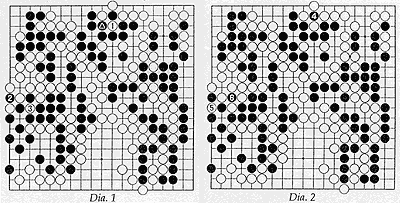
Diagram 1 shows the position just before the triple ko started. Black's last move was at the marked stone (Black 213 in the game). White starts a ko with 1. Cho believed that he would lose the game if he lost this ko, so he plays Black 2, capturing a white stone in a ko, forcing White to capture the other ko with 3.
Black goes back and captures the ko at the top of the board with 4 in Diagram 2. White captures with 5, and Black must capture with 6. But this is the same board position as Diagram 1.
After this, Cho and O played the same sequence two more times, at which point, O said, "it's a no-result, isn't it?" Cho hesitated for a moment, then nodded in agreement.