
Atomic-bomb game
The number of go tournaments held in Japan during World War II were far fewer than those held before the war. Many young players were being drafted into military service and, because of a paper shortage, newspapers were compelled to reduce their size. Go columns were among the first to be dropped. In spite of this, newspapers continued to sponsor tournaments and games, even though they would probably never be published.As the war dragged on, conditions for staging even the most important games became extremely difficult. In the spring of 1945, Kaoru Iwamoto, 7-dan, earned the right to challenge Hashimoto Utaro for the third Honinbo title. However, finding a venue for the title match in bombed-out Tokyo had become impossible.
A venue for the games was finally found in Hiroshima. However, the police chief of the city, who was an amateur go player, ordered the players not to play there, since it was too dangerous. However, when the police chief was called away on official business, the players, taking advantage of his absence, ignored his order and played the first game of the match July 23-25 under a rain of bullets from strafing airplanes.
When the chief returned and heard that a game had been played, he was furious and fabade players in no uncertain terms from playing any more games in Hiroshima.
Another venue was found in Itsukaichi, an outer suburb of Hiroshima, and the second game was played there Aug. 4-6.
On the morning of Aug. 6, Hashimoto happened to be in the garden when the atomic bomb was dropped. He saw a brilliant flash of light and the mushroom cloud rise above the city. A tremendous blast of wind shattered all the windows and turned the playing room into a shambles. The position on the board had to be set up again. Under these circumstances, they managed to complete the game; Hashimoto won by five points.
That evening, atomic-bomb survivors started to pour into Itsukaichi and the players began to understand the magnitude of the disaster and just how lucky they were. The house in which they were to have played their game was destroyed and its owner killed.
The war ended a week later and the match was resumed in November, ending in a 3-3 tie. A playoff became necessary, but Japan was in such disarray that it was not until July 1946 that a best-of-three playoff was arranged. Iwamoto won the first two games, and thereby took the Honinbo title.
Hashimoto and Iwamoto were important forces in the go world during the years following the war. Had they been killed in Hiroshima that fateful day, the history of go today would most likely be quite different.
Iwamoto defended the Honinbo title against Minoru Kitani in 1947, but Hashimoto came back in 1959 to recapture it. Then, with the prestige of holding the top title in the go world at that time, Hashimoto broke away from the Japan Go Association and formed the Western Japan Go Association. Although, a bitter rivalry existed between these two organizations for a while, they coexist amicably today and cooperate on many levels to promote go in Japan.
Iwamoto, who will be 97 on Feb. 5, has contributed much to the popularization of go in the West. In 1929, he retired as a go player and immigrated to Brazil. However, two years later he returned to Japan and resumed his go-playing career. Perhaps it was this experience that caused him to want to make go a truly international game. He has gone on numerous overseas tours and has established go centers in Amsterdam, Sao Paulo, Seattle and New York.
More on capturing stones
Last week, I presented three problems in which Black was asked to capture some white stones. The answers are below.

Problem 1. Capturing the white stone on the 1-1 point with 1 is correct. The black stone on the edge is also in atari, but it is wrong for Black to connect at 1. This lets White save his stone by connecting at 2.
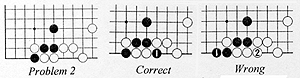
Problem 2. Capturing two stones on the edge with Black 1 is correct. Black's stone on the edge is also in atari, but it is wrong for Black to try and rescue it by extending to 1. White will connect at 2, rescuing his two endangered stones.
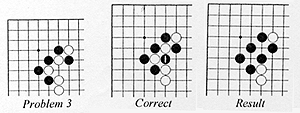
Problem 3. Black 1 is correct. With this move, Black captures two white stones. If White were to play 1, he could rescue his two stones. The diagram on the right shows the result of this capture.
Connecting stones
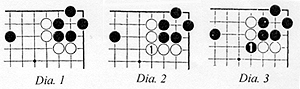
White's stones in Diagram 1 are not connected. White 1 in Diagram 2, however, forms an unbreakable link between these four stones. If Black can play 1 in Diagram 3, the two white stones at the top and the two on the right are separated.
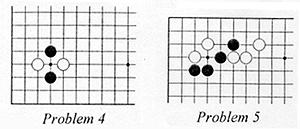
In Problem 4 and Problems 5, Black must play so as to link up all of his stones.
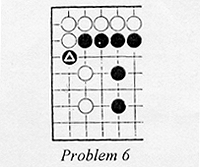
Problem 6. How can Black link up his marked stone?