
Go in China
Despite having been invented in China, go has not always enjoyed a place of honor in that country. During the Cultural Revolution (1966-1976), go was out of favor with the zealous Red Guards, although the Chinese government officially supported about 30 go players, classed as "national sportsmen and sportswomen." It was not until 1981 that the current, well-supported professional system was initiated.Over the past 38 years, however, there has been an active go exchange between China and Japan, consisting of goodwill tours featuring games between Japanese professionals and the top Chinese players. They began in 1960 and, with the exception of a six-year suspension from 1967 through 1972, have continued until the present. The rivalry between Japan and China took on a different character with the introduction in 1984 of the annual Japan-China Super Go knockout team match, which the Chinese won more often than not. In 1996, Japan's defeat was apparently so humiliating--nearly its entire team was wiped out by the 20-year-old Chang Hao--that the series was canceled.
Regular tournaments and title matches were first held in the late 1970s. Today, there are a number of big titles, similar to those in Japan, with about 100 professionals competing for them. The strongest Chinese players are Chang Hao and Ma Xiaochun.
Nie Weiping was the first Chinese player to seriously challenge Japanese supremacy in go. In the late 1970s, he consistently defeated some of the strongest Japanese players. On numerous occasions, he anchored the Chinese team in the Japan-China Super Go series to save China from defeat by beating the best players Japan could field.
From the late 1980s, a new player, Ma Xiaochun, began to dominate the Chinese tournament scene. However, his supremacy is now being challenged by a new generation of players, the foremost of whom is Chang Hao, who is only 21. Last year, he defeated Ma Xiaochun in a major title match. Two other young professionals, Zhou Heyang, 22, and Wang Lei, 20, have achieved significant successes not only in Chinese tournaments but also in international tournaments.
In spite of the short history of China's professional go system, there is no gap between the playing strength of the top Chinese players and that of the top Japanese and Korean players.
How did the Chinese become so strong so fast? For one thing, the government sponsors go in public schools, so talented young players have a chance to compete for local and national titles at the primary, junior high and high school levels. In addition, Chinese professionals say that they have learned a lot from Japanese pros who acted as tutors during the early years of the Japan-China go exchanges. They also had available all the go theory that was developed in Japan over the last 400 years.
More on illegal moves
In last week's column, I showed some examples of illegal moves. If your stones have no liberties, they cannot remain on the board. So, if you play so as to fill the last liberty of your stones, you are committing suicide. This is prohibited.

Diagram 1 is another example of an illegal move. Black cannot play a stone at "a'' because it would have no liberties. However, the three marked white stones in Diagram 2 are in atari: Black is threatening to capture them by playing at "a."
Thus, Black 1 in Diagram 3 is not suicide, since playing there results in the capture of White's stones. Diagram 4 shows the result of this capture.
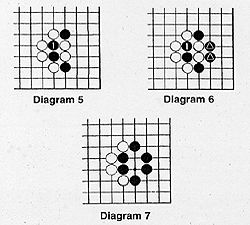
Black 1 in Diagram 5 is also illegal, but, if we add the two marked stones in Diagram 6, then Black is allowed to play 1 because it captures two white stones. The result of this capture is shown in Diagram 7.