
Kobayashi wins Judan title
Five years ago, Koichi Kobayashi was the top go player in Japan. He had held the Kisei title for eight straight years and the Meijin for seven. Only the Honinbo title eluded him, but that one was held by his lifelong rival, Cho Chikun.Three times he challenged Cho for that title, but each time Cho repelled Kobayashi's determined efforts and defended his title. Then in 1994, Cho challenged for the Kisei title and Kobayashi's eight-year reign came to an end. The following year, he also lost his Meijin title to Masaki Takemiya. This was the beginning of a long slump brought on, it is believed, by the sickness and eventual death of his wife, Reiko, herself a famous go player.
Late last year, Kobayashi remarried and this seems to have reinvigorated his game. At the end of last year, he won the prestigious Tengen title and also won the right to challenge Cho for the Kisei title. He also became the challenger for the Judan title, the fourth most important Japanese title. In the Kisei title match, Cho again proved his prowess by defeating Kobayashi 4-2. In contrast, Kobayashi had an easy time defeating Naoto Hikosaka, the Judan title holder, by winning three straight games in the best-of-five title match.
This is not the first time that Kobayashi has held the Judan title. In 1984, he defeated Masao Kato to take this title and held it for three consecutive terms. But Kato came back as the challenger three years later and dethroned him.
The fact that Hikosaka won the Judan title last year was a surprise. At 37, he is certainly among the top Japanese players, holding the rank of 9-dan, but he is not considered in the same league as the top titleholders. Still, he had good results last year, becaming the Judan challenger by beating Cho Chikun, then going on to beat the great Masao Kato (who has won more than 40 titles) in the title match to take his first-ever title. He also did very well in this year's Honinbo league, almost becaming the challenger for the title. He ended with a top 5-2 record, but so did another player, Cho Sonjin. In the playoff, Hikosaka lost to Cho.
Like Cho Chikun, Cho Sonjin was born in South Korea. He is 28 years old and came to Japan to study go when he was 12. He has won two tournaments for young players, but this will be his first challenge for a major title. No one gives him much of a chance against Cho Chikun, but it would not be the first time an unheralded player has upset the champion.
In an interview after the playoff with Hikosaka, Cho Sonjin said he was overjoyed to have earned the honor to play the Honinbo in a best-of-seven match and that he was determined to play some beautiful games. The Honinbo title match will begin on May 12 and is scheduled to continue through July.
The rule of ko
Since January, I have introduced four basic rules. They are:
Rule 1. The board is empty at the start of the game.
Rule 2. Black makes the first move, after which he and White alternate.
Rule 3. A move consists of placing a stone of one's own color on an empty intersection.
Rule 4. A stone or a solidly connected group of stones of one color is captured and removed from the board when all the interestions directly adjacent to it are occupied by the enemy.
By using these four rules, we have been able to explain many of the tactics and strategies of go, but there is one more important rule. This is the rule of ko, which is:
Rule 5. No stone may be played so as to re-create a former board position.
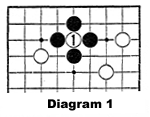 This rule prevents self-capturing moves. For example, White cannot play 1 in Diagram 1 because this stone will be immediately taken off the board and the position is unchanged from the previous move.
Rule 5 also prevents endless cycles of capture and recapture, a situation known as ko. The following six Diagrams illustrate this.
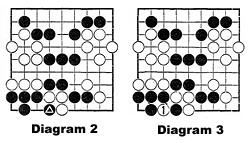 Diagram 2. It is White's turn to play. His three stones on the lower edge are in atari (threatened with capture), but so is the marked black stone.
Diagram 3. White rescues his three stones by capturing the black stone with 1.
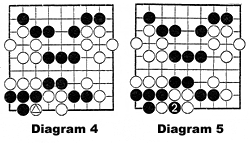 Diagram 4. Now the four black stones in the lower left corner are in atari. However, the marked white stone is also in atari.
Diagram 5. Black would like to capture with 2, but when the white stone is taken off the board, the position is identical to Diagram 2, which is prohibited by Rule 5. Therefore--
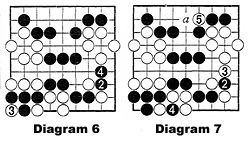 Diagram 6. Black has to play on some other point. If he plays 2, for example, White can capture four stones by playing at 3. But Black can now play 4, and the five white stones in the upper right can no longer make eyes. Although Black lost four stones in the lower left, the five white stones and the territory Black gets around them by playing 4 is bigger.
Diagram 7. Therefore, White must answer Black 2. He does so by playing 3. But Black can now capture at 4. Note that the 2-3 exchange makes the board position different from Diagram 2. A move like Black 2 is called a "ko threat."
Now White cannot immediately recapture Black 4, but must play a "ko threat" such as 5. If Black answers White 5 by playing at "a," White can go back and capture 4. A ko situation such this will continue for several moves until one side runs out of ko threats.