Long and short games
A frequently asked question by people unfamiliar with go is: "How long does it take to play a game?" The answer, of course, depends on the circumstances. Games between friends or those played in go clubs usually take about an hour but can last for up to two hours. Professional games take much longer, and all tournaments impose time limits. In the top three Japanese title matches, Kisei, Meijin and Honinbo, which are held over two days, each player is allowed eight hours in which to make his moves. In most of the others, five or six hours is the norm. International tournaments, on the other hand, are stricter, allowing only three hours for a player to make his moves. In chess, when the flag on the player's clock drops, he loses, but in go a player who runs out of time is given either 30 seconds or one minute to make each of his remaining moves, so losses on time are rare.There are also a number of TV tournaments. Those games are played with more stricter time limits-The players have to make each of their moves in 30 seconds. Those games usually last about an hour and a half.
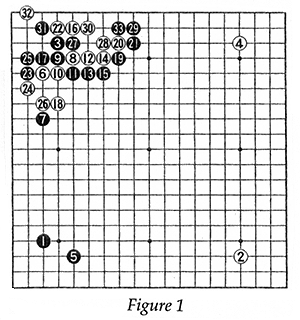
If a game which is played to the very end and the territory for each side is counted, it will last on average between 200 to 300 moves. However, often a player will assess his position as hopeless and resign, so many games end with less than 200 moves being played. The shortest professional game on record lasted only 33 moves. The game, played on Dec. 9, 1965, is shown in Figure 1. After Black played 33, the nine white stones at the top cannot avoid capture, so White resigned.
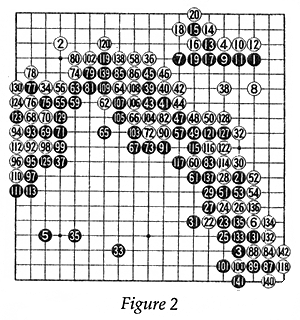
The shortest counted game lasted for only 142 moves. This game was played on April 7, 1966, and is shown in Figure 2. The reason this game was so short was that each side mapped out and secured a huge piece of territory. When the game was counted, Black had 128 points to White's 129. You should note that the seven black stones in the upper right have no chance of making two eyes and living, so they were taken off the board and subtracted from Black's territory.
The longest game on record was played on Dec. 20 and 21, 1950, and lasted for 411 moves. You might wonder how a game played on a board with only 361 playing points could last so long. The answer is that numerous ko fights had taken place during the game. Therefore, some points were played on many times.
Answers to last week's problems
Two stones were missing in Probelm 1 that I set last week. Those stones are marked in the diagram below.
In Problem 1, you were asked to calculate the value of Black playing A or White playing B. If Black plays 1 in Diagram 1, White must answer at 2 to prevent Black from intruding further into his territory in the upper right corner. Next, Black connects at 3 to prevent his stone from being captured.
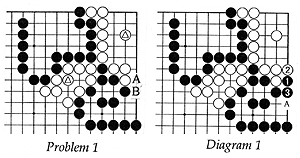
Now consider the position if White moves first. In this case, he will play 1 in Diagram 2. Black will block at 2, putting the white stone in atari, so White will connect at 3.
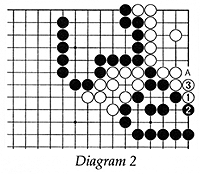
Let's compare these two diagrams. In Diagram 1, Black has forced White to play a stone at 2, while in Diagram 2, White has forced Black to play a stones at 2. In other words, by playing first Black has gained point A in Diagram 1 and deprived White of point 2. This means that playing Black 1 and 3 is worth two points. When White plays first in Diagram 2, he gains point A and deprives Black of point 2. Therefore, whichever side plays first gains two points.
In Problem 2, the point A is the key point for both sides. Let's look at what will happen if Black plays here first.
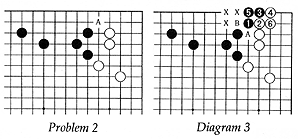
If black plays 1 in Diagram 3, White must defend his corner with 2. Next, Black plays 3 and 5 forcing White to defend with 4 and 6. Note that it is White privilege to play A. Black will have to defend at B to protect his three stones at 1, 3 and 5. The reason we can assume that White will play A first is that Black A does not present a threat, whereas White A threatens to play B.
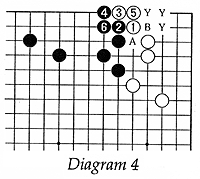
If White plays first he will play the sequence to White 5 in Diagram 4. Black must defend at 6, and, just as in Diagram 3, it is Black's privilege to play A, forcing White to defend at B.
Let's compare Diagram 3 and Diagram 4. In Diagram 3, Black has gained the three points marked X, while in Diagram 4, White has gained the three points marked Y. Therefore, whichever side plays A in Problem 2 will gain six points.