
The origins of go
The origins of go are concealed in unchronicled past of ancient China. There is a tangle of conflicting popular and scholarly anecdotes attributing its invention to two Chinese emperors, an imperial vassal, and court astrologers. One story has it that go was invented by the legendary Emperor Yao (ruled 2357-2256 B.C.) as an amusement for his idiot son. A second claims that the Emperor Shun (ruled 2255-2205 B.C.) created the game in hopes of improving his weak-minded son's mental prowess. A third says the person named Wu, a vassal of the Emperor Jie (ruled 1818-1766 B.C.), invented go as well as games of cards. Finally, a fourth theory suggests that go was developed by court astrologers during the Zhou dynasty (1045-255 B.C.).In any event, it is generally agreed that go is at least 3,000 and might be as much as 4,000 years old, which makes it the world's oldest strategic board game.
Go probably evolved out of a method of divination practiced by the kings and shaman-astrologers of the early Zhou culture. One of these methods is believed to have entailed the casting of black and white pieces on a square board marked with astrological and geomantic symbols. Some fundamental go terms still in use today have astrological meanings. For example, the central point of the board is called tengen, "axis of heaven," and the eight specially marked points near the perimeter are called hoshi, "stars," the nine together making up the traditional "Nine Lights of Heaven," i.e., the seven stars of Ursa Major (the center of the Chinese astronomical system), the sun and the moon.
The four quarters of the board are named after the four directions, each correlated to one of the basic trigrams of the "I-Ching" system. Beginning at the upper right and going clockwise, they are: Southwest (female, earth), Northwest (male, heaven), Northeast (hard, limit), and Southeast (gentle, yielding).
The earliest mention of go appears in the "Analects" of Confucius, which was believed to have been written in the 5th century B.C., while the earliest physical evidence was a 17x17 line go board discovered in 1952 in a tomb of the former Han dynasty (206 B.C.- A.D. 9)
Four basic rules
In the last installment, I presented the four basic rules and showed how the objective of the game--to control territory--is achieved. As a reminder, I state these four rules again.
1. Moves are played on the intersections.
2. The stones do not move after being played.
3. Black plays first.
4. Black and White alternate in making their moves
     |
The rule of capture
In this installment I will explain the rule of capture. Here is the rule:5. A stone or a group of connected stones is captured if all of its liberties are occupied.
Liberties and capturing stones
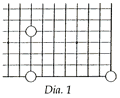
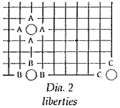
The lone white stone in Diagram 1 in the center of the board has four liberties, namely the points "A" in Diagram 2. If Black can occupy all four of them, he can capture the white stone.
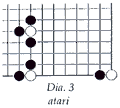
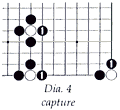
For example, Black occupies three of these liberties in Diagram 3, so he can capture the white stone if it is his turn to play. The white stone in Diagram 3 is said to be in "atari." Black captures it with 1 in Diagram 4. The resulting position is shown in Diagram 5.
The white stone at the edge of the board in Diagram 1 has three liberties, namely the points marked "B" in Diagram 2. If Black occupies two of these liberties, the white stone will be in atari, as in Diagram 3. Black 1 in Diagram 4 captures it. Diagram 5 shows the result.
The white stone in the corner in Diagram 1 has only two liberties, the two points marked "C" in Diagram 2. If Black occupies one of these liberties, the white stone will be in atari, as in Diagram 3. Black 1 in Diagram 4 captures this stone and the result is shown in Diagram 5.
In the next installment, I will show how captures are executed in a game.