
Go in South Korea
Although go was played in Korea long before it arrived in Japan, it is only since 1956 that it has been played professionally there. Go, called "paduk" in Korean, was traditionally regarded only as a pastime or a gambling game, but in 1980 it was officially recognized by the South Korean government as an important cultural asset.The (South) Korean Go Association was founded almost single-handedly in September 1955 by Cho Nam Chul. Today, there are more than 150 professional players competing for prizes in 16 different tournaments, including eight newspaper tournaments and three TV tournaments.
From the middle of the 1970s, the player who dominated the South Korean titles was Cho Hun Hyun, a ninth-dan. In his youth, Cho studied in Japan, but instead of making his career there, as did his compatriot Cho Chikun, he returned to South Korea with the intention of raising the strength of his countrymen. His efforts have borne fruit. His disciple Lee Chang Ho, at the age of 22, is clearly the strongest player in South Korea and some think the strongest in the world. He holds most South Korean titles as well as some important international titles. Another South Korean title-holder, Yoo Chang Hyuk, is also a disciple Cho Hun Hyun.
Because of Lee Chang Ho's spectacular successes in domestic tournaments as well as in the international go arena, he has become a hero in his native land where he has ignited a huge following, somewhat like that of a rock star. This has caused a surge in the popularity of go in South Korea. Large South Korean companies have poured vast amounts of money into international tournaments and a legion of young prodigies are emerging. It has been predicted that in 10 years, South Korea will be the preeminent go-playing country in the world.
A review of the rules
Let's review the rules of go that I have presented so far.
1. Stones are played on the intersections.
2. The stones do not move after being played.
3. Black plays first.
4. Black and White alternate in making their moves.
5. The object of go is to control territory. The winner is the side that controls more territory at the end of the game.
6. A stone or a group of connected stones is captured if all of its liberties are occupied.
7. When stones are captured, they are put into a prisoner pile. At the end of the game, all the captured stones are placed into the opponent's territory.
8. Suicide is illegal. Players cannot fill the last liberty of their own stones.
Eyes and living groups
The concept of eyes determines whether a group of stones is alive or dead.
 Point "a," surrounded by the group of seven white stones in Diagram 1, is an "eye," Black cannot play there unless he occupies all the outside liberties of these stones as in Diagram 2. In that case, he can capture them by playing 1. The result of this capture is shown in Diagram 3.
 Now let's take two groups of stones with one eye each (Diagram 4), merge them into a larger group as in Diagram 5 (of course the groups in Diagram 4 cannot move in an actual game; this is done only for the purpose of instruction). Next, let Black occupy all the outside liberties (Diagram 6). The result is that the white group can never be captured. Why not?
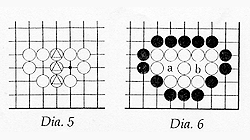 Points "a" and "b" inside the white group are eyes, and it is suicide for Black to play on either of these points because, unlike Diagram 2, doing so does not result in the capture of White's group. If Black plays at point "a" in Diagram 6, White still has one liberty at "b" and vice versa. Since Black can never simultaneously occupy these two liberties, the white group remains alive. This gives rise to the following rule:
9. A group is alive if it can form two eyes.