
Are you a bottom-line strategist who follows the daily fluctuations of the market, or a long-term investor who keeps in mind the big picture and doesn't bother about short-term problems? This is a question relevant to the way you play go.

I recently got a phone call from the friend I stayed with while visiting the Netherlands. He told me that he had recently been on a fantastic winning streak, where before he had been stuck in a rut because he was too focused on territory. I had shown him a strategy that doesn't focus on territory, but concentrates on building up strength and thickness.

An obvious advantage to this is that you don't have to read the board and worry whether your groups are going to die (although it may happen to your opponent's groups). The disadvantage is that, if no groups die, you have to make an assessment and count the existing and potential territories fairly accurately at some point. I then demonstrated this plan of attack to my friend by playing on the Internet. He was shocked when my groups didn't seem to make a lot of territory, yet in the end, one of my opponent's groups died. As a matter of fact this exact same thing happened in the game we started last week, the final game of the European Fujitsu Finals (Nov. 29-Dec. 2), played by Alexandr Dinerchtein (Black) and myself.
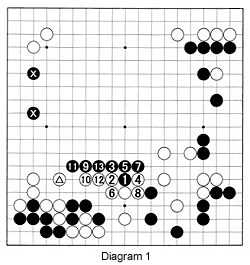
Diagram1

Diagram 1 :
Last week's problem was to determine Black's next move after White's last move, the marked stone. Black should try to find a move that keeps White's stones on the right weak. In that respect black 1 and 3 seem a good combination. Also these moves lead White to believe that he should link up his stones on the right with his center group by playing 4 to 8, then capture four black stones with 10 and 12. For alternatives, look at References 1 and 2.

After black 13, White faces a big problem. Black has a lot of center influence. Should White allow Black to connect the two marked stones to his wall running from 7 to 11? How much territory can he expect to make at the top ? Based on these two questions, try to work out where White should play next.

refe1,2

Reference 1 :
Moving out with 1 is feasible. Even if White links up his groups with 2, black 3 makes miai of A and D, aiming at exchanging B for C. If Black gets to play at A, he can aim at E, white F, black G.

Reference 2 :
Simply answering black 1 and 3 by extending at 4 is probably better for White. But I was worried about black 7. The moves that follow are one example, but there are many ways to exploit the warui aji (bad potential) after white 4.
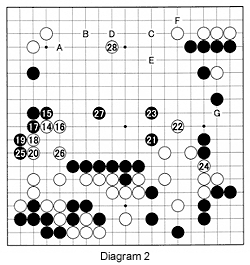
Diagram2

Diagram 2 :
I decided that Black shouldn't be allowed to connect his groups and played at 14. The moves to 20 are obvious-Black needs to build a base on the left, then go back to his center group, exchange 21 through 24 and protect both of his groups, while making territory with 25 and 27. White 22 and 24 are aiming at a tsuke (attachment) at G. Next, White stakes out a position on the upper edge with 28. The idea was that Black could invade at B, answered by white D, to turn the space to the right of it into territory. Or Black could invade at C, also answered by D, to turn the space to the left of it into territory. Black could also reduce with A, but this would give White too much territory. Black C could be followed up somewhere around black E, and White has to answer at F. Either way White has a good game. But Black's move is a surprise.
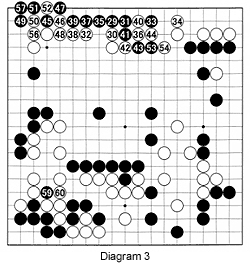
Diagram3

Diagram 3 :
Note: The moves black 55 and white 58 are played in the ko at 45 and 52 respectively.

Black 29 was the move that avoided the variations that followed after invading at B or C in the previous diagram. This move was heavily criticized by the Japanese pros because it is so low, and, I suspect, it looked unconventional. But if Black can take away all of White's territory, the game is over. Up to 37, Black is implementing this strategy successfully, while White has almost no choices. However, black 39 was too much-see Reference 3 and 4. Playing at 40, I felt the game would soon be over. However, Black's resourcefulness produced a ko in the corner with 45 through 49.

Reference 3 :
Black 1 is good. White can block at 2, but black 3 makes his group virtually alive. For example, White can reduce Black's eye-space with 4 and 6, then kill Black locally with 8. But Black can run away with 9. In other words, Black is safe.

refe3,4

Reference 4 :
This was Black's plan. If, after black 1, White blocks with 2, it becomes even harder for White to kill Black. After black 11 (capturing two stones), White can throw in at 10 to make this into a false eye, but after 13, White also has a poor shape. Black can next cut off the two marked stones with A, white B, black C. Compared to Reference 3 this gives an even better result.

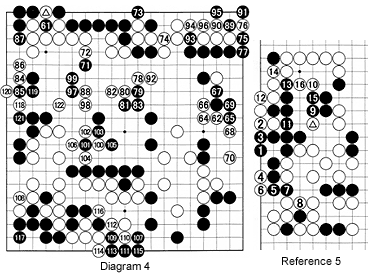
Diagram 4 :
Note: Black 63 is played where the marked stone was taken. White wins the ko, but is losing the battle. With 62 through 70, this territory changes hands, and after securing the center with 78 through 92, White has a solid 5-point lead. However, the combination of the ponnuki (capturing one stone) of 100 through 106, the connection at 108, and the invasion at 118 and 120, enable White to kill the black group with 122. Upon seeing this move, Black resigns.
dia4,refe5

Reference 5 :
After White plays the marked stone, Black can try making eyes with 1 and 3, but white 4 and 6 always take the second eye, while he can't make another eye around the marked stone.

By winning this tournament, I have earned the right to represent Europe in the World Go Championship for Professionals-the Fujitsu Cup, in April.

By Richard Bozulich

By Rob van Zeijst

  1. Example of a pro game
  2. Insight to the pro game
  3. The basics of territory
  4. Be proactive
  5. Take the Initiative
  6. The endgame
  7. The Last Points
  8. Last week's problem
  9. The endgame
  10. Endgame Tesuji
  11. As expected,
  12. Kisei Title
  13. Balancing attack,
  14. Balancing attack and defense
  15. Tobi, kosumi, keima
  16. Tobi, kosumi, keima
  17. The end of the game
  18. O Rissei keeps Kisei title
  19. Solutions to last week's problems
  20. Over the next few weeks
  21. Efficiency calls for good shape
  22. Get an eye for shape
  23. Middle of three stones
  24. Kosumi: pros and cons
  25. Defects of kosumi
  26. Kosumi
  27. Hazama
  28. Attacking
  29. Where there is a keima, there is a cut
  30. Cutting keima the right way
  31. Visualization is a must
  32. Function over form
  33. Rationality
  34. Intuition
  35. Realistic approach
  36. Connecting stones
  37. The so-called cosmic style
  38. Ponnuki
  39. Ponnuki
  40. Ponnuki
  41. Sabotage
  42. Ponnuki and Ko
  43. Fighting ko effectively
  44. Handicap go
  45. Handicap go
  46. The nine-stone handicap
  47. Basics of handicap go
  48. 5 more basic principles of handicap go
  49. Yoda defends Meijin Titlego
  50. Original ideas
  51. The third part of the game
  52. In go, it is easier to...
  53. A good way to improve a game
  54. A big gap between genders
  55. World Championship for Women
  56. Hane defends the Tengen Title
  57. 7-stone handicap
  58. Let's start the New Year...
  59. 9x9 pro game
  60. 9x9 pro game
  61. The following is...
  62. The Go player's...
  63. Of the three most prestigious titles, ...
  64. This is the third installment in a series...
  65. Achallenger has to overcome many obstacles....
  66. In the battle for the 42 million yen.....
  67. Only one week after losing his Kisei.....
  68. After recently losing his Kisei title.....
  69. It is a well-established fact that.....
  70. Go--The first step
  71. Some basics about the pro world
  72. How deep can a pro read?.....
  73. Who are the best go players.....
  74. Can computers play go?.....
  75. Last week, we established.....
  76. Computers have led to a flourishing.....
  77. Though I recommend that you join a go club.....
  78. Last week, we finally got to the point where we discovered that.....
  79. Some people like to offer quotations aimed at showing .....
  80. One of the best and most authoritative Web sites for.....
  81. At the beginner levels, go is an easy game to play.....
  82. We often do things in life without thinking.....
  83. We are often told to do the right thing.....
  84. Following a pattern set by others is easy.....
  85. This week's Go Weekly, a Japanese weekly go newspaper.....
  86. How fast can you do a job and do it right.....
  87. When I am asked by go students how they can.....
  88. Books have been written on the subject.....
  89. Go players are always quick to point out that go is a superior.....
  90. The last few weeks were devoted to tactical issues.....
  91. The fifth and final game in the best-of-five Gosei title match .....
  92. The dividing of land, property, and things of .....
  93. Fireworks are expected between current Meijin .....
  94. Dividing land, property or living space in one's own favor is .....
  95. The dream match between the current Kisei .....
  96. Three games have now been completed in the best-of-seven series.....
  97. We have talked strategy over the past few weeks.....
  98. In study, in all branches of sport.....
  99. The most important things a go beginner.....
  100. In many games and sports,.....
  101. How do you do confront your fears?.....
  102. In go, you cannot expect to deal with.....
  103. When your opponent is much stronger than you.....
  104. Using the power of your opponent for.....
  105. The combination of aggressiveness, .....
  106. Last week, there was some good news for.....
  107. On Dec. 18, in the fifth game of.....
  108. Go Weekly, which hits the nation's newsstands every Monday.....
  109. In go, the beginner must try to master the basics of life and.....
  110. Last week, we started a new series on life and.....
  111. This is the third article in a series on life-and.....
  112. In this article, the fourth in a series, we will take.....
  113. This is the fifth installment of tsume go.....
  114. Practice, practice, practice. This is the way to improve.....
  115. The Kisei title match, worth more than $400,000.....
  116. The Kisei title match, worth more than $400,000.....
  117. For a champion, 25-year-old Keigo Yamashita has.....
  118. In two-day best-of-seven matches.....
  119. Naoki Hane has iron nerves.....
  120. The game of go can be as easy or as difficult.....
  121. On April 18 and 25, the TV Tokyo network will.....
  122. Give and take is widely used in daily life to strike.....
  123. Although go has a history of almost 4,000 years.....
  124. The adage "Chess was invented but go was discovered".....
  125. Unlike chess, in which a board position.....
  126. Over the past few weeks we have concentrated.....
  127. Go is sometimes perceived as a more difficult game than chess
  128. Last week, I stressed that the objective of go was to.....
  129. Anyone can learn the basics of go.
  130. Go can be considered a zero-sum game as .....
  131. If you play a strategic game like go, taking or keeping .....