
Sabotage is an accepted strategy to accomplish this. When top professionals adopt this strategy, it is not always apparent. It may be as simple as using three moves where two would suffice, but it is often more abstruse, and concerns shapes that do not work quite as well as others--shapes that need reinforcement or that do not make as much territory. In other words, inefficient shapes.
For the past few weeks, I have been discussing various aspects of the ponnuki. The ponnuki itself is a good, efficient shape, but that efficiency disappears if additional moves are required. Inducing inefficiency in an opponent's ponnuki shape is a valid strategy.

Diagram 1: The four original stones (unlabeled) form a ponnuki--a perfect shape. The ponnuki is efficient but if more stones are added its efficiency disappears. In particular, moves A through D and X are inefficient and create an imperfect ponnuki. Moves E through H do not do much harm, but contribute very little to the original ponnuki.
Diagram 2: The moves to 6 are a joseki. Black 7 and 9 form a good cut. The response, white 10, is an interesting move. Basically, White leaves 6 as bait--Black can capture white 6 by playing 11 and 13, but white 12 and 14 are an exquisite combination.
Diagram 3: Next, Black can cut again with 15. White captures a black stone with 16, forcing Black to answer with 17. In theory, this is a ko, but at the beginning of a game, a ko threat is not worth the trouble. In other words, Black can play a ko threat, but White will capture by playing at 17. Incidentally, the result would be two ponnuki shapes (see Reference 1).
Diagram 4: Black can cut again with 23. White captures with 24, forcing Black to connect once more with 25. White repeats the trick by jumping to 26. Let's take a closer look at the result. White has two ponnuki shapes and all of his stones are working together well, except for the one marked C. But even this stone is justifiable, because it connects to the stone marked X.
On the other hand, the black stones at A, B and 25 are all parts of an imperfect ponnuki, as illustrated in Diagram 1--they make Black's shape inefficient in terms of territorial value. The black territory on the upper side is not very large, while the white wall is thick and has great attack potential.
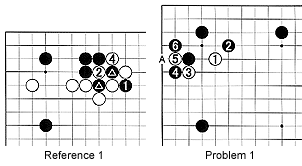 Reference 1: (Black 3 is not shown as it is played elsewhere as a ko threat.) After white 2 (white 16 in Diagram 3), Black could play a ko threat. But White would ignore such a threat and capture with 4. As a result, the two marked black stones would be captured and White makes two perfect ponnuki shapes.
Problem 1: When Black has a double-wing formation--a shimari (corner enclosure) with extensions on both sides--white 1 is the standard move to reduce Black's moyo (potential territory). After black 2, white 3 and 5 form the cross-cut tesuji. After black 6, White is willing to sacrifice white 5 and allow Black to capture at A to make a ponnuki--but not a perfect one. What should White's next move be?
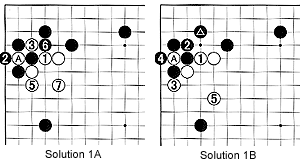 Solution 1A: White 1 is a good move. Black 2 initially makes a perfect ponnuki, but white 3 is good. Black can't afford a ko, which risks all of his territory. So connecting at A is the wise thing to do. White 5 then threatens to activate white 3. To prevent this, black 6 is nearly unavoidable, giving White the opportunity to make good shape with 7. This is a good result for White.
Solution 1B: To avoid the result seen in Solution 1A, Black will usually connect at 2. However, this allows White to make an atari at 3 to get more use out of white A. After black 4, white 5 is a good, light move. Take a good look at this result--the stone at 2 and the marked black stone are not striking models of efficiency. On the other hand, Black has secured his upper left corner and the upper area, while White's stones are still a little weak. The exchange shown here is a middle game joseki that works out roughly even for both sides.
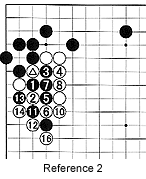 Reference 2: (Black 9 will be played where the marked white stone is, and black 15 connects at 2.) If Black cuts at 1, white 2 is a good response. Black can capture with 3, but white 4 confines Black. If Black tries to break out with 5, or makes a similar move, he only gets himself deeper into trouble. After white 8, Black has to connect with 9 where the marked white stone is. After white 10, Black can cut and capture again with 11 and 13, but in the sequence to 16, White lays waste to most of Black's territory. White has succeeded in giving Black a lot of imperfect ponnuki shapes, while his wall is flawless.
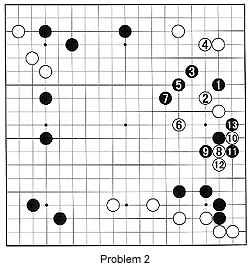 Problem 2: This is the third game of the 1971 Honinbo match. Black is played by Rin Kaiho and white by Yoshio Ishida. The problem starts when Black invades at 1. White must prevent Black from connecting, which he does with 2. In addition, he must prevent Black from invading the upper right corner, which he does with 4. Black 5 makes good shape, which is matched by white 6. After black 7, white 8 and 10 form a great sabaki (clever combination to make a light shape with the potential for eyes). Black decides to capture white 10 by playing 11 and 13. How should White respond?
 Problem 3: This is a game played by Go Seigen (white) and Akira Hasegawa, in 1949. The moves 34 and 36 are an abrupt intrusion into Black's territory on the right side. Black fights back by taking away part of White's lower right corner. White 46 is a great move, although it leaves behind weaknesses. Later on, a fight breaks out in the center and Black, trying to exploit the weakness in White's shape, sets up a ko with 57. Why? Why not use the move at black 55 to connect 27 and 7? Before you attempt to answer, think about today's theme--spoiling shapes and inducing imperfect ponnuki shapes. What is Black's other aim?
The answers to Problems 2 and 3 will be published next week.