
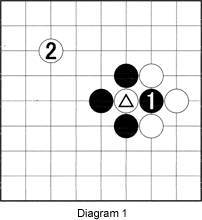
 Ko rule
Diagram 1: This is a ko situation. The white marked stone is in atari, meaning Black can capture it on his next move by playing at 1. White cannot capture the marked stone immediately because of the ko rule. He must play elsewhere, allowing Black to decide whether to answer that move or connect the black stones by playing where the white marked stone had been.
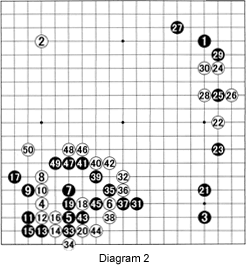 Diagram 2: This is the game that was declared forfeit. It was played between the current Meijin, Norimoto Yoda, and O Meien, a former Honinbo. Yoda is Black.
After White expands his moyo while limiting Black's with 32, hostilities break out with black 35 and 37. By taking the initiative on the outside with 40 through 48, White shows courage, as his stones around the lower left become weak. Finally, White plays 50 in the belief Black will not be able to cut through.
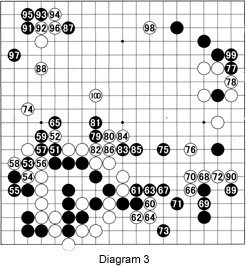 Diagram 3: However, with a tremendous combination and sacrificing one stone, Black forces his way out with 53 through 59. White 60 is a smart move as it gives him a base in the sequence through 64. Black 65 however, gets a good grip on the outside. White 66 takes aim at four black stones to the left. Black immediately defends with 67 through 73, but at the cost of White cutting through with 70 and 72. Black 79 through 85 keep White weak. Before deciding how to continue the attack, Black first makes territory with 91 through 97, and then with 99. Next week we will look at the ko situations.
 Diagram 4: Later on in the game, a double ko appeared in the lower left. This is not an accurate reproduction but the black corner stones are the same. With the sequence through 10, Black makes a double ko. Of course, Black will win this ko, but it is not necessarily advantageous, as we will see next week.
Diagram 5: This is a simplified version of the double ko. Black's stones are in atari, but he can play at 1 to capture the marked stone. White can play elsewhere and Black may answer this move. White then can recapture the ko by playing where his marked stone was. However, Black can capture at A. This can go on forever, but Black cannot lose the ko.
Solutions to last week's problems
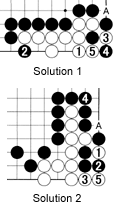 Solution 1: White 1 is correct. If Black plays 2 to take away White's second eye, White can play at 3 and 5 so that Black now has a shortage of liberties. Black can connect at 3 or at A, but White will play the other point (A or 3).
Solution 2: White 1 is a clever move. After white 5, Black cannot connect at 1 and A at the same time. Note that black 4 is necessary because White can cut there if Black connects at 1 and A.
Solution 3: The seemingly inoffensive move at 1 is part of White's rescue plan as it threatens to capture the two marked black stones at left (making an eye in the process) as well as the three marked stones on the other side by playing where black 2 is. If Black captures this stone White will play at A. Black would be unwise to connect at 2 then, because White would cut at B. This is why Black played the defensive move at 2. White 3 is an unexpected move that ensures the capture of one black stone, creating an eye in the process. Now the question is, will White capture the two marked stones at left? If Black wants to try to save them he has to connect at 6, but white 7 through 11 will follow, compounding the damage. In other words, White has two eyes.

Solution 4: White 1 and 3 are a fine combination. If Black uses 6 to connect at 3, white 7 puts him on the spot. Black cannot play at A or B because of the presence of the marked white stone. Black first has to capture at C before playing A, but then White plays at B to put eight black stones in atari. Black loses.
Want to find out more? Come to Ben's Cafe (03-3202-2445, www.benscafe.com) in Takadanobaba, Tokyo, where the English speaking go community congregates every Sunday. You can enjoy free lessons, 11 a.m.-1 p.m. ).
Van Zeijst is a four-time European go champion and European representative at the Fujitsu World Championship.