
Last week, we looked in-depth at the first 49 moves of the second game of the Kisei title match between O Rissei (Black) and Ryu Shikun. Let's see what their problems are and the solutions they come up with.
Balancing attack, isolation with making territory
Diagram 1 :Try to understand the moves of both parties while keeping in mind White's theme in this diagram: the isolation of and attack on the marked stones, balanced with making territory.
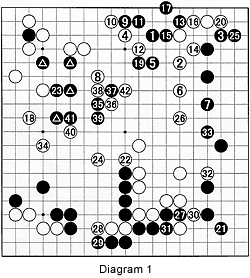
The first problem is black 1 (last week's move 49). This move is usually played as in Reference 1. It seems that Black decides he needs to invade at the top anyway, and the sooner the better, so he plays at 1.
White 2 is the second problem. The move in Reference 2 is usual, but he rejects that, because he believes he needs to cut Black in the center. So he chooses white 2 in Diagram 1.
What about black 3? Shouldn't he make a base as in Reference 3 ? Based on this diagram, Black seems to have concluded that black 3 is essential for making a base for both camps.
White 4 prevents Black from making a base there, while making territory. Remember that in the end territory counts.
Black 5 isolates the white group to the right. See References 4 and 5.
White 6 is then natural. Black 7 is a tightfisted move, typical of O. This move seems unreasonable, as black 1 and 5 come under attack again, as well as the marked stones, but it also prevents white 2 and 6 from making a base on the right.
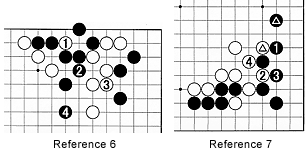
White 8 splits off the marked stones while attacking black 1 and 5 from a distance. Attacking from close range usually makes it easier on the opponent. Black now has a choice. He can keep on running to the center where White stones are already waiting, but even if he does move into the center, this will inevitably lead to a weakening of the marked stones. This explains moves 9 through 17 by Black-this sequence makes one and a half eyes, while prodding for weaknesses in White's positions on the left and right. Half an eye means that it is gote both to make the eye and for the opponent to take it away. Spending one move to steal away an eye is quite an investment and an indication that he is out to kill. See Reference 6.
For the moment, the attack is over and White grabs territory with 18, while, and this is important, taking away a possible base for the marked black stones. From the explanation at Reference 6, combined with that of white 18, black 19 now becomes a logical move. White 20 is huge in terms of territory and also builds eyes. Black 21 is another big move, which also threatens the white group to the left of it along with the combination 27 through 31.
White 22 builds eye space and thickness in the center while eyeing Black's marked stones. Black invests a move at 23 to defend his stones. White 24 takes away possible black territory, while further isolating the marked stones. Black 25 defends and also takes away White's eyes, so White defends with 26, giving Black the chance to cash in on his earlier move at 21 by playing 27 through 31. Move 32 is an excellent one. See Reference 7.
White 34 takes profit again, while cutting off Black's marked stones almost completely-now they have to live independently. With 37, Black sacrifices one stone to make a good shape, meaning eye-shape.
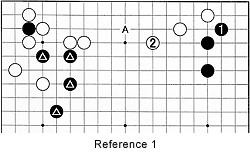
Reference 1 :
White will play at 2. This isolates the marked stones from a distance . Black needs to invade at A, but if he does, he gets two weak groups, his invasion and the marked stones-one of them may die.
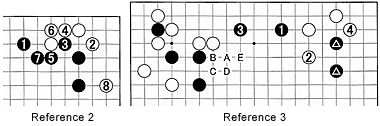
Reference 2 :
Usually, White plays at 2 in response to black 1. This is a joseki (standard corner exchange). The drawback is that Black strengthens his stones on the left side, indirectly, with 1, 5 and 7.
Reference 3 :
Making a base with black 3 would be the usual idea, but this has no impact on White's stones in the upper left, and White plays at 4 to grab the corner and make a base himself. Black can't connect his stones on the left with a move at A, because White can cut with B, followed by black C and white D. Instead of A, Black could try a move at E, but then White will split with D. The worst part of this variation is that the marked stones on the right suddenly look weak.
Reference 4 :
There are people who believe that black 1 cuts unconditionally. Not so! White can attach at 2. If Black cuts at 3 (or 5, but we get a similar diagram), White can cut with 4, and so on. In the end Black has to ensure life by capturing at 15. Looks like a terrific result for White-or is it ?
Reference 5 :
However, the moment White cuts with 4, Black exchanges 5 for 6-White needs to connect with 6 to prevent the marked stone from being cut off-then captures with 7. Now White is definitely split. This is terrible for White.
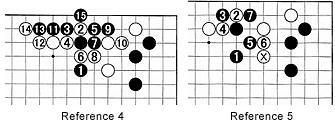
Reference 6 :
This is an amateur approach-but playing at 1 to prevent Black from playing there to make unconditional life is a heavy investment. If, after black 4, White can't kill Black, he has no justification for playing at 1. Pros prefer to play profitable moves on the outside, such as one that would force Black to add a move at 1.
Reference 7 :
If Black plays at 1 without thinking, White can start a ko at any time with the sequence 2 through 4. Black has many choices in response to the marked white stone, but most variations end up with the marked black stone getting cut off. This is the reason why Black strengthens the marked black stone and plays at 33.
Problem 1 :
Look at Diagram 1. Where should Black play next ? Here are some questions you should consider while deciding. Can Black escape with 37 ? If he can and does escape, will it do him any good? Is Black's group in the upper part of the board alive? If it isn't, how should he proceed ? What about the group including the marked stones? Try to make a rough count to see what the score is, even if you can answer the above questions.
Problem 2 :
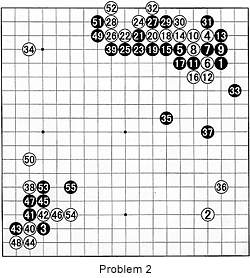
This is a weird game between Cho Chikun (Black) and Yoda (White). Several strange things happened. For example, white 22 was a clever move. Couldn't Black have cut through at 24 instead of connecting at 23 ?
Problem 3 :
What about white 34? Shouldn't he escape with his three stones around 6 ?
Problem 4 :
Is black 35 good? Does it threaten the three white stones ?
Problem 5 :
Allowing for black 37, doesn't white 36 smell of cowardice ?