
For a recent article on upcoming trends, a newspaper interviewed a group of young people about their interest in go. The general consensus was that go was "more exciting than computer games" because it involved real opponents and you really had to think about what you were doing, instead of just reacting to circumstances.
The convenience of haya-go (speed-go), which can be played with friends during lunch breaks, was another point in favor of go. And one kid said he really liked the tumultuous situations that resulted from the ko.
Fighting ko effectively
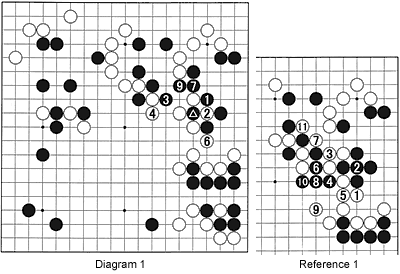
Let's start right away with the solution to Problem 3 that I posed two weeks ago. This is a marvelous game for the study of the ko.
Diagram 1: In this game between Akira Hasegawa (Black) and Go Seigen, Black starts a ko out of the blue by playing at 1. Couldn't he have connected at 2? The question is, why is black 1 better than just connecting at 2? It does not seem to make sense to create a ko when you can avoid one, but let's see what actually happens before jumping to conclusions. White 2 is a natural move, but Black has a perfect ko threat in 3. White is bound to answer with 4. Next, Black can recapture the ko with 5 (where the marked stone is). White 6 is an attempt to increase the positive gain from the ko, while reducing the negative effects (see References 1 and 2).
Black 7 puts a white stone in atari. White needs to recapture the ko by playing 8 at the white 2 spot, but now Black attempts to free his stones on the upper side by playing at 9. What should White do next?
Reference 1: If Black connects after white 1 (6 in Diagram 1), White also will connect. Moves 4 through 11 show one possible continuation. The result is that Black's three stones at the top will be captured, while Black cannot capture the white group consisting of white 1, 5, 9, etc.
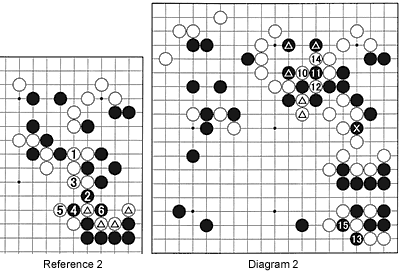
Reference 2: If White passively connects with 1, Black can then capture the marked stones with the sequence through 6. Even though this result is not bad for White, he thought he could get a better one and, therefore, continued the ko fight.
Diagram 2: At this point, White has the choice of capturing the stone marked X or cutting off the stones marked with triangles. But considering that capturing two stones by playing white 10, 12 and 14 also frees the white stones marked with triangles, White's choice is obvious. On the other hand, Black plays a ko threat with 13 and completes the capture of the white group in the lower right corner by playing at 15. What should White do next? Should he capture the marked black stone?
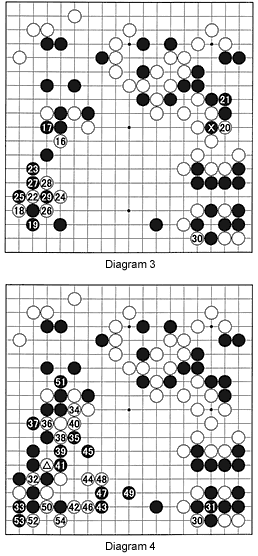 Diagram 3: Before capturing the marked stone, White also has the option of starting a huge ko by playing at 21. At the moment, though, he has no ko threats that are large enough. So he first probes with 16 and 18. Black answers in a seemingly passive way, but he cannot afford to lose the ko that White is threatening to start on the right. After Black's conservative moves on the left, White decides he does not need to start a ko and ends that option peacefully by capturing the marked stone with 20. Black must play at 21, or that group will die. White sets up another ko with 22 through 28. Black captures with 29. Why does White start a seemingly illogical ko?
Diagram 4: This is not a ko that Black can afford to lose, so he neutralizes it with 33. White wraps up the game quickly with 34 through 40. Now the purpose of the marked stone (the move that started the ko) becomes obvious. It forces Black to add a move at 41, allowing White to strike with 42. In the sequence through 54, White has made sabaki (light shape with eyes) in the lower right, and this ensures a great victory. White wins by five points. This game includes three ko fights, which all had different purposes. Let's try to establish the benefits of starting a ko:
1. Shape--Winning a ko can avoid an empty triangle.
2. Good aji (getting rid of nasty problems)--winning a ko and thereby getting a double ponnuki (as exemplified by black 2 and 6 in Diagram 1, white 10, 12 and 14 in Diagram 2 and white 20 in Diagram 3)
3. Kikashi (forcing moves)--the moves 22 through 28 (Diagrams 3 and 4) are an example. Black has to defend his territory with 27 and 33.
4. Life and death problems--This can be any kind of ko fight, ranging from direct ko fights, in which one party loses his group while his opponent's survives, and a one-sided ko in which one group is fighting for its life, to multistep and multistage ko fights, double ko fights or combinations thereof.
5. Spoiling shape--This is more like a combination of 1 and 3, in which you force your opponent into a bad shape by threatening to make the ko fight bigger. White 6 in Diagram 1 is an example of this.
Almost all ko fights fall into one of these five categories.
Another problem
Here is another great example of how the ko can be used as an aggressive weapon. On Sept. 6, Lee Chang Ho of South Korea and Yu Bin (Black) of China played the semifinal of the Toyota Denso Cup. Lee established himself as probably the best player in the world when he won the world championship at the age of 16, 11 years ago.
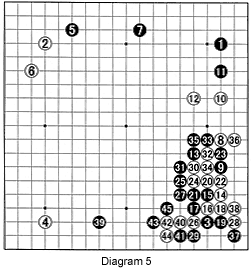 Diagram 5: The fight immediately starts when White invades with 14. The moves through 24 seem natural, but black 25 appears unyielding. However, White's cuts of 30 and 32 seem crude and in the sequence to 38, he ends up having played two stones (24 and 30) unnecessarily. Black 39 is a difficult move to assess. Full of fighting spirit, White immediately extends with 40 and 42. Black 43 stops this movement, leaving White with no choice but to go either up or down. White chooses to go down with 44, and black 45 starts a semeai (capturing race between two groups). Who will win this race? There is an interesting ko that White can start. Can you see how it would work?