
This year, these two rivals play the best-of-five finals of the international LG-cup. Incidentally, in the semifinals all the players were Korean, indicating the overwhelming strength of Korean players. In this first game of the LG final, Lee Se Dol is Black and Lee Chang Ho is White.
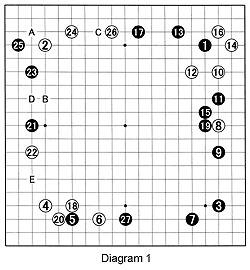 Diagram 1: The moves through 17, with slight variations, have been seen before in games we have discussed. Instead of 18, White can also start a fight by playing at 19. The exchange to 20 is quiet. Separating the left side, black 21 is important to establish a base in this area. White 26 is a good move. Many amateurs would immediately answer at A, as this is a joseki (standard corner exchange). This would force Black to defend at B. Theoretically, this would allow White to extend on the lower edge. However, a black move at C next would be severe. Because Black's top left group would be strengthened, he would be able to invade around E. To avoid these backlashes, White chose 26 to keep the possibility for an invasion at D open, while at the same time putting pressure on the black group in the top right corner. The drawback is Black's advancement to 27. All the big points have been played now. Where should White play next? List a few possible moves, and then look at the pros and cons of each.
Thickness is the name of this game
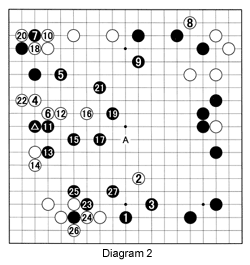 Diagram 2: Building a huge moyo (potential territory) in the lower right side, black 1 was the last move in Diagram 1. What are the benefits of White's response at 2? First, this move restricts Black's moyo. Second, it provides a foothold for a later invasion in the lower right. Third, it seeks to build a white moyo in the lower left by attacking the marked stone, an attack White starts immediately after Black answers with 3.
How should Black respond to such an invasion? White is strong in the lower left, but his group in the top left still has weaknesses. So Black plays 5 to split White's position, then settles his stones with 7, making a base while taking away White's breathing space. White needs to defend at 10, but first exchanges 8 for 9, which is profitable in terms of points--but that is not the currency of this game. Until this point, it is not clear how the game will develop. However, when Black pulls out with 11 through 17, this black group is doing more than just escaping--it is driving a wedge between the white group around 4 and the lone stone at 2, while building a Black center moyo. In response, White can jump to 19, but that will just invite Black to jump to A, isolating white 2 even further.
Therefore, White chooses to counterattack with 18. What is the aim of this move? Refer to Reference 1. Surprise, surprise, Black totally ignores White's threat and occupies the key point of 19. White has little choice but to follow up on his threat with 20. Again, Black ignores him and strengthens the center even more with 21, forcing white 22 to establish a makeshift connection. Black 23 through 27 complete Black's center moyo.
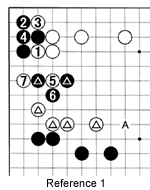 Reference 1: In response to white 1 (white 18 in Diagram 2), Black would usually answer at 2. The exchange white 3 for black 4 would follow, but next white 5 is severe, threatening to split the marked black stones. Black has no good answer to this move. If he plays at 6, white 7 cuts the marked stones from the black corner group. If Black has no good response to white 5, it means the marked white stones are strong, making a white jump to A unnecessary. That is the meaning of white 1.
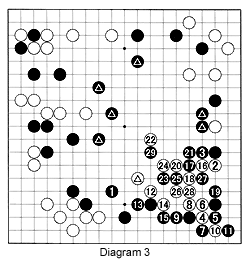 Diagram 3: Black 1 (27 in Diagram 2) completes Black's moyo. White has to save the marked stone to make a game of it. In a case like this, the best strategy is usually to play against enemy stones at various places, hope weaknesses appear and play a move that has to be answered. That is what White does with 2 through 20. Then he makes the appearance of eye-shape with 22. Black first quietly grabs the tail with 23 through 27, and then plays rough with 29. This move may seem to have the subtlety of a woodsman swinging an ax, but it is backed up by punctilious reading, making use of the acute shortage of liberties White has with 20 and 24. White is dead and the game is over. White starts another fight in the center, but thanks to Black's overwhelming strength there--in particular the marked black stones--Lee Se Dol wins the game by resignation.
Solutions to last week's problems
 Solution 1A: Black shouldn't play 1, but if he does, white 2 is the right answer. Even if Black plays 3, white 4 captures four black stones, making a life shape. See Solution 1B.
Solution 1B: After taking the four black stones, White's shape looks like this. Even if Black tries to kill with 1, White plays 2 (and vice versa) to make two eyes.
Solution 1C: White 2 in response to black 1 is wrong! Black will play 3 and White has to take stones with 4. See Solution 1D.
Solution 1D: After taking the four black stones, White's shape looks like this. In stark contrast to Solution 1B, White can't live here, even if he were to play the first move. He needs either A and B or C and D to make two moves. However, Black can always prevent White from playing the second move in the sequence.
Solution 2A: Black should cut with 1, threatening to capture one white stone. If White connects with 2, Black links up his stones with 3. White can't play: If he does, he will be captured immediately. So white 4 is played somewhere else (not shown). Next, black 5 is a good move. White is forced to capture five stones with 6. But...
Solution 2B: ...Black comes back at 7. White can only make two eyes if he gets to play at both A and B, but if he plays either, Black will play at the other spot. That means White is better off not playing at all. Then Black can reduce White's shape to the one shown in Solution 1C and 1D. In other words, White is dead.
Solution 2C: If White connects as in Diagram 2A, he dies. In fact, his best shot is playing at 2. Black can now capture the marked stone with 3, but if White plays a ko threat, and Black answers, White can recapture 3 at the marked stone. If he ignores Black's ko threat, he can capture at A, and he will live. Living in ko is not ideal, but it is the best White can do.
Rob van Zeijst is a four-time European go champion and European representative of the Fujitsu World Championship.