
Since the players were allowed only 10 seconds per move, they had to rely on intuition, backed up by fast reading of the positions. Although playing on a small board may seem easy, take a close look at the game shown here and you will find it offers deep reading, a chancy ko fight with interesting ko threats, a semeai (capturing race) and plenty of excitement.
Given enough time, almost any situation can be worked out, but with only 10 seconds per-move a player has to make fast judgments based on gut feeling.
9x9 pro game
In this game, Kozue Mukai, an 18-year-old 1-dan and the only female player, played Black against Daisuke Murakawa, the tournament's youngest participant at 12 years old. He is the second youngest Japanese to become a pro.
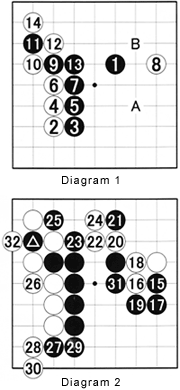
Diagram 1: In response to white 2, black 3 is very aggressive. The purpose is obvious--Black wants to lean on White's stones to strengthen her own stones and turn the lower right side into territory. White is forced to comply twice with 4 and 6.
White 8 is an interesting move. Instead of diving straight into either the upper or lower hand corners, at the risk of being contained there, white 8 makes miai of A and B. In other words, depending on Black's response, White can go either way. How should Black reply?
Black starts out with the double hane combination of 9 and 13. This is a tesuji (locally clever move). White has no choice but to capture one stone with 12 and 14. This may seem like a loss for Black, but she has a lot of forcing moves using the sacrificed stone black 11. Now, Black is ready to respond to white 8.
Diagram 2: Black 15 is again a forceful move. It is also based on discovering a tesuji. After exchanging 16 and 18 for 17 and 19, White plays at 20. This may look like a natural move, but black 21 is a strong tesuji, because of the forcing move of black 23, which the marked stone has gained her. Black 21 then is another sacrifice to regain control over the upper left corner with 23 and 25. White has no choice but to comply with 26. Black now forces 27 and 29 in sente, then closes off the center with 31, a large move with a possible follow-up in the upper right corner. But, according to Masaki Takemiya, the commentator, Black should have descended to clinch the game (see Reference 1).
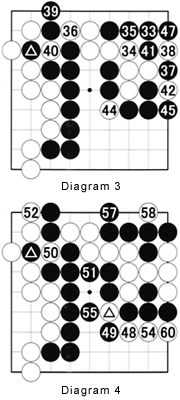
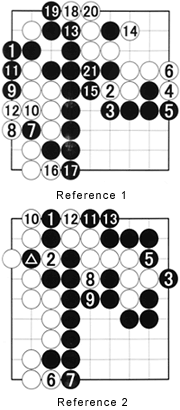
Diagram 3: (Black 43 captures the ko at the marked stone.) Black 33 is a strong attack on the corner. But after black 35, white 36 is a good move, and starts a ko. Black should have immediately played at 39, because 37 is a good ko threat--in effect by first playing at 37, Black is wasting a ko threat (see Reference 2). Again, instead of cutting at 41, Black should have just connected at 42 (see Reference 2). Black's strategy with 45 and 47 is based on faulty reading, which becomes apparent in the next diagram.
Diagram 4: (Black 53 and 59 captures the ko at the place of the marked black stone; White 56 captures at 50; Black 61 fills at 50; White 62 captures at the marked white stone.) This diagram contains a complicated ko fight. Black saw that she had more ko threats, or could win by setting up a damezumari (shortage of liberties) for White's stones. However, white 48 is a clever move, which creates two ko threats. Black wins the ko by filling 61 at 50, but has to ignore White's ko threat of 60, which puts four Black stones in atari. White 62 is at the place where the marked white stone is. Upon seeing this, Black resigns.
Reference 1: Black should have descended to 1. This sets up the clever combination of 7 through 12, enabling Black to win this game. Black has a total of 23 points (including prisoners), while White has 15 points. Since the komi is 61/2 points, Black would win this game by half a point. Keep in mind, Takemiya had only about 10 seconds or so to think about his commentary. This gives you an idea about his reading and intuition abilities.
Reference 2: (White 4 is where the marked stone is.) Takemiya suggested Black play at 1 first. Because of a lack of ko threats, White would have to connect with 4. And if we play it out to the end, we find Black has 24 points (including prisoners) and White 15 points + 61/2 komi. This time, Black wins by 21/2 points. There are other variations, but each time, with correct play by both sides, Black wins.
7-stone handicap
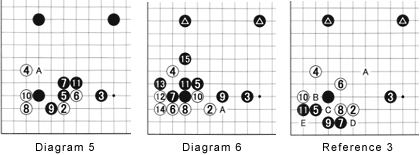
Diagram 5: In a previous article, we started a discussion of the 7-stone handicap game. We looked at A as a defense (playing at 4 instead basically has the same outcome). Defending allows a quiet, drawn-out game. However, you may want to take a more aggressive approach and pincer with 3. Often, White will then make a double kakari with 4. Black has several ways of responding. Attaching with 5 (attaching at A gives similar results) is a good move--it splits White's stones. White will usually play at 6 and, after 7, invade at 8. Black 9 and 11 are standard moves. This whole sequence forms a joseki (standard exchange).
Diagram 6: After white 4, Black can also split White's stones in a different way with the sturdy but slow kosumi of 5. After White invades with 6, Black has to decide on which side to block--at 7 or at 8. Because the side with the wider black extension usually prevails, Black blocks at 7. Black 9 is important. This connects all of Black's stones to form a powerful wall in the center. The next problem is posed by white 14. Connecting at 13 would result in a terrible shape. Therefore, black 15 is correct. This move fully utilizes the marked black stones.
Reference 3: One thing Black should not do is withdraw into the corner with a move like 5. He will live, but White gets the outside when he plays at 6. We can visualize the moves through 11. White may now want to defend around A. He can play later at B, followed by black C, white D and black E, allowing Black to live on a small scale. Neither the marked black stones nor black 3 are in good positions now. Instead of working together, they may become a target for a White attack.