
Besides making the game fun and exciting for both players, the handicap system has another advantage for the weaker player. It teaches him how to handle thickness. Since his stones are already placed strategically around the board, the black player has thick positions in almost any fight that occurs. Winning the game may seem like the objective, but the real goal should be to become stronger and win the next game--hopefully with fewer handicap stones--as well. And that only happens by grasping the basics of the game.
Basics of handicap go
Aside from trying to achieve the right state of mind, Black should aim to win by applying certain general principles. A few of these principles are:
 1. Avoid being contained or surrounded by your opponent's stones. Try and contain or surround his stones.
2. Guard your base and undercut your opponent's base.
3. Avoid getting cut but threaten to cut or actually cut your opponent's stones.
4. Keep your cool. Things will go wrong occasionally, and even top pros make mistakes. The important thing is to stay calm and rectify things as soon as possible. A short recovery time is an essential part of your strength.
5. Work out a plan and try to determine your opponent's overall plan.
Write down these principles and keep them next to you for reference during your games. This will help you control your emotions and make you more aware of the way you think and make decisions.
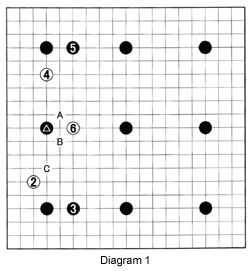
Diagram 1: We have been studying this diagram for the past few weeks. Trying to ensure life with the marked stone is always wrong, because this violates principles 1 and 3. There is also a real danger of violating principle 4 because you are just reacting to circumstances--to become stronger, the black player has to change his attitude from reactive to proactive.
Although sacrificing is one option I recommended for novices, breaking through the surrounding white stones is probably the best strategy. In our study of A and B over the past two weeks, we realized that it is impossible to avoid a fight. Now we will investigate black C, which is a fighting move that stacks the odds in your favor.
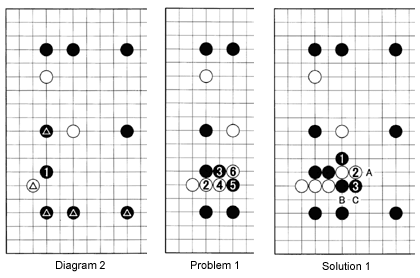
Diagram 2: Black 1 involves all of the black marked stones in the fight against the marked white stone. In fact, this is an unfair fight, pitting five black stones against one white stone, and applying such intense pressure can evoke a violent reaction. Be careful.
Problem 1: White will almost surely cut through with the moves through 6. What should Black's response be?
Solution 1: Black should use the combination of black 1 and 3 to threaten to take two white stones in a ladder with A, while guarding his lower left corner against a white cut at B and C.
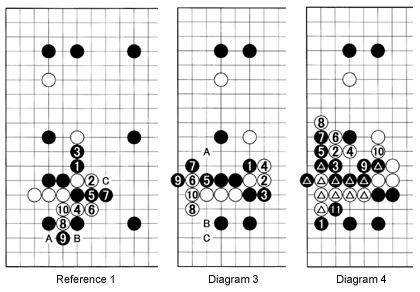
Reference 1: Wrong! Black 1 and 3 are motivated by fear. White will probably cut through with 4 through 10, leaving behind a cut at A and another at B while still threatening to escape with his two center stones by playing at C. Even though Black has not lost at this point, the game will probably become a series of tumultuous fights, with White dictating the flow of those fights.
Diagram 3: After black 3 in Solution 1, White will usually play at 4 to disable the ladder. The moves to 10 next are a common follow-up. At this point, White threatens to either attack at A or ensure life in the corner with B or C.
Diagram 4: If Black plays at 1, which is the recommended move in some books, White may play at 2, at which point Black must connect at 3. At this point, a semeai (capturing race) has started between the two marked groups. Who will capture who? Black must play at 5 to increase his liberties. Black 7 and 9 do not increase his liberties, but are kikashi moves that create cutting points in White's position. After white 10, black 11 wins the semeai by one move, because White's marked stones have four liberties while Black's have five. If you can remember this and play it perfectly, congratulations! But if you make one mistake, your stones are doomed.
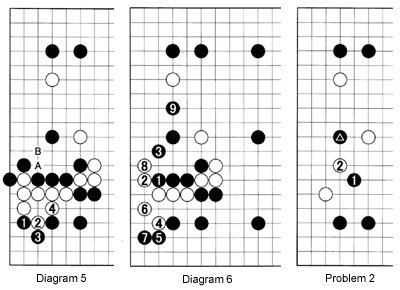
Diagram 5: There is one other pitfall. The moment Black plays at 1, White may play at 2 and 4, making a ko unavoidable. White has some internal ko threats, starting with A or B. This is not really a ko Black has to win--after all, it is only about the life of a white group--but mishaps can occur easily. If you want to try this ko just for fun or for practice, go ahead.
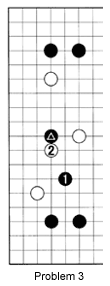 Diagram 6: In Diagram 3, in response to white 6 (white 2 in this diagram), we took black 7 for granted. But actually, after white 2, black 3 is better style. White will probably try to make some eye-space in the corner or on the side with 4 and 6. Black 7 avoids the ko shown in Diagram 5. White may play at 8 next, but black 9 deftly avoids a direct fight by playing elsewhere, while White's group is still not alive. This is good for Black. He is OK, while White still has to add a stone to ensure the safety of his group on the left.
Problem 2: In addition to the moves A, B and C in Diagram 1, I propose black 1. I have never seen it recommended in any book, but it is an uncommitted move in relation to the marked stone that pushes White into making a decision. After White has made a decision, Black sets his strategy. If White responds with 2, where should Black play next?
Problem 3: Alternatively, if White chooses to answer black 1 by playing at 2, how should Black respond?
The answers will be appear next week.