
To overcome this tendency, a strategy was demonstrated last week in which a stone was successfully sacrificed to gain twice as much in exchange. This is a calculated style of playing, and, as the example showed, efficient as well.
Today we will concentrate on "Balkanization"--dividing the opponent into small groups by cutting. This is a more advanced strategy and involves foresight and reading the board well.
Handicap go
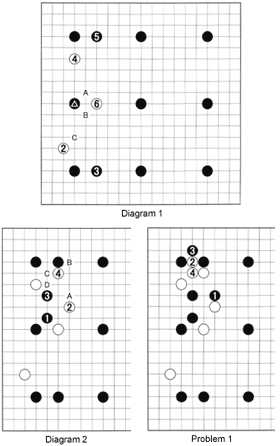 Again, we will focus on a nine-stone-handicap game. The goal today is to split the opponent's stones and force a way out. Our other goal is more general: Making a choice with a desired end result in mind, and visualizing the sequence that will lead to that result. As stated last week, the handicap stones count as the fist move.
Diagram 1: The moves through 6 are common ones. There are alternatives, like playing at 6 instead of 5. However, none of Black's moves can be criticized. At this point, if Black wants to save his marked stone, he should split White's positions with A, B or C. Since the gaps between White's stones seem widest between 2 and 6, B and C would seem to be the most successful strategies. But let's start with A.
Diagram 2: White will often try to surround the black stones. White 2 is, therefore, a natural move. In an attempt to keep the white stones separated while moving out, black 3 looks good. More often than not, White will next use the leaning attack tactic. Four approaches spring to mind when faced with the leaning attack--keep running while keeping a tight hold on what you are doing; look the other way and hope the problem goes away; cut, chop and fight until a group dies; or cut through a keima (knight's move) and hedge your risks. Before looking at the diagrams, try to envision what would happen with each choice.
Problem 1: White will likely play hane-komi (hane on the inside) at 2. Don't panic; be patient. After white 4, where should Black play next?
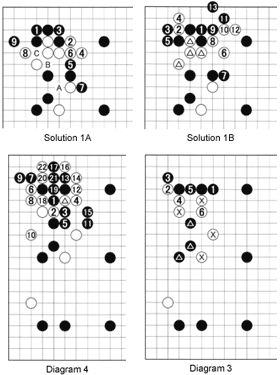 Solution 1A: Black should defend either of the two cutting points (1 or 3). If he plays at 1, the moves through 9 seem natural. What is Black's defense against white A? Black B threatens to cut at C, rendering the whole white group in that area eyeless.
Solution 1B: Black 1 protects the other cutting point. This may look dangerous because there is a cut at 2. But does this really work? If Black replies with 3 and 5, the two white stones 2 and 4 cannot do anything for the moment. But Black has to be careful, because if the three black stones around 1 lose a liberty, Black needs to reply. That happens when White plays 8. Black 9 through 13 are a good way of incapacitating white 2 and 4. Poking his head out with 7, Black has also gained the edge in the center.
In other words, after white 4 in Problem 1, Black can repair the defects in his shape by connecting on either side. It would be a mistake for Black to worry too much about his stones on the left side and let White have the upper left corner.
Diagram 3: Going back to Diagram 2, ignoring the problem does not work well. After black 1, White will exchange 2 for 3 and 4 for 5, then bottle up the marked black stones, while connecting his own stones. Changing course in midstream, especially when done in a wishy-washy way, is usually a bad idea.
Diagram 4: What about cutting with 1 and 3 (C in Diagram 2)? In general, this is the wrong way to cut through a keima. Since the marked white stone is important, White will probably pull out with 4. Black 11 is a good move in itself, as it splits his opponent's groups while White escapes. But all too often, misery is waiting around the corner. Black 15 completes White's escape, but white 16 and 18 drive a nail in Black's coffin. If Black insists on connecting at 19, white 20 and 22 kill the whole black corner group. Of course, tactics are to blame, but the real problem was the way Black cut with 1 and 3.
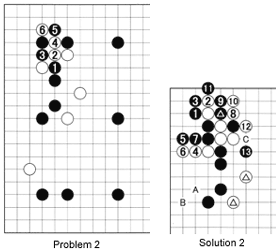 Problem 2: Black 1 and 3 are the right way to cut a keima (D in Diagram 2). The moves to 6 follow. How should Black respond to the cut at 6?
Solution 2: Black 1 is probably unavoidable, even if this puts the marked black stone in danger. However, black 3 immediately corrects this problem. White can try to be clever and play 4 and 6 before sacrificing two stones with the sequence to 11 and capturing one stone with 12. However, Black keeps up the pressure by cutting off the marked stones once again with 13. This threatens a play at C, which takes away White's eyes. True, White may later be able to play at A or B to escape with his stones in that area, but his position will remain low, while escaping or living will likely inflict heavy collateral damage on surrounding stones.
Next week, we will look at escaping from the easier side--easier because the gap between White's stones is larger.