
The game was played in the first round of the Second LG Cup in Seoul on May 27, 1997. The commentary is based on that by Pietsch's teacher Satoru Kobayashi, 9-dan and a former Kisei titleholder. Some problems are posed at important points in the game. The answers are in the commentary for the following diagram.

Diagram 1: White 12 and 16 somehow gave Kobayashi the impression Yoda was treating the game as a lesson for Pietsch, especially as a White move at A would have been more usual than either of those moves. Between top pros, Black could not lose after playing at 17. Black makes his first mistake when he plays at 25. As White is already strong in the center, because of white 16, Black cannot expect to develop a large moyo on the right side. Instead of 25, Black should have played at B. White naturally invades at 26--the first real test for Pietsch.
Problem 1: How should Black handle this situation?
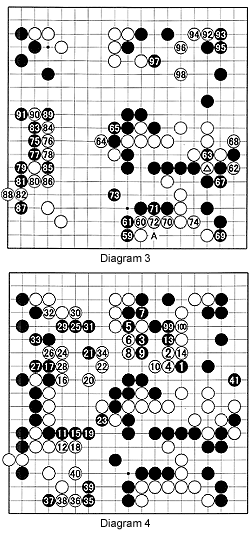
Diagram 2: The combination black 27 through 31 gets a passing mark. White 32 dares Black to attack. However, black 33 is a bad move. Pietsch apparently wants to combine the cut at A with the attack on White's weak group on the right side. However, such a move would always be answered by white 34. In general, a play that will always be answered with the same move is usually a bad play, because it takes potential out of the position. In this game, the exchange black 33 and white 34 eliminates a possible invasion at B. White 44 is too nonchalant and is really a losing move. Instead, White should have played at C, followed by black D, white E, black F and white 56. This would have built some eye-space, in addition to creating an escape route into the center. White gets a bad result by allowing Black to lock him up with 45 through 49. Now he is forced to start a ko with 50 through 58.
Problem 2: Where should Black play his ko threat?
Diagram 3: (White 66 captures the ko where the marked stone is.) Black 59 is close to being the losing move. He should have played at A instead, as in Reference 1. When White responds with 60 and Black answers with 61, White goes all out by cutting at 62. After Black captures the ko with 63, White plays his only ko threat at 64, then recaptures the ko. Black has no ko threats and is forced to connect at 67. After White 68, the game should have been over--White is clearly leading. However, Black hangs in with 75 through 83, then neatly follows up with 85 and 87, a clever, professional technique. These moves leave behind a cut at 85 in White's position. But after Black's small success here, white 92 and his following moves lay waste to Black's largest territory. Attaching against White's strong stones with black 97 is a good technique to attack White's group from 92 on. Naturally, White ignores this and escapes with 98.
Problem 2: Where should Black play next?
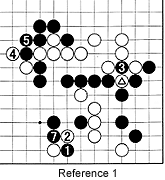
Reference 1: After White took the ko where the marked stone is, Black should have played at 1. If White answers with 2, Black captures the ko with 3. White's only ko threat is at 4, and when Black answers with 5, White can take back the ko by playing where the marked stone is. But black 7 puts White on the spot--if he answers, he loses the ko, and if he doesn't answer, he loses his group in the lower right. Black 1 would have done severe damage to White's position, enough to win the game.
Diagram 4: Black 99 is bad, as it helps White reinforce his position. Instead, he should have followed Reference 2. It is hard to say whether Black has any good alternatives to the moves he plays in the upper left corner with 11 through 33. After white 34, two large points remain on the board, the extension at 39 and the defense at 41. To win the game, Black needs to play both. The moves 35 through 39 are an excellent combination, in effect taking sente and seizing both the extension at 39 and the defense at 41. Kobayashi said he was impressed that Pietsch found 35, as simply extending to 39 would not have been sente--Pietsch's combination earned him a feather in his cap, and the game. The rest of the moves are omitted. In a drawn-out endgame, Black wins by half a point.
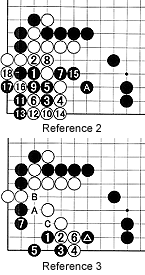
Reference 2: Even if Black plays the marked stone A, White will ignore this and play above 41 in Diagram 4. After A, the combination black 1 through 5 seems aggressive, but does not work, due to the clamp of white 6. If Black insists with 7 through 15, White throws in at 16, then fills in Black's liberties very quickly with 18. As you can see, White wins the capturing race effortlessly after 6, although even a pro might be forgiven for thinking that the combination 1 through 5 would work for Black.
Reference 3: However, if White ignores the marked black stone here and plays elsewhere, Black will make a placement at 1, then threaten a ko with 3 and 5, and if White connects at 6 to decline the invitation to play a ko, black 7 makes it difficult to kill this black corner group because Black can always force the exchange A for B, then reinforce with C.
|
IN MEMORIAM: Hans Pietsch, 4-dan Pro
The international go community was shocked and saddened at the news of the murder of German professional Hans Pietsch on Jan. 16. Pietsch was visiting Guatemala on an international go friendship tour with Yoshiaki Nagahara, 6-dan, when he was attacked. Nagahara escaped unharmed. Pietsch came to Japan to study go in the early '90s, under Chizu Kobayashi, a 5-dan pro, and her brother Satoru Kobayashi. He turned pro in 1997, the first European to do so, and rose to 4-dan in 2000. One of his finest moments was his victory over Norimoto Yoda, then Gosei titleholder, presented in this week's go column. In an interview last year, Pietsch confided he felt he had little talent to become a top pro, but was very happy to have been able to make it into the pro ranks. At the same time, he worried about his future, as the prospects for low-level pros were not great. "The competitive world of go offers a great life to very talented people, but for others it can be very tough," he said. "And the society of professional go is a closed one that outsiders cannot enter easily." He advised people who wanted to turn pro to consider the step very carefully. "It is a long, winding and often lonely road, and it takes strong will, extensive study, and great ambition as well as talent to succeed," he said. Pietsch will be missed by all his friends and supporters in Japan and Europe.
|


 Copyright 1999-2002 The Yomiuri Shimbun