
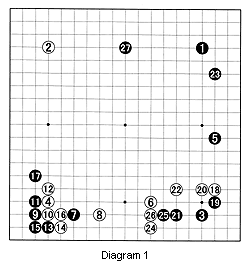
 Diagram 1: O plays 1, 3 and 5, the so-called low Chinese fuseki, an aggressive opening strategy. White 6 is a modern approach to deal with this opening. Black 7 invites white 8. O then plays at 9 to enter the corner and take territory in a standard sequence to 17. White 18 next isolates black's stone at 3, which Black has to defend with 19 and 21. The combination of white 22 and 24 is a little slow, which is illustrated by black 25, which has to be answered with 26, giving Black the opportunity to seize the initiative at the top. At this point, Black is already doing well. Where should White play next?
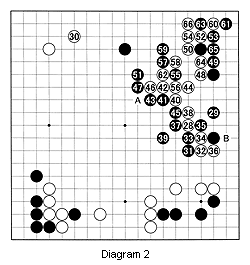 Diagram 2: White 28 is one step too far. He should have played at 33 instead, probably followed by black 29. This would have expanded White's influence and pushed back Black's. However, after white 30, Black strikes back at 31 to isolate white 28. Against this obvious move, White had prepared the cut at 32. Though a cut at 34 was anticipated, Black unexpectedly cut back with 33 and 35. Reference 1 shows a more natural sequence. Although Black has taken the initiative in the center, he should have followed the sequence in Reference 2, instead of playing at 39. In the game, 40 is a resilient move, giving White a good shape and leading to the sequence to 66. After this move, White is completely alive and Black has run out of steam. In addition, he has a weakness at A and he has lost about five points because White can play at B (see Reference 1).
 Reference 1: Black 3, white 4 and black 5 are a more natural way to cut than the moves played in the game. After black 7, white 8 hits the vital point of Black's shape, but after black 9, White will have to move into the center by playing at A, for example, followed by a black move around B. Note the difference in Black's territory on the right.
Reference 2: After black 1 and white 2, Black should have pushed once more with 3 before defending the cut with 5. White's most natural move would be A. But then black B, white C and black D would follow, leading to an uphill battle for White.
Diagram 3: Black invades the upper left corner with 67 through 73. White 74 enlarges White's moyo (potential territory) on the lower side while pushing back Black's stones on the left. Black 75 and 77 make eyes and territory, which moderates the threat of a white cut at A. At the same time, Black is hoping for an attack on the upper left corner, which in turn indirectly strengthens the black stones 67 through 71.
White tries out the aji in the lower right corner, but Black lives in the sequence through 87. White 88 expands White's lower side while aiming for the cut at A. Black has to do something. When reducing a framework, the best thing to do is draw a line between its borders (in this case 74 and 88), then play a move just outside that line. Black 89 is about in the middle just outside that line.
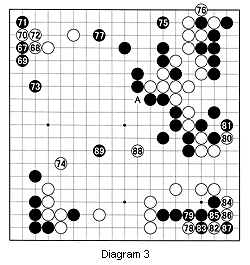 Usually a direct attack on such an intruder does not work very well. Instead, it is best to set up a splitting or leaning attack, if possible. In a splitting attack, you create another weak group and then attack both at the same time by splitting them. In a leaning attack, you attach stones to your opponent's strong stones to strengthen your own stones, which then play an assisting role in attacking a weak group in a kind of diversionary attack. How does that work in this case?
Solutions to last week's problems
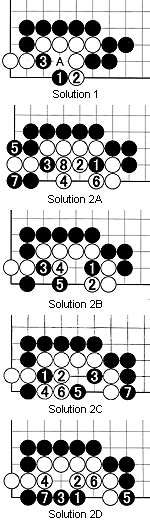 Solution 1: The question was how Black can kill the White group. Black 1 is the vital point. If White plays at 2, black 3 puts him on the spot. White cannot capture the two black stones with A (or any other move) because he has liberty problems. On the other hand, if White does not play at 2 but somewhere else, Black will play at 2 to secure a connection to his stones on the outside.
Solution 2A: In this shape, White has a couple of defects. Black has various ways to take advantage of these defects. Cutting at 1 is one possibility. If White plays at 2, Black can cut at 3. White has little choice but to play at 4. In the sequence to 8, Black picks up two white stones in sente.
Solution 2B: In response to black 1, White can also play at 2. Black will still cut with 3. However, after white 4, black 5 is nasty. This sets up a ko for the entire white group.
Solution 2C: It is also possible to cut at 1 first, then cut at 3 to pick up the two stones on the right.
Solution 2D: Black 1 is a vital point. If White plays at 2, Black can make a seki (standoff) in the sequence through 7.
Problem for this week
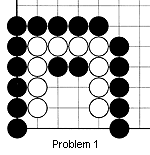 Problem 1: White to play first and make life. Because of the limited number of possibilities for the first move--only four in total because of the symmetry--this is not a difficult problem. However, even for fairly strong players this problem holds a blind spot.
Hint: Especially in the Western world, people commonly believe that you have to be active in order to get a better result. However, this problem illustrates this is not always true.
Rob van Zeijst is a four-time European go champion and European representative to the Fujitsu world championship.