
Yes, there are some Westerners who have established themselves as professional go players. For example, American Michael Redmond, 9-dan pro, who came to Japan at the age of 14 and was taken in by Yusuke Oeda, 9-dan, as a live-in disciple. Redmond often appears on TV as a go commentator. A German, Hans Pietsch, 4-dan, and a Romanian, Catalin Taranu, 5-dan, both turned pro in 1997. However, for most Westerners who come to Japan to be insei (professional pupils), the culture shock is too great to overcome and they leave within a year or two, disillusioned. Some of them even become weaker go players. How can that be?
Rationality
As stated earlier, Western culture promotes rationality--meaning Westerners like to express things in numbers and figures; they want to quantify things. On the other hand, go professionals often talk in terms of "more or less," "somewhat" and "in some way"--they often use ambiguous terms.
Are they unsure? Don't they understand themselves? Are they really the all-knowing masters? Ambiguity often shocks and sometimes even scares Westerners.
Intuition
During a long career, a top pro will come to understand the many board situations and possibilities that exist, as well as the limitations of his knowledge. But even though he has seen many situations, it is highly unlikely that he will ever witness the exact two situations. Because a go board has 361 intersections, it is easy to understand that after about 50 moves no game is ever the same as one played before. Therefore, a pro has to judge a current situation based on similar experiences from the past.
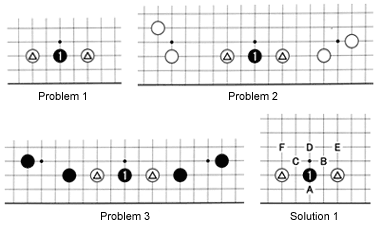
Problem 1: What is the value of black 1?
Black 1 invades the territory claimed by the two marked white stones. Wouldn't that be about nine points? Then, isn't the value about nine points? Now, look at Problems 2 and 3.
Problem 2: Black 1 is an invasion alright, but is the value of this move the same as the invasion in the next problem?
Problem 3: Again, Black is invading the two marked white stones. What is the value of this move?
It goes without saying that the invasion in Problem 2 has a different value than the one in Problem 2. Do you judge this intuitively or quantitatively? Or can you approximate the value by giving it a number of points?
 Solution 1: To solve this problem, I use a system which I call QARTS (Quantitative Analysis of Relative Territory and Strength). The system is based on something I read years ago: Creating a weak group is a liability of about 20 points. That seems to be common knowledge among professionals, but it seems we can use this information in other ways and for other purposes, too.
For example, we can use this information to quantitatively describe an invasion. In this particular case, I want to refrain from giving an answer since we don't know anything about the surrounding circumstances. Depending on those circumstances, White may choose to play any of the moves A through F, or tenuki (elsewhere).
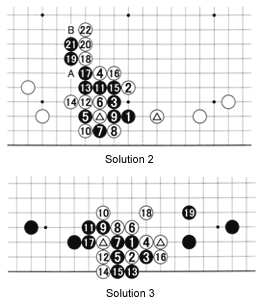
Solution 2: This is a more concrete problem. White will probably cap at 2. If we just suppose Black can live--even though that is a very long shot--with the tesuji sequence 5 through 15, Black might get away. But even after white 22, Black has problems with a cut at A and wanting to push at B. But, whatever happens, White has already changed the status of a large part of the lower edge from potential territory to solid territory.
In addition, White stands to gain a lot on the right side as well and the attack is far from over. In short, black 1 is worth at least minus 20 points.
Solution 3: This is the other side of the spectrum, where black 1 is an invasion that cuts off one of the marked white stones. After white 2, the moves to 8 are forced.
Next, Black can connect underneath by playing at 12 or 16, or he can cut at 9. The moves to 19 are one example of what can happen. It is clear that both of Black's corners are stronger and White's group is still liable to come under attack. Here, Black 1 created two weak white groups (would be worth 2 x 20 points according to QARTS), of which one was immediately sacrificed by White to contain the damage, turning a liability of 20 points into a sacrifice that helps the other group.
Still, black 1 was probably worth at least 20 points for creating a weak white group, plus the territory he took away from White.
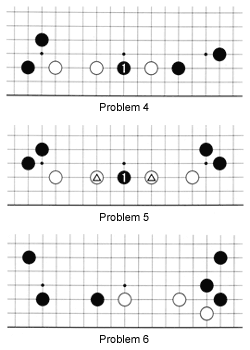 Problem 4: What is the value of black 1?
Problem 5: What about the value of black 1? Is this a hazardous invasion or is it an intelligent attack?
Problem 6: Where should black play?
Solution 4: Black 1 is an excellent move locally. It splits White's position and there is a chance that both white groups will come under attack. Because of this, White probably has to force the exchange 4 for 5 (a loss of at least a couple of concrete points as well as the loss of a possible attack at A). Then, as long as the two white stones around 2 are weak, White is unable to invade the lower-right corner at B or C. So even though black 1 doesn't make any territory directly, it destroys White's territory and position in that area, and enables Black to make territory in the lower-left and right corners--this is worth at least 20 points.
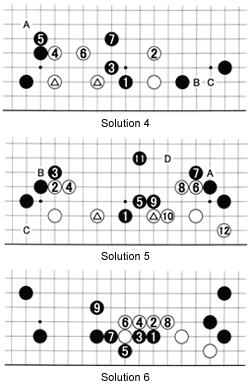 Solution 5: This is a deep invasion and unreasonable since White is strong on both sides. White will usually attack 1 from a distance by playing against strong black stones (this technique is called a leaning attack) with 2 and 4, creating a cutting point at B. Black may get out with 5 through 11 but white 12 takes a lot of points while creating another cutting point at A. White still has the possibility of sliding to C and breaking out at D. Even though Black took away some points from White in this area, in doing so, he forces himself to look after his weak group, meaning he can't also defend his positions on the left and the right at the same time. Black lost at least 20 points through this invasion.
Solution 6: Black 1 is a strong move. White is almost forced to play the sequence to 8. Black takes away a lot of territory while making plenty of points for himself in the sequence to 9. These moves also aim at renewing its attack on the entire white group.