
The fifth and final game in the best-of-five Gosei title match settled the series, providing challenger Norimoto Yoda (White) with his second crown in addition to his Meijin title. This left Koichi Kobayashi, the last go player in his 50s with a title, in the cold.

Yoda has always been a promising player from even before turning pro at the age of 14 and entering the Meijin league at only 18. But while he won minor titles and recorded good winning averages, for many years he was regarded as a "talented player who never quite made it." However, a few years ago he had a mental breakthrough and captured the Meijin title that he recently defended successfully for the second straight time.

In addition to the Meijin title worth 36 million yen, the Gosei title increased his earnings by another 7.7 million yen.

Today's theme is moving the dividing line between potential territories in your favor, which we will illustrate using the fifth game of the Gosei title match. The game has a couple of points that are of didactical interest.

After both players map out their territories clearly, their respective borders can be very close to one another. How can a player increase his own territory while decreasing that of his opponent?

Diagram 1: The moves through 18 have a nostalgic feel, as this looked like a fuseki (opening) from the 1950s or '60s. Leaving white 6, 8, and 10 on their own involves a special strategy. White relies on his skill to make sabaki (light shape providing eye-space). In the old days, white 18 was often answered at 20, white A. However, this leaves Black in two minds from where to approach white 2--at 19 or at 21. Black 19 immediately puts us in the present. With white 20 and black 21, each player goes his own way. The moves through 28 form a joseki (standard exchange). The problem is what to do next?

White has a moyo (potential territory) in the upper part of the board, while Black has a moyo on the right, extending all the way to the lower right and lower side. On his next move, it is Black's goal to increase his moyo and decrease White's. How should Black play?

Diagram 2: Black 1 and 3, which force a response with 2 and 4, comprise a good combination that limits the scope of White's potential while expanding Black's moyo in this area in sente. Black then maps out and reinforces his territory in the lower right by playing at 5, putting pressure on all of White's marked stones.

Diagram 3: In contrast, if Black plays at 1 immediately, White will probably jump to 2. This threatens the marked black stones with an invasion at A. If Black defends at 3, and we assume the same moves 4 through 6 as in the actual game, the difference becomes clear. Black's position is narrow, while White's shows scope for expansion.

Diagram 4: The moves 29 through 33 were actually played in the game. This leaves White with no choice but to move out with 34 and 36. While defending at 42 next might have been normal for Black, black 37, which hits the vital point, was a severe attack that denied White easy eye-space. In the sequence to 49, Black takes profit and almost completely gobbles up the marked white stone while White settles his group. Next, it is White's turn. Where should he play to limit Black's moyo and strengthen his own territory? In short, how can he move the line between potential territories in his favor?
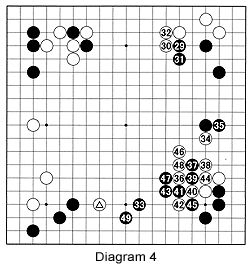
Diagram 5: Yoda's next move was the jump to 1. A lesser player might have pulled out the marked stone to save it. However, Yoda wanted Black to capture the marked stone with A, white B, black C, after which White can switch to the next large spot. For comparison, imagine a black stone at 1. This would threaten black D, white E, black F, splitting White's position or making it very low. White 1 defends and threatens to rescue the marked stone, so it has both defensive and offensive qualities while setting up a moyo on the left.

New problems
This week's problems involve damezumari (shortage of liberties).

Problem 1: Black to play and kill the white group.
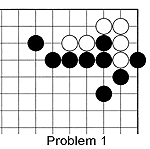
Problem 2: Black's marked stones have only four liberties. He has to capture the two marked white stones to connect them to his buddies, but how? Black to play and free his marked stones.

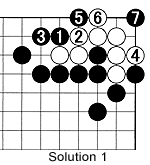
Solution 1: Black 1 is the correct move. White can't play at 3 as Black cuts at 2. Therefore, White has to play at 2, but now he has to little space to make eyes.
You'll find the solution to Problem 2 next week.
Want to find out more? Come to Ben's Cafe in Takadanobaba (03-3202-2445 or www.benscafe.com), where the English-speaking go community congregates every Sunday starting at 11 a.m. You can enjoy free lessons until 1 p.m.

Van Zeijst is a four-time European go champion and European representative at the Fujitsu World Championship.

By Richard Bozulich

By Rob van Zeijst

  1. Example of a pro game
  2. Insight to the pro game
  3. The basics of territory
  4. Be proactive
  5. Take the Initiative
  6. The endgame
  7. The Last Points
  8. Last week's problem
  9. The endgame
  10. Endgame Tesuji
  11. As expected,
  12. Kisei Title
  13. Balancing attack,
  14. Balancing attack and defense
  15. Tobi, kosumi, keima
  16. Tobi, kosumi, keima
  17. The end of the game
  18. O Rissei keeps Kisei title
  19. Solutions to last week's problems
  20. Over the next few weeks
  21. Efficiency calls for good shape
  22. Get an eye for shape
  23. Middle of three stones
  24. Kosumi: pros and cons
  25. Defects of kosumi
  26. Kosumi
  27. Hazama
  28. Attacking
  29. Where there is a keima, there is a cut
  30. Cutting keima the right way
  31. Visualization is a must
  32. Function over form
  33. Rationality
  34. Intuition
  35. Realistic approach
  36. Connecting stones
  37. The so-called cosmic style
  38. Ponnuki
  39. Ponnuki
  40. Ponnuki
  41. Sabotage
  42. Ponnuki and Ko
  43. Fighting ko effectively
  44. Handicap go
  45. Handicap go
  46. The nine-stone handicap
  47. Basics of handicap go
  48. 5 more basic principles of handicap go
  49. Yoda defends Meijin Titlego
  50. Original ideas
  51. The third part of the game
  52. In go, it is easier to...
  53. A good way to improve a game
  54. A big gap between genders
  55. World Championship for Women
  56. Hane defends the Tengen Title
  57. 7-stone handicap
  58. Let's start the New Year...
  59. 9x9 pro game
  60. 9x9 pro game
  61. The following is...
  62. The Go player's...
  63. Of the three most prestigious titles, ...
  64. This is the third installment in a series...
  65. Achallenger has to overcome many obstacles....
  66. In the battle for the 42 million yen.....
  67. Only one week after losing his Kisei.....
  68. After recently losing his Kisei title.....
  69. It is a well-established fact that.....
  70. Go--The first step
  71. Some basics about the pro world
  72. How deep can a pro read?.....
  73. Who are the best go players.....
  74. Can computers play go?.....
  75. Last week, we established.....
  76. Computers have led to a flourishing.....
  77. Though I recommend that you join a go club.....
  78. Last week, we finally got to the point where we discovered that.....
  79. Some people like to offer quotations aimed at showing .....
  80. One of the best and most authoritative Web sites for.....
  81. At the beginner levels, go is an easy game to play.....
  82. We often do things in life without thinking.....
  83. We are often told to do the right thing.....
  84. Following a pattern set by others is easy.....
  85. This week's Go Weekly, a Japanese weekly go newspaper.....
  86. How fast can you do a job and do it right.....
  87. When I am asked by go students how they can.....
  88. Books have been written on the subject.....
  89. Go players are always quick to point out that go is a superior.....
  90. The last few weeks were devoted to tactical issues.....
  91. The fifth and final game in the best-of-five Gosei title match .....
  92. The dividing of land, property, and things of .....
  93. Fireworks are expected between current Meijin .....
  94. Dividing land, property or living space in one's own favor is .....
  95. The dream match between the current Kisei .....
  96. Three games have now been completed in the best-of-seven series.....
  97. We have talked strategy over the past few weeks.....
  98. In study, in all branches of sport.....
  99. The most important things a go beginner.....
  100. In many games and sports,.....
  101. How do you do confront your fears?.....
  102. In go, you cannot expect to deal with.....
  103. When your opponent is much stronger than you.....
  104. Using the power of your opponent for.....
  105. The combination of aggressiveness, .....
  106. Last week, there was some good news for.....
  107. On Dec. 18, in the fifth game of.....
  108. Go Weekly, which hits the nation's newsstands every Monday.....
  109. In go, the beginner must try to master the basics of life and.....
  110. Last week, we started a new series on life and.....
  111. This is the third article in a series on life-and.....
  112. In this article, the fourth in a series, we will take.....
  113. This is the fifth installment of tsume go.....
  114. Practice, practice, practice. This is the way to improve.....
  115. The Kisei title match, worth more than $400,000.....
  116. The Kisei title match, worth more than $400,000.....
  117. For a champion, 25-year-old Keigo Yamashita has.....
  118. In two-day best-of-seven matches.....
  119. Naoki Hane has iron nerves.....
  120. The game of go can be as easy or as difficult.....
  121. On April 18 and 25, the TV Tokyo network will.....
  122. Give and take is widely used in daily life to strike.....
  123. Although go has a history of almost 4,000 years.....
  124. The adage "Chess was invented but go was discovered".....
  125. Unlike chess, in which a board position.....
  126. Over the past few weeks we have concentrated.....
  127. Go is sometimes perceived as a more difficult game than chess
  128. Last week, I stressed that the objective of go was to.....
  129. Anyone can learn the basics of go.
  130. Go can be considered a zero-sum game as .....
  131. If you play a strategic game like go, taking or keeping .....