
Last week, we had a look at the fourth game of the Kisei title match between 25-year-old defender Keigo Yamashita and Naoki Hane, 27, current holder of the Tengen title. The two-day Kisei match is worth 42 million yen, with each player allotted eight hours of free time to think about their moves, before being restricted to one minute per move. This creates enormous stress, requiring stamina and an excellent psychological condition.

Yamashita's momentum?

When Yamashita lost the first three games in this best-of-seven series, he was considered finished. But he edged back into the match by winning the fourth game, and then scored a resounding victory in the fifth game. Let's have a look at the fifth game.

Diagram 1: Playing 6, which constitutes the Low Chinese Opening, is a rarely used strategy for White. However, in combination with expanding his framework with 10 and 12, the result seems reasonable. Black 13 is an interesting move as it could be followed by black 15 or black A. White decides the latter move, which could be followed by white B and black C, is more dangerous, and plays 14 to prevent this. However, black 15 is the vital point for attacking the white formation on its right. After black 19, white 10 and 12 are under attack. White 22 is a difficult move to assess; it seems to do hardly anything but it did provoke black 25, leading to the sequence through 31. Norimoto Yoda, the current Meijin and official commentator, said that after white 30 it felt as if Black was fighting with a hole in his stomach. If 17 had been at D, Black's shape might have been justified. Instead of 25, Black perhaps should have played at E. Still, White is under attack on the right side. How does he cope? Yamashita came up with the combination 32, 34 and 36. These moves are backed up by considerable reading of the board. See Problems 1 through 4.

New Problems
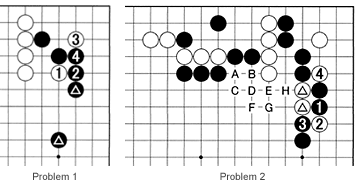
Problem 1: Instead of playing the moves in the game, White could have opted for exchanging 1 for 2 first, then invade at 3. In that case, Black would have connected at 4. White can now connect 3 to his main group in two ways. Explore those possibilities and find out which is the best one. Note that white 1 strengthens Black's marked stones, which is why White rejected this possibility.

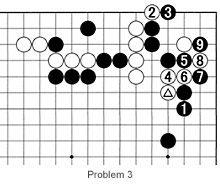
Problem 2: After the last white move in Diagram 1, Black can play at 1. White counters with 2 and 4. However, Black can now capture the two marked stones in a ladder with H. Before playing 2, White should first make preparations to invalidate that ladder by playing a move that threatens to cut at A. All the moves B through G threaten to cut at A. Which move also breaks the ladder to allow White to play at 2 and 4?
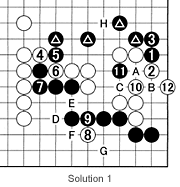
Problem 3: In response to the marked white stone, black 1 looks reasonable. However, if White plays at 2, Black cannot stop him with 3. If he tries, White will play 4 through 8. Black 9 is forced. How can White capture a few black stones?

Problem 4: Black to play. How can he ensure his survival?

Solutions for the problems will be shown next week.

Solution to last week's problems
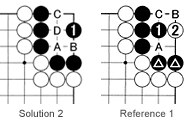
Solution 1: Instead of connecting his stones with a move at 4, which he did in the actual game, Yamashita could have tried to kill with 1 and 3. However, white 4 through 8 are a strong response, creating weaknesses in Black's position.

In addition, White easily ensures life with 10. This makes one eye at A, and one at B or at C. Black 11 is no use as white 12 makes an eye at B. Instead Black plays a 12 instead of 11, white 11 follows. In addition, White can exchange D for E, followed by white F and black G, and depending on the circumstances he might attach and cut with H. Black's marked stones do not seem all that strong now.
Solution 2: Black 1 is the only move that allows him to survive. White A is met with B, leaving C and D as miai, i.e. if white C, then black D, and vice versa.

Reference 1: Black 1 is no good as white 2 puts him on the spot. This move aims at A killing the marked stones. Black's last hope is B to make a ko. However, White captures with C and Black has little hope of winning this ko. Even if he did, it is better to live without a ko as in Solution 2.

Van Zeijst is a four-time European go champion and European representative at the Fujitsu World Championship.

By Richard Bozulich

By Rob van Zeijst

  1. Example of a pro game
  2. Insight to the pro game
  3. The basics of territory
  4. Be proactive
  5. Take the Initiative
  6. The endgame
  7. The Last Points
  8. Last week's problem
  9. The endgame
  10. Endgame Tesuji
  11. As expected,
  12. Kisei Title
  13. Balancing attack,
  14. Balancing attack and defense
  15. Tobi, kosumi, keima
  16. Tobi, kosumi, keima
  17. The end of the game
  18. O Rissei keeps Kisei title
  19. Solutions to last week's problems
  20. Over the next few weeks
  21. Efficiency calls for good shape
  22. Get an eye for shape
  23. Middle of three stones
  24. Kosumi: pros and cons
  25. Defects of kosumi
  26. Kosumi
  27. Hazama
  28. Attacking
  29. Where there is a keima, there is a cut
  30. Cutting keima the right way
  31. Visualization is a must
  32. Function over form
  33. Rationality
  34. Intuition
  35. Realistic approach
  36. Connecting stones
  37. The so-called cosmic style
  38. Ponnuki
  39. Ponnuki
  40. Ponnuki
  41. Sabotage
  42. Ponnuki and Ko
  43. Fighting ko effectively
  44. Handicap go
  45. Handicap go
  46. The nine-stone handicap
  47. Basics of handicap go
  48. 5 more basic principles of handicap go
  49. Yoda defends Meijin Titlego
  50. Original ideas
  51. The third part of the game
  52. In go, it is easier to...
  53. A good way to improve a game
  54. A big gap between genders
  55. World Championship for Women
  56. Hane defends the Tengen Title
  57. 7-stone handicap
  58. Let's start the New Year...
  59. 9x9 pro game
  60. 9x9 pro game
  61. The following is...
  62. The Go player's...
  63. Of the three most prestigious titles, ...
  64. This is the third installment in a series...
  65. Achallenger has to overcome many obstacles....
  66. In the battle for the 42 million yen.....
  67. Only one week after losing his Kisei.....
  68. After recently losing his Kisei title.....
  69. It is a well-established fact that.....
  70. Go--The first step
  71. Some basics about the pro world
  72. How deep can a pro read?.....
  73. Who are the best go players.....
  74. Can computers play go?.....
  75. Last week, we established.....
  76. Computers have led to a flourishing.....
  77. Though I recommend that you join a go club.....
  78. Last week, we finally got to the point where we discovered that.....
  79. Some people like to offer quotations aimed at showing .....
  80. One of the best and most authoritative Web sites for.....
  81. At the beginner levels, go is an easy game to play.....
  82. We often do things in life without thinking.....
  83. We are often told to do the right thing.....
  84. Following a pattern set by others is easy.....
  85. This week's Go Weekly, a Japanese weekly go newspaper.....
  86. How fast can you do a job and do it right.....
  87. When I am asked by go students how they can.....
  88. Books have been written on the subject.....
  89. Go players are always quick to point out that go is a superior.....
  90. The last few weeks were devoted to tactical issues.....
  91. The fifth and final game in the best-of-five Gosei title match .....
  92. The dividing of land, property, and things of .....
  93. Fireworks are expected between current Meijin .....
  94. Dividing land, property or living space in one's own favor is .....
  95. The dream match between the current Kisei .....
  96. Three games have now been completed in the best-of-seven series.....
  97. We have talked strategy over the past few weeks.....
  98. In study, in all branches of sport.....
  99. The most important things a go beginner.....
  100. In many games and sports,.....
  101. How do you do confront your fears?.....
  102. In go, you cannot expect to deal with.....
  103. When your opponent is much stronger than you.....
  104. Using the power of your opponent for.....
  105. The combination of aggressiveness, .....
  106. Last week, there was some good news for.....
  107. On Dec. 18, in the fifth game of.....
  108. Go Weekly, which hits the nation's newsstands every Monday.....
  109. In go, the beginner must try to master the basics of life and.....
  110. Last week, we started a new series on life and.....
  111. This is the third article in a series on life-and.....
  112. In this article, the fourth in a series, we will take.....
  113. This is the fifth installment of tsume go.....
  114. Practice, practice, practice. This is the way to improve.....
  115. The Kisei title match, worth more than $400,000.....
  116. The Kisei title match, worth more than $400,000.....
  117. For a champion, 25-year-old Keigo Yamashita has.....
  118. In two-day best-of-seven matches.....
  119. Naoki Hane has iron nerves.....
  120. The game of go can be as easy or as difficult.....
  121. On April 18 and 25, the TV Tokyo network will.....
  122. Give and take is widely used in daily life to strike.....
  123. Although go has a history of almost 4,000 years.....
  124. The adage "Chess was invented but go was discovered".....
  125. Unlike chess, in which a board position.....
  126. Over the past few weeks we have concentrated.....
  127. Go is sometimes perceived as a more difficult game than chess
  128. Last week, I stressed that the objective of go was to.....
  129. Anyone can learn the basics of go.
  130. Go can be considered a zero-sum game as .....
  131. If you play a strategic game like go, taking or keeping .....