
We ended last year with a problem that could be solved on several different levels. The "real" way is to visualize the situation move by move--completely in your head and without putting a stone on the board--and solve all problems as they arise. The second method to solve a problem like this is to place a stone on the board only when you are sure it will lead to the final solution. The third way is to do everything on the board using actual stones. A beginner should not expect to solve this problem using the third method, while a dan player should. A medium-ranked dan player should be able to work out a solution using method two, but only a strong amateur would be able to solve it with the first method. If you can solve the problem within, say, three to five minutes, you can probably rank yourself among professionals in this field.
As you can see in the solution, you have to read or calculate 23 moves ahead, including all the side branches. This may seem like a lot of moves, but for a pro, it should be a routine task. There are many problems in actual games that require reading as many as 50 or 60 moves ahead. And, of course, if a mistake is made in the reading somewhere, that will often lead to defeat. On the other hand, solving a problem may not win the game, because the go board is such a vast space. As a matter of fact, this is often the case when sacrifices--routinely taking 10 moves or so--are made. So yes, being able to read accurately and quickly is vitally important, but this ability must serve an overall grand strategy to win the game.
The best examples of intricate tactics serving a grand strategy can be found in the games of Go Seigen, a Chinese player who came to Japan after the war and is generally regarded as the top player of the 20th century. He was especially active in the '50s and '60s.
The problem
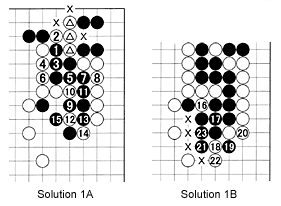
Solution 1A: The problem was whether Black will be able to capture the three marked white stones if he plays at 1. Notice that the white stones in question have three liberties, indicated by the X marks. The moves to white 4 are straightforward. Black 5 is the first move where you may stumble. Other likely problem areas are 7 and 10 (see References 1 and 2). White 6 constitutes another stumbling block (see Reference 3). Black 7 is the next move that might be missed--if you have another move in mind, see Reference 2.
Solution 1B: Along the way, there are some minor pitfalls, but the last problem is posed by black 23. Do not follow Reference 4. Thanks to the moves leading to black 23, Black finds himself with four liberties--marked by the crosses--against White's three liberties. No matter where White plays next, Black can win this capturing race by one move.
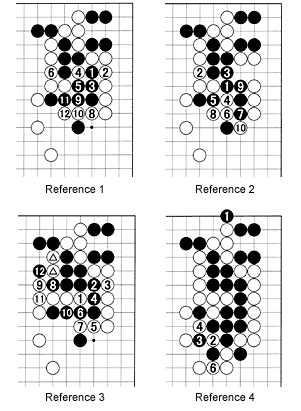
Reference 1: (Black plays 7 where he captured white 4.) Some players might be inclined to play at 1, because it is sente (White has to answer). And if White does so with 2, black 3 looks promising, but the throw-in of white 4 and 6 through 12 keep Black in atari and foil his escape.
Reference 2: Black 1 looks like a promising move, but white 2 and 4 spell problems for Black's liberties. Even black 5 and 7 cannot save Black. In the sequence to 10, he gets stuck with the short end.
Reference 3: White 1 is another way of keeping Black's liberties reduced to just two, and the moves through 7 accomplish the same goal--but black 8 before 10 is clever. White's stones are in atari now, and if he tries to save them with 11, black 12 captures the two marked white stones.
Reference 4: (Black 5 is played where 2 was captured.) Instead of black 23 in Solution 1B, black 1 looks like a strong move, as it reduces White's liberties immediately. However, the throw-in at 2 puts Black on the spot. He has no choice but to capture with 3. But white 4 puts the whole group in atari once more. Even if Black plays 5 to connect at 2, white 6 finishes Black off.
9x9 tournament
To celebrate the New Year, NHK broadcast a tournament featuring eight pros in their teens. For the tournament, a 9x9 board was used instead of the regular 19x19 board. Commentator Masaki Takemiya, 9-dan and winner of many titles, said it was hard to tell which version of the game was harder, especially since only 10 seconds were allowed per move, in addition to one minute twice for each player. The games are pieces of art, balancing intuition with fast reading for the best result and calculating total territories and prisoners for the ultimate outcome.
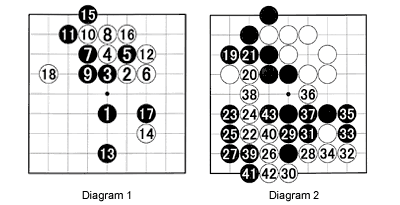
Diagram 1: Ko Iso, playing Black, was born in Taiwan 15 years ago and is a 2-dan at the Nihon Kiin now. His opponent is Taiki Seto, an 18-year-old 4-dan, who, with an impressive win-to-loss ratio, was considered the favorite to win the tournament.
Black immediately starts a fight with 3 and 5. White 6 looks OK, but after the exchange 7 through 12 that naturally follows, black 13 looks like a winning move. White 14 takes the empty corner, but black 17 threatens to completely seal off White's territory on the left side. If White passively answers, he will lose for sure. And even though it seems unreasonable, he invades with 18.
Diagram 2: Black naturally resists with 19 and 21. White 22 looks like it may make life in the corner, but Black answers perfectly with 23 through 27. White 28 and 30 are a hopeless final attempt. Instead of 32, White could have been more aggressive by extending to 33. This might have proven more tenacious (see Reference 5). After white 38, Black forces with 39 and 41, then finishes off White's group by connecting at 43. White resigns.
What is the status of Black's group in the lower left? (See Reference 6)
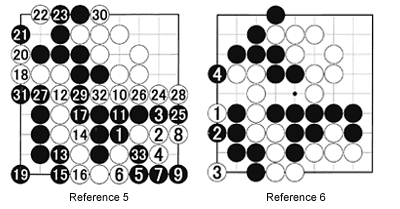
Reference 5: If White extends to 2, Black cannot cut at 33--White will just connect at 6 and black 33 cannot escape. He has to block at 3, and to keep White from getting two eyes, he must play all the moves through 9. However, even after White's cleverest moves, earning more liberties and forcing a capturing race with the large Black group that extends all through the board, in the end White loses by one liberty. The question is, if White had played more aggressively, would Black still, with just 10 seconds per move, have found the right answers at every turn?
Reference 6: White 1 and 3 look clever, but black 4 connects his groups.
Next week, we will resume our discussion on the 7-stone handicap.