
The leaning technique (***)
The more techniques and applications you learn, the stronger you get. When you get close to the shodan level, the leaning technique, or motare, becomes useful for making a leap into the world of solid dan players. The principle behind the technique is not difficult, but its application and timing can be problematic.In many cases, the leaning technique is similar to the splitting technique, in which one renders two or more groups of the opponent eyeless and chases them in the same direction in order to engineer a double attack. But the leaning attack technique uses the opponent's strength to reinforce one's position-the kind of philosophy underlining judo. If you are striving for the top rank, you should have both techniques under your belt.
Lean comfortably
The fastest way to learn how to use the technique is by example. Last week, there were two problems involving the leaning attack technique. Here are the solutions.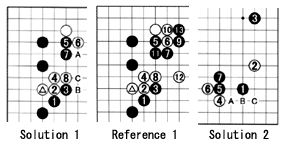
Reference 1 : Instead of black 7 above, Black has an even more audacious move at 7 in the diagram. This increases the pressure on the white group at the top. Under such perilous conditions, usually the best thing to do is to abandon your stones as quickly as possible. Any further resistance only adds to the burden, so escaping with 8 and 12 is essential, but Black gets more than adequate compensation through 13.
Solution 2 : Black 1 is put under pressure by white 2 and 4. Since black 3 is already in place, of the two white stones, white 2 is weaker. In order to attack it, leaning on the stronger white stone with 5 and 7 is a strong way of playing. White can now choose among A, B and C.
Continuation A : If white 8, black 9 is the only move. When White aims at cutting through with 10, Black defends with 11 and 13. White has managed to create two groups. The easiest way for Black is to settle himself with A, but B is a bold alternative when playing a game without a handicap.
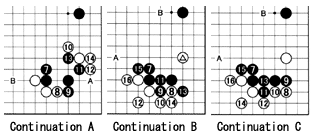
Continuation C : In response to white 8, Black can play at 11 immediately, which is the only move in an even game. But in a handicap game, black 9 is an acceptable move. The moves to 15 form a joseki. Black can now choose between A and B depending on the circumstances.
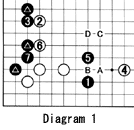 Diagram 1 : The leaning attack is a sophisticated kikashi (forcing move) sequence. When Black attacks with 1, White has many options, including defending in the corner, but if he decides he wants to attack, white 2 to gauge Black's response is an interesting move. Black will usually answer with 3. Now White attacks with 4 and, after black 5, plays out his second kikashi at 6. In most cases, Black will respond with 7. Now White can attack black 1 and 5 by exchanging A for B, then cap at C or D. In a way, White borrows the strength of the marked stones to strengthen himself, then reverses the role of attacker and defender.
Diagram 2 : This is the first game of the Kisei titlematch held this year with O Rissei on Black and Cho Chikun on White. The best way to study this game is by actually putting the stones on the board and following the action move by move.
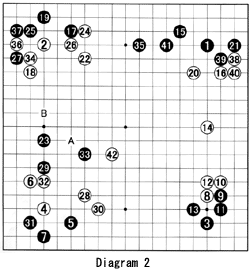 White builds a moyo on the right with 14, 16 and 20, while Black grabs territory. Next, White sets up a huge moyo on the right with 22. Invading with a move like black 23 seems forced. What would you do in this situation?
Most players would probably attack the invader directly with moves such as A or B. The problem is that the attack would quickly fizzle out with White not getting anything to show for it.
White 24 and 26 beautifully exemplify the principles of the leaning attack. White seems to gain nothing as Black smoothly swivels into the corner with 25 and 27. Next, White prepares to make the same shape again as on the upper edge. After white 30, Black dodges the attack again by jumping into the corner. White 32 is forced. Now black 33 looks well-timed. White 34 seems to be a slow move whereas black 35 takes actual territory. But as we finally come to 42, suddenly we realize that Black's stones around 23 are still weak, Black's corner territories (all four of them) are relatively small and White's center and right moyo are flourishing. In the end, White wins by 41/2 points.
Problems
Problem 1 : Using the principle we have just studied here, where should Black play next ?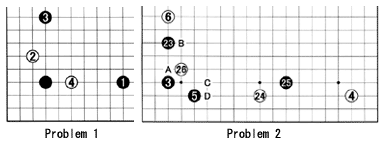
(The number of h indicates the difficulty level with one representing beginner and five the most advanced.)