
Get stronger at ko
Among weaker go players, nothing arouses more fear than a ko. How can one overcome this fear when a ko situation is about to occur ?First, a ko should be welcomed, not avoided. At least, it is an opportunity to learn something new. Second, before starting a ko, try to quantify its value. Third, before starting a ko, be aware of the number of ko threats and who captures the ko first.
This process will help you understand the situation. We will address these three aspects in the coming weeks.
Solution to last week problems
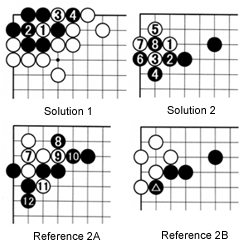 Solution 1 : Playing at 1 is a good move. Black needs to respond at 2, after which White can set up a ko with 3. Sure, Black captures the ko first which is an advantage, but White does not lose much in starting the ko.
Solution 2 : When Black plays atari at 6, White must play at 7 to start a ko. Of course, Black must capture with 8.
Reference 2A : White must not make the mistake of connecting at 7 instead of starting a ko. In the sequence to 12, capturing Black's corner is hopeless.
Reference 2B : In contrast to the ko in Solution 1, this is not a one-sided ko. If White has more ko threats, he may win the ko. This does not merely make his corner alive but also destroys any territory Black may have where his marked stone is. In addition, depending on the surrounding situation, all of Black's four stones may become a weak group.
Reference 2C : Of course, if Black wins the ko fight, there is no problem and Black secures a nice corner.
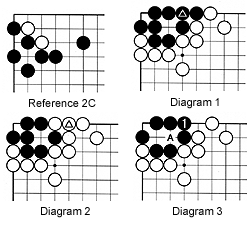 Diagram 1:-if White starts the ko in Solution 1 and he loses, exactly how much would he lose? This means that Black wins the ko and his last move will be the marked stone. Black has two points in territory plus two prisoners that he captured, a gain of four points.
Diagram 2: If White wins, this will be the final picture with the marked stone the last one played. That means, White has two points in territory plus seven dead black stones, seven points of territory after those stones have been removed, and one other prisoner taken to the left of the marked white stone. But he has lost one stone that was sacrificed as the very first move before the ko was started. That means White has gained 16 points.
Diagram 1:-if White starts the ko in Solution 1 and he loses, exactly how much would he lose? This means that Black wins the ko and his last move will be the marked stone. Black has two points in territory plus two prisoners that he captured, a gain of four points.
Diagram 2: If White wins, this will be the final picture with the marked stone the last one played. That means, White has two points in territory plus seven dead black stones, seven points of territory after those stones have been removed, and one other prisoner taken to the left of the marked white stone. But he has lost one stone that was sacrificed as the very first move before the ko was started. That means White has gained 16 points.
Diagram 3 : To avoid ko, Black must play at 1 (or A, but that would lose a point). Black would gain three points of territory.
Flower-viewing ko
In other words, if White starts the ko, he might lose one point (the difference between Diagram 1 and 3). But if he wins, he stands to gain 16 points plus three points (that Black does not get in Diagram 3) for a total of 19 points.The value of the ko is the sum of what Black would gain (16 points) and what White would gain (four points) as a result of the ko, minus the original investment of one point.
Even though, Black is the first to capture a stone, this ko is clearly favorable for White. This kind of ko is called hanami ko (flower-viewing ko).
Total value and value per move
So now we know the value of the ko, we can also look at the value per move. It takes two moves for White to capture the corner and gain 19 points. So that is only 9 1/2 points per move. Nothing to brag about. Many moves are worth far more than that in the middle game and early end game.Usually, the terms are not so favorable and both sides stand to lose something by starting a ko.

Problems
Problem 1 : Here Black has just played 1. White can capture the ko. He also has the luxury of being able to play elsewhere. How much is this ko worth and how much per move ?Problem 2 : With 1, Black starts a ko. First try to figure out what the value is of this ko. Then try to figure out how this ko would proceed. Finally, work out how many points is this worth per move?