
Go Training in Europe
Guo Juan, former 5-dan pro in China, who now holds Dutch citizenship, again won the European preliminaries of the Fujitsu World Championship held on Dec. 8, 9 and 10 in Amsterdam. Most of the top contenders, including Alexandr Dinnerstein and Catalin Taranu, 4-dan pro in Japan, and myself, were eliminated in the second or third round.This year, 10 people from around Europe had been invited to participate in training sessions giving by the top European players. Among the topics they studied were tsumego (problem-solving), visualization techniques and their broader application to the fuseki (beginning game), and basic rules on evaluation.
Taranu mentioned that it was important to choose a good instructor, someone whom one can trust and whose style one can understand. As go is not an exact science and professionals often offer conflicting opinions, it is not a good idea to hear conflicting opinions. It is far better to hear consistent views from one source.
Dinnerstein asserted that Korean go had evolved to such a high level that a game could be decided by move 10. This is a refreshing departure from the wishy-washy comments by some Japanese professionals and shows that strong convictions are a trademark for Korean players.
Losing with move 2
Takeo Kajiwara, 9-dan, is a Japanese professional who loves to spice up his game commentaries with strong views. I remember being strongly influenced by his book "The Direction of Play" when I was about 1-dan (amateur).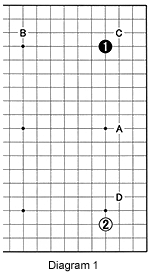 Diagram 1 : In his book, Kajiwara discusses the relative benefits of the standard opening moves. For example, Black is looking to expand in the direction of A and B, but is cautious as White can always invade at C while making a substantial territory in the corner. White 2 is a move that easily makes territory, by playing, for example, at D. Combining these two features, one can easily infer that white 2 is helping Black to make territory while preventing White from expanding. Therefore, Kajiwara calls white 2 a losing move.
Diagram 2 : Black should now play at 3. If White occupies the last empty corner, black 5 drives home the point that Black is expanding his own territory while preventing White from getting any himself. If White now plays at 6 to challenge Black in that corner, black 7 clearly shows Black is developing in the center while keeping pressure on white 2. At the same time, this move challenges the influence of white 4. Now visualize a black stone at A or B and you can imagine how bad the game already is for White. The reason for this bad position strongly points to white 2.
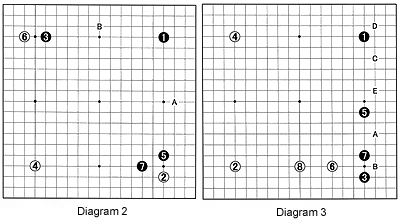
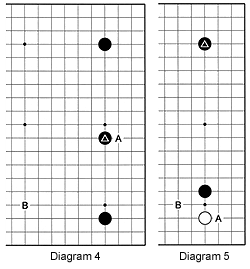 Diagram 4 : Therefore, in Korean go the high Chinese opening (shown here) has fallen out of favor unless Black can move around B, whereas the low Chinese opening, playing the marked stone one line to the right at A, still enjoys popularity.
Diagram 5 : In answer to a question by a young European player as to how she can become a professional, Satoru Kobayashi, one of the top 9-dans in Japan, countered with his own question: "In this situation, which would you prefer-A or B ?" Without hesitation she answered B. This was the "Correct" answer. A move at A is not wrong, it is just too local, emphasizing territory. Black B on the other hand, takes into account the placement of the marked black stone.
Answers to last week's problems
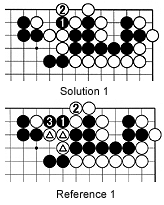 Solution 1 : After black 1, white 2 is the only move. The result is a ko.
Reference 1 : Although the ko is not very favorable for White (Black captures first), if White simply connects at 2, black 3 follows and White's three marked stones are captured. Now White gets nothing.
Solution 2 : In answer to the white marked stone, if Black plays his marked stone, the moves 1, 3 and 5 constitute a great tesuji (clever move locally) that turn the corner into a ko. After white 5, Black can play at the spot where the marked white stone was (that stone disappeared when Black played at 2). But now White can live with 7. Even the tesuji of 8 and 10 does not work.
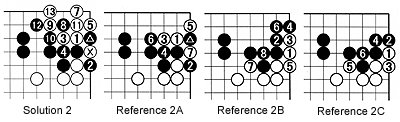
Reference 2B : If Black has few ko threats, he cannot play ko and has to submit with 2.
Reference 2C : On the other hand, if White has few ko threats, he cannot play ko and has to connect at 2. Now compare 2B and 2C and you will see there is a two-point difference. In some cases this can decide the outcome of the game. A ko then is the only solution for both parties.
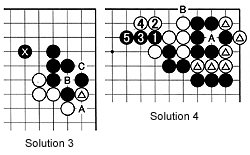 Solution 3 : After the marked white stone, Black plays the marked move and we get a truce. Unless one party has a huge surplus in large ko threats, usually this ko is not played. The reason? The investment is too large. Black can make a ko by playing at A but if he loses the ko (White plays at B) and White is able to connect below B, not only has Black lost his investment at A (a whole move) but White can now cut at C as well. Therefore Black doesn't want to start a ko even though it is a direct one for him.
If White starts the ko with B, Black ignores him. Next White can cut at C. Now we get the same kind of situation as above when Black cut at A and the same arguments apply. So White does not want to start the ko either as it is a two-stage ko. In the end, White probably will play at B and Black will connect at C. The value depends entirely on the surrounding circumstances, but no professional would try to calculate it-the investment is huge while the potential return is small.
Solution 4 : Instead of immediately starting a ko, Black should just cut at 1. The moves through 5 would follow. Black has now turned the ko into a problem for White. If White starts the ko with A, Black has an internal ko threat at B. Next, Black can recapture the ko. Now, White could lose not only the marked white stones but the entire corner. In effect, black 1 puts the burden of the ko squarely on White whereas Black has already gotten his compensation in advance (center influence).