Boshi-old hat for go-getters
Boshi, which literally means cap, and its counterpart tobi (jump) are useful means of gaining the upper hand in go. If you cannot make a base on the edge of the board by ensuring eye space, head for the center of the board before your opponent does and try to gain the upper hand there. The answers to last week's problems will help you understand what boshi and tobi mean.
Solutions to last week's problems
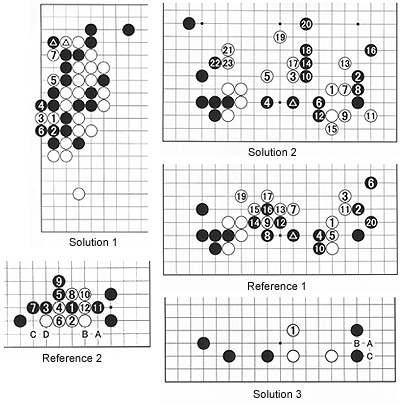
Solution 1 : White 1 and 3 are a fine combination. Black 4 would be disastrous as 5 is atari and 7 captures the entire side and corner. The exchange of the marked white stone for the marked black stone is necessary, because without it the 1-3 combination would not necessarily work. Wherever Black plays, White will capture the four black stones around 2.
Solution 2 : In a game between Koichi Kobayashi (Black) and Satoru Kobayashi for the Gosei title in 1992, the pattern shown here appeared.
A tobi at 1 makes miai (a situation where one option is as good as another) between a boshi at 3 or one at 2. Black decides that a boshi at 2 is would be more harmful, so he plays a tobi there. White 3 is another tobi and 5 is both a tobi and a boshi. Black's aim is the combination of 4, 6 and 10. But White runs to the corner and ensures life with the moves up to 15. In playing 17 through 23, White builds strength and creates eye-space in the center. The boshi of 3 slowed down Black to allow White to grab the corner. In the end, thought, Black cut through White's positions in the center and won the game.
Reference 1 : The players repeated part of the pattern in another game in the series. Kobayashi (White) decided to try 3 first before playing boshi at 7. This time, Black is forced to live on the inside while White gets the outside, giving him a good position. White won this game.
Solution 3 : White 1 is a good move. It reinforces his base and keeps an escape route to the center open. By strengthening his own stones without strengthening Black's stones, White will later be able to invade at A, followed by black B and white C, ensuring life in the corner. Also the lower left corner is not black territory yet.
Reference 2 : In contrast, if White ignores Black's thickness, Black could attack from underneath, stealing White's base, while making points (not shown). Alternatively, he could try to lock up White with moves such as 1 and 3. The moves to 12 are one example. Note A and C are miai, meaning that if Black plays one, White should play the other one. (Do not answer A with B and C with D.) So White is not in danger of dying, but Black has built up a terrific thickness in the center and his corner on the right is slightly stronger.
The follow-up
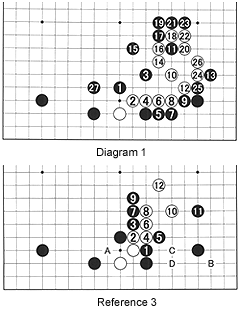 Diagram 1 : The moves to 1 are the sequence given last week as an example of boshi. Many people would assume White is dead. But there are worse things than dying locally, i.e. trying to live with an extremely weak group (1 stone in this case). How would you attack with Black if White tries to flee?After white 2, black 3 induces the moves to 10. Black has profited in the corner with 5 to 9, but now he plays another boshi. Black 17 allows White to live but after 27, Black's profit in the lower right corner is close to 25 points while his wall is fearsome and White is highly unlikely to win this game.
Reference 3 : A moves like black 1 is bad as it forces White to play a good move. This also applies to 3 and 5. After 11, White is out and Black is left with weaknesses at A, C and D and an invasion possibility at B. No one single move can take care of all problems in the lower right corner.

Reference 4 : Black 1 is an overplay-it leaves too many cuts behind. White first creates defects with 2 and 4, then cuts (note: no atari at 7!) with 6. In the sequence to 10, White is alive and immune to further harassment by Black.
Problems
Problem 1 (intermediate): Kisei titleholder O Rissei (Black) and Meijin titleholder Norimoto Yoda played this game to decide who would challenge Koichi Kobayashi for the Judan title. Yoda plays 1 because this area looks so big. Yoda later commented he should have played at A first to harass Black's marked stones before invading around 1.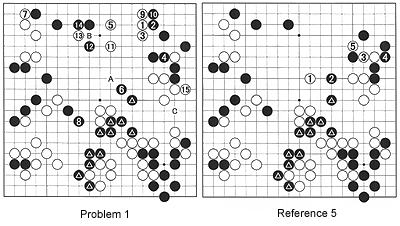
The moves to 5 seem natural, but now black 6 is a good move that takes care of the marked stones. White 7 takes care of another weak group while also putting pressure on the black stones to the right of 7. Building up more thickness with 8, Black starts to dominate the center. A boshi at 11 is a real possibility, so White plays tobi there himself. The same applies to black 12. White 13 is a probe. If black defends at B, which would weaken the white stones around 5, White would add a move to that group to defend it. As Black answers with 14, White switches to 15, an important move that prevents a black invasion at C. Where should Black play next ?
Reference 5 : White should play a move around 1. If Black plays a tobi at 2, White can start a fight with 3 and 5, in the hope of involving the marked black stones. There are plenty of other things White could do instead of 3 and 5, but exchanging 1 for 2 is essential to establish hegemony in the center for White.
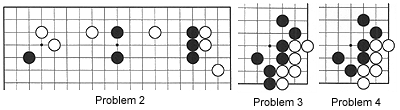
Problem 2 (beginners) : With just one move, Black can connect his stones, capture a white stone and make territory. Where should he play ?.
Problem 3 (beginners) : What move should Black make to attack the white group ?
Problem 4 (intermediate) : If you solve problem 3, how can White resist a similar balck attack ?