Tips from the Pros
Five top Japanese go professionals and I were invited to the Chunlan Cup tournament, about 250 kilometers from Shanghai, from Dec. 24 to 29. By Chinese counting rules, I lost my first-round game by half a point, although I would have won in Japan by the same margin. Four of the five Japanese players were eliminated in the second round. Only O Rissei will play in the quarterfinals next month. During the tournament, I had the opportunity to talk with O about his achievements in go. Asked for some tips, this is what he said:Think about go all the time. For example, have a concrete move in mind that seems to be a tesuji (excellent local move) and try to think of all its implications and the shape to which it applies. This will teach the weaknesses and strengths of shape.
O said his biggest step forward came when he stopped trying to win at all costs. Now he just tries to play the best move he can think of. This allows him to stop worrying before big matches and sleep well the night before.
Tsume go (solving life and death problems) is important because it saves a lot of time during actual games. It allows you to read variations faster and deeper, so that you may discover moves you might have not otherwise thought of.
Kikashi and nozoki
We will resume our discussion on kikashi (forcing move) and nozoki (literally, peek) by first looking at last week's problems.
Reference 1A : After the moves in the solution, White can exchange 1 for 2. Later he can aim at playing at 3. If Black now plays 4 to prevent White from connecting below 4, white 5 almost certainly keeps him alive in the corner. Black can capture the three marked stones with 6 and 8, but he loses more territory when White plays 9 and 11. Notice that Black's original answer (the marked stone) has become superfluous.
 In other words, the nozoki of 1 in the solution is on the outside while Black's answer at 2 is on the inside, doing nothing else but connect. The nozoki, therefore, is a successful kikashi.
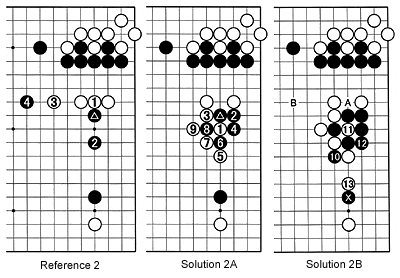
Reference 2 : White 1 looks obvious, but after black 2 and 4, he finds himself with a group whose sole function could be to take flight.
Solution 2A : White 1 is an interesting move that forces Black to add stones to his nozoki (marked stone). This means that White also will strengthen his stones. White 5 is a light move. Even if he does not want to, Black is almost forced to keep fighting, and this will continue to strengthen White's position.
Solution 2B : What happens after Black cuts at 10? Forcing Black to connect, White first gives atari then plays another light move with 13, destabilizing the marked black stone. White's stones are not in much danger as he can slip away at B while threatening to play A, a move that would split Black's groups.
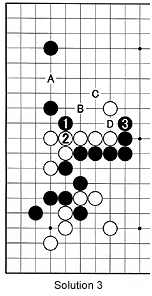
Solution 3 : Nozoki at 1 is probably best. White will almost certainly answer this, but then he would face black 3. In the ensuing battle, White would be handicapped with the cut at D, which makes a move in the neighborhood of A an overplay. On the other hand, defending against the cut with B or C is painful. It is clear that White's stones are under a strong attack.
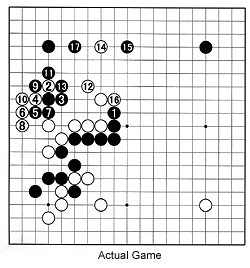
Actual Game : Black (Cho Chikun) immediately played 1 without nozoki. White grabbed his chance to counterattack with 2. Black 3 is almost forced now. In the ensuing sequence to 12, White manages to somehow give shape to his stones and get sente, enabling him to play at 14. Still 15 and 17 are strong moves that will give White a hard time. In the end, O Rissei won the game, successfully defending his Oza title.
Problems
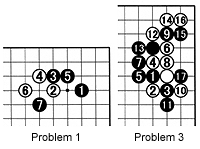
Problem 1 (Intermediate) : The moves 1 to 6 are a well-known joseki. Sometimes Black plays 7. Do you think this is a kikashi (forcing move) or is it aji-keshi (waste of potential) ?
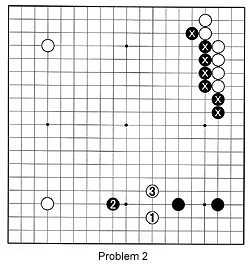
Problem 2 (Intermediate) : In this game between Keigo Yamashita (black), and Kikuyo Aoki, Black plays 2 to try to weaken the position of 1, in order to use the power of the wall of marked stones. White's answer at 3 is natural. How does Black attack ?
Problem 3 : (Advanced) I remember seeing this sequence once in a title match, and being struck by Black's cut at 17. Actually it is a wonderful kikashi. How does White respond ?