
Expectations and reality
When the Nasdaq stock market experienced a sudden drop two weeks ago, with 20-20 hindsight analysts blamed over-optimistic expectations by investors. When prices recovered analysts could explain these trends, too.Sometimes go is just as muddled and huge gaps can develop between how the players perceive the game and what it actually is. The board is so large that the total number of possible moves will cause most computers to crash. In go, therefore, we cannot possibly calculate what the best move is at every given point when the number of possibilities is so large. However in specific situations when we know what the outcome of a given position is going to be, we can calculate its merit.
This is even true when playing a ko although the value of every move, including the threat it poses, may be different. During the heat of a ko fight we often lose track of what we are doing at that moment, but let's try to remember that we are supposed to win the game, not just the battle.
Semeai and ko
During semeai (capturing race) ko often occur.Diagram 1: In this situation, White can make a clean capture, if it is his turn to move. However, what happens if it is Black's turn to move ?
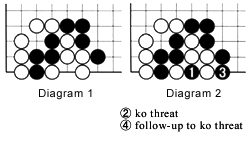 Diagram 2: Black 1 makes a ko by taking the white stone. Now White has to make a ko threat. If Black ignores this threat, he can capture four stones with 3. But now White can complete his ko threat with his next move. In effect, Black gets to play 1 and 3, while White can play 2 and 4 (not on the board), which might have a smaller, equal, or even a larger value.
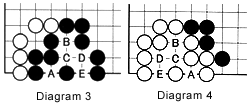 Diagram 3 shows the end result after black 3 in Diagram 2. Black's gain is five points (A through E) on the board in addition to the five stones he has captured. This makes a grand total of 10 points in favor of Black.
Diagram 4 shows a similar result if White wins the ko fight. White earns five points in territory (A through E) plus five points in captured stones for a grand total of 10 points.
Therefore, the difference between White winning the ko and Black winning it is 10 plus 10, meaning 20 points. When Black ignores White's ko threat at 2, he therefore gains 20 points by capturing with 3. At the same time, White's two consecutive moves elsewhere may be worth just as much or even more.
The reverse applies if Black decides to answer White's ko threat. Then it would be White who uses two moves to win the ko fight, and, in exchange, Black may make a ko threat and complete it. Consequently, even if one player loses the ko he will usually get some compensation, so not every ko fight is worth winning or even playing. Remember that it takes two moves to win a ko and so the yield per move is only half of the total. In this example, it is 10 points per move. This is true for direct ko fights.
But there are situations in which it takes more moves to win a ko.
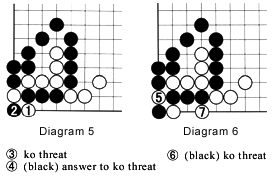
Diagram 6: Let's suppose White has a ko threat at 3, which Black answers with 4. White 5 takes back the ko. Next, it is Black's turn to make a ko threat with 6. Now, let's suppose that White ignores Black's threat and plays at 7. Ignoring a ko threat can be an enormous risk, but the situation has become a direct ko. And just like any other direct ko, the loser gets compensation by playing two moves elsewhere.
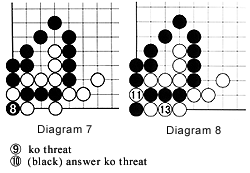
Now, how many points do you think the ko is worth locally? And, how points per move does that entail ?
Solutions to last week's problems:
Solution 1 to Problem 2: White 1 is the vital point. Due to the presence of the marked white stone, Black has to play 8 first before he can approach with 10. This forced delay for Black means White wins the semeai and captures the marked black stones. Reference 1: Taking away a liberty from the outside is usually a good tactic, but once Black makes an eye, after the tesuji of Black 4 and 6, White cannot play at A as he puts himself into atari.
Solution 2 to Problem 3: After white 1, black 2 puts White on the spot. In the sequence to 10, it has become a very unfavorable three-step ko for White.
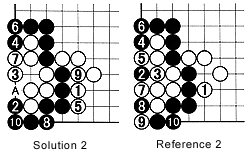 Reference 2: In contrast, if Black starts the semeai from the inside (or outside) with 2 (or 4), after white 3, Black has to approach from the inside, slowing him down. In the end, Black 10 is not even sente (move that must be answered), because he cannot play at A.