The European Go Congress and the American Go Congress will be held this summer, lasting two weeks and one week, respectively. Every year, 400 to 700 participants, ranging from absolute beginners to top players, take part in the EGC. I have participated the past 10 EGCs and I can assure you that it is great fun !
The last time I participated the congress, I met a father who gave his son in his mid-20s a lift to the EGC. He said during the drive, he became so intrigued that he decided to have a look at the congress. As a result, he stayed and decided to learn the game. He told me, through go he had got to know his son much better.
Handicap in golf and go
Why can golf be an interesting game for all parties involved? The answer is, of course, the handicap system that allows absolute beginners to play even with professionals.The same is true for go-it uses a handicap system that allows players of any strength to play, without changing the nature of the game. That means that even beginners can have a game with someone who has already played the game 10 or 100, or even 1,000 times. By increasing the handicap appropriately, the game becomes interesting for both players. When playing the "Capturing game," one way of setting the handicap is by requiring one party to capture only one stone while requiring the stronger party to capture two, three, four or even more stones. This system also works for children and it will motivate both players to do their best.
Play go with children ( use Diagrams 3 and 4 )
Even if you have just learned the capturing rule yourself, you can teach kids right away. To make it understandable to children, try the following two explanations, depending on the interest of the child.Version 1 : The marked white stone is a flower and the flower gets its water through the lines. If the lines get cut off, no water flows to the flower and it will die. On the other hand, if two flowers (stones) are connected, they get more water supply and therefore become stronger. However, even multiple flowers can lose their water supply and die.
Version 2 : The marked white stone is a car and the lines represent roads. Even though the "car" itself cannot be moved, it "Moves" by connecting to other cars. However, when all roads get blocked, one car or multiple cars have to be taken off the road.
Kids as young as 3 or 4 years old can pickup these ideas quickly.
Saving stones: One at a time
As thrilling as capturing a stone is, it feels as good to save one. Last week we briefly talked about stones that are connected and those that are cut.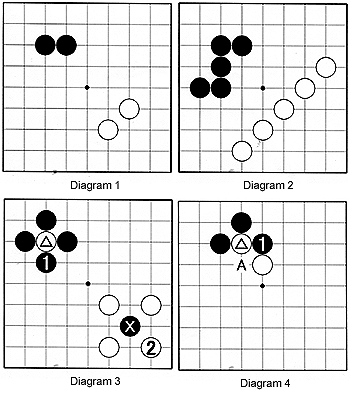
Diagram 1 : The black stones are connected through the lines, but the white ones are not.
Diagram 2 : The same is true here-the black stones are all connected, but none of the white stones is connected, and they can be cut in theory.
Diagram 3 : Black 1 takes away the last liberty of the marked white stone and is taken off the board. However white 2 does not take away a liberty of the marked black stone. In fact, this black stone has all of its four liberties left.
Diagram 4 : If you understand the previous diagrams, you can also understand that black 1 takes away the next to last liberty of the marked white stone. The last remaining liberty is at A.
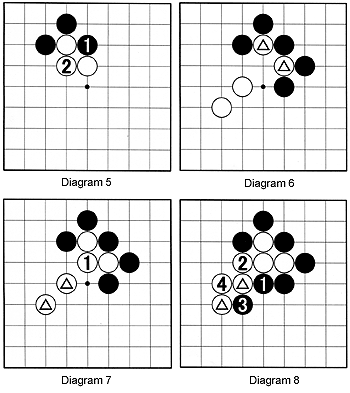
Diagram 5 : Therefore, it is clear that in order to save that stone, in response to black 1, White should play at 2.
Diagram 6 : The two marked white stones are in trouble. Fortunately, on his next turn, White can save them.
Diagram 7 : White 1 saves the two white stones and links them to the two marked stones. That is to say, they are not physically connected yet, but it is impossible for Black to split them.
Diagram 8 : For example, Black may threaten the three stones by playing at 1 but white can then connect with 2. Once again, Black may try cutting the white stones, but white 4 solidly connects all of his stones. Solutions to last week's problems
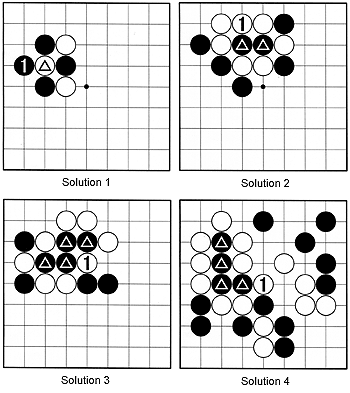
Solution 1 : Black 1 takes away the last liberty of the marked white stone and captures it-it is taken off the board.
Solution 2 : White 1 takes away the last liberty of the two marked black stones and captures them-the stones are taken off the board.
Solution 3 : White 1 takes away the last liberty of the four marked black stones and captures them-the stones are taken off the board.
Solution 4 : White 1 takes away the last liberty of the four marked black stones and captures them-the stones are taken off the board.
New problems
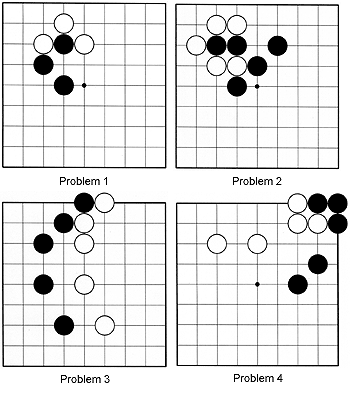
Problem 1 : Black to play and save a stone.Problem 2 : Black to play and save two stones.
Problem 3 : Black to play and save a stone.
Problem 4 : Black to play and save some stones.