
What do fashion designers, investors, housekeepers, army generals, vacationers and game players have in common? They all have to think and plan ahead. And to do this effectively, the most important thing is to break up many decisions into separate steps, hope for the best and plan for the worst and plan one step at a time. It seems that most of these people do useful things, but what about game players ? Why play games at all? Aren't they useless and removed from real life ?

Games prepare us for real-life situations while providing simulations that help us develop our ability to perform certain tasks. And arguably, the most important skills you can develop by playing games are anticipating and planning ahead, memory and motor skills and creativity. Pedagogic games are used as a standard tool to develop the minds of newborns to the most elderly people. In fact, games played by two or more people may improve communication and cooperation skills as well. However, the word "game" often carries a certain stigma.

To organize and promote games like go, chess, checkers, bridge, as well as memory games, an umbrella organization uses the word "mind sports" and appropriately calls itself the MSO, or Mind Sports Organization. It has a fabulous Web site (www.msoworld.com) that lists all its activities, including championship games and worldwide branches. The Japanese branch is organizing a mind sports event to be held on July 28 and 29 at the International Forum Building in Yurakucho, Tokyo.

More locally, the Banyu Inryoku, based in Shinjuku Ward, Tokyo, has been active for several years now and organizes several game parties each year. To counter purportedly bad social influences, especially among youngsters, the organization will focus more on spreading mind sports targeting young people. Banyu Inryoku also believes mind sports are a vehicle to promote friendship with foreign residents in Japan. The secretariat is run by Mrs. Kondo from her Cosmo game club, which houses several mind sports, including go, Othello, renju, shogi, etc. The telephone number is (03) 3205-1746 (Japanese only).

Atari-The last liberty

Before a stone is actually captured, there are several signs showing how healthy it is, like its number of liberties or the number of liberties of the surrounding enemy stones. And recognizing how many liberties a stone (or group of stones) has is the key to knowing how to handle that stone.

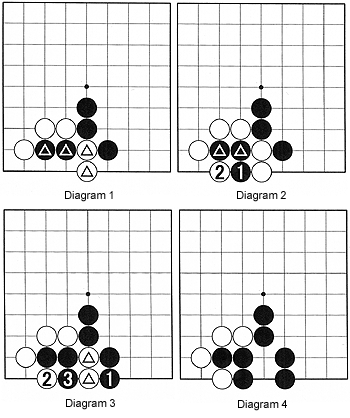
Diagram 1 : In this situation, it is Black's turn. Both the two marked white stones as well as the two marked black stones seem to be in trouble as they have only two liberties each.
dia1-4
Diagram 2 : Black 1 is wrong. Yes, it does take away one liberty of the white stones, but it also takes away a liberty of the marked black stones as well. Now Black's stones are down to their last liberty-we call this situation "atari." So, Black has put himself in atari. And White can take away Black's last liberty and capture the three stones (black 1 and the two marked stones).

Diagram 3 : What about black 1 in this diagram ? It puts the marked white stones in atari but does not endanger Black's own stones. Even if White plays at 2 now, black 3 takes away the last liberty of the two marked white stones and takes those two white stones off the board.

Diagram 4 : So when Black plays at 3 in the previous diagram, he physically takes away the two white stones. The situation is now as shown here.

Remember the first technical rule: A stone or group of stones without liberties cannot exist.

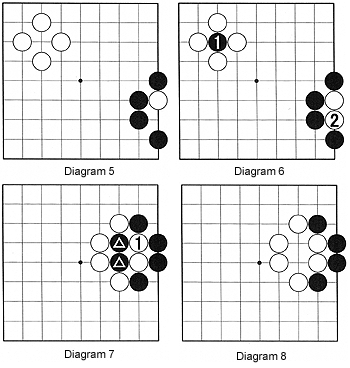
Diagram 5 : For example in these two situations.......
dia5-8
Diagram 6 : (Illegal) Black is not allowed to play at 1 because that would be suicide. Even though there are situations in which suicide would give an overall advantage, it is illegal according to Japanese rules (although it is legal under rules in other countries). Likewise, White is not permitted to play at 2 for the same reason.

Diagram 7 : (Legal) However, this is a completely different case from the previous two diagrams. White 1 is not suicide because the two marked black stones are in atari and this move takes away their last liberty. The move has not been completed yet though.

Diagram 8 : Now the move made by white 1 in the previous diagram is finished-the two black stones have been taken off the board. As you can see now, white 1 was not suicide after all; rather, it freed the stone below it.

Solutions to last week's problems

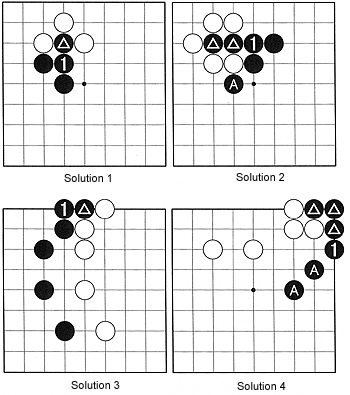
Solution 1 : Black 1 is correct-it saves the marked black stones by connecting it to the other two black stones.
sol1-4
Solution 2 : Black 1 saves the two marked black stones by connecting them to two other stones. Be aware, though, that black A is not connected to Black's main group yet.

Solution 3 : By playing at 1, Black saves his marked stone and connects it to another stone.

Solution 4 : Black 1 saves the three marked black stones by (more or less) connecting them to the two black stones marked A.

New problems

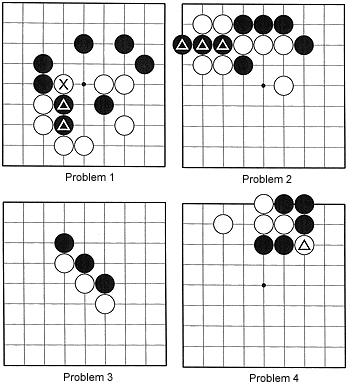
Problem 1 : Both the marked black and the marked white stones are cut off from their main groups. It is Black's move. He can put the white stone in atari and capture it while saving his own marked stones. How ?
prob1-4
Problem 2 : Black's marked stones seem to be in trouble. Fortunately, it is Black's turn. By putting some white stones in atari he can save his stones. How ?

Problem 3 : Black can capture one stone by putting two stones in atari. How does Black do this ?

Problem 4 : White just cut with the marked stone. Black can now capture some stones by playing atari. Which is the correct atari ?

By Richard Bozulich

By Rob van Zeijst

  1. How to teach go
  2. The last rule--ko
  3. Basic strategy of go
  4. Go as a second language
  5. Building castles
  6. The secrets of the lazy
  7. Don't mistake movement for action !
  8. Madmen and common sense
  9. Breaking down the borders
  10. Go the 4th R in school curriculum
  11. Go an educational tool
  12. Mixed-doubles go
  13. Problems and answers
  14. The answer is in the doing
  15. Upsetting common sense
  16. Believing is winning
  17. The art of tenuki
  18. Classification and association
  19. Being in good shape
  20. Keeping in shape
  21. Games of Culture
  22. Deduction and Induction
  23. Asking the right questions
  24. War or peace ?
  25. Avoid simple solutions
  26. The master player
  27. The Ing Memorial Cup in Europe
  28. new ruler on the Kisei Throne
  29. Expectations and reality
  30. Quantity or quality ?
  31. Fujitsu Cup
  32. A Slip of the mind
  33. Losing your bonus
  34. Get out of that groove
  35. New lease on life
  36. Games people play
  37. Changing your mind
  38. Pick your fight
  39. Sanrensei-Part II
  40. Invasion tactics
  41. sanrensei strategy
  42. JAL Cup World Amateur Go Championship
  43. The Honinbo Title: Up for grabs
  44. O Meien becomes new Honinbo
  45. Rote memory vs calculation
  46. The problem with go
  47. The art of stealth
  48. Keep your options open
  49. Where Zen and go meet
  50. Think globally, sacrifice locally
  51. Yamashita the new Gosei king
  52. Toughing it out
  53. The leaning technique
  54. Learning by example
  55. Proverbs guide your hand
  56. Yoda, the new hero
  57. Young turk wars
  58. Evolving game
  59. Solution to last week's problem
  60. Every move is a new board situation
  61. King of ko
  62. Get stronger at ko
  63. Solutions to last week's problems
  64. Answers to last week's problems
  65. Go Training in Europe
  66. Kikashi and Nozoki
  67. Tips from the Pros
  68. Applying the theory
  69. Answers to last week's problems
  70. More on honte
  71. Aggressive players know boshi
  72. Boshi-old hat for go-getters
  73. Boshi-erasing influence
  74. Rui Naiwei-top woman player
  75. last week's problems
  76. Making the connection
  77. More connections
  78. professionals use connections
  79. Solutions to last week's problems
  80. Sometimes a person might wonder
  81. Solutions to last week's problems
  82. Solutions to last week's problems
  83. Guidelines for explaining the game
  84. Handicap in golf and go
  85. Atari-The last liberty
  86. The second technical rule
  87. Concept of territory
  88. The Concept of Life
  89. Mine is bigger than yours
  90. Third line vs fourth line
  91. How low can we go ?
  92. Wariuchi
  93. Changing your perspective
  94. Solution to last week's problems
  95. O Meien defends Honinbo title
  96. O Meien retains his title
  97. Thickness-a hard issue
  98. Upping the ante
  99. Look and understand-cutting is zilch
  100. Bad style vs good style
  101. Solutions and references
  102. In go, most people have,,,,
  103. Two eyes