In general, problems are recognizable by the the way they affect situations. But by this point, it is usually too late to do anything about them. The best way to recognize problems is by imagining all of the effects of a given situation before they become problems. The best way to do this is through visualization, for example, by imagining a situation that is likely to occur and then judging its desirability. In go, we get a lot of help from the board in front of us and the stones that are already there. Regularly visualizing not only your move, but also your opponent's will do wonders for your playing ability.
Everyone says practice makes perfect, but this phrase is only a half-truth. In fact, if you practice the wrong moves, you will improve strategies that may not be the right ones to use in given situations. What we have to focus on then, is distinguishing right from wrong, or truth from fantasy. To make things even more complicated, the truth isn't always visible and because of this, it is often an interpretation of recognized problems and how they are solved. This brings us back to the original question, because solving a problem only changes that problem. In chess and go, this means you beat opponents until you find one you can't beat. In the office it means you get promoted until you reach a position you can't handle.
O Meien retains his title
It took O Meien seven games to finally overcome the 21-year-old Cho U in the first defense of his Honinbo title, which had a purse of 32 million yen at stake. Both players were born in Taiwan and came to Japan at very young ages to sharpen their go skills.The game clearly illustrates that a solid reading and a good sense for both creating and solving problems results in victory.
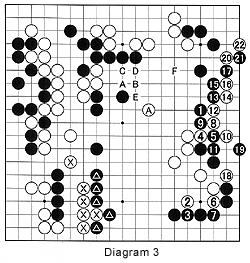 Diagram 3 : This is a continuation of the game we started last week. White's last move was A-he is trying to strengthen his group in the lower right while aiming to cut with white A, black B, white C, black D, white E. However, Black can simply connect his stones with F. Black doesn't need to worry about his stones in the center, because thanks to the exchange of the marked black stones for the marked white stones, Black gave up four stones but gained tremendous strength in the center. In short, White (A) was an empty threat. See Solution 1 for the correct move.
However, although it was moving in the right direction, black 1 wasn't exactly correct either-see Solution 2 for the correct move.
White creates a living group by moving to 18 as he can survive easily. However, he then goes on to extract more blood, which in turns angers Black, who then does something incredible. It should also be noted that Black throughout the game had been feeling he had fallen behind and therefore had been on the lookout for a way to suddenly move the game in his favor-it was that way of thinking, in addition to O Meien's attempt to scoop out Black's entire territory on the right, that caused Cho U to play his next move.
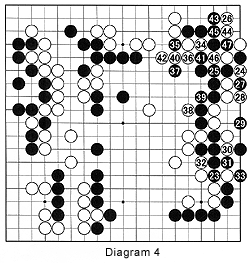 Diagram 4 : The move is Black 23-it attempts to capture all of White's stones without compensation-this is also called mochikomi. A prerequisite for this move is that Cho must have read all of the possible variations after this move, including the semeai (capturing race) in the upper right corner later on. But did he really ?
The moves to 29 are forced. Next, White throws in a few kikashi (forcing moves) with 30 and 32, and later 38. But 34 decides the outcome of the game. Black 35 and 37 are clever forcing moves, but after White finally cuts with 46, the semeai in the upper right is all that counts.
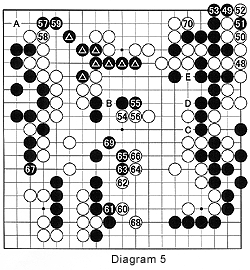 Diagram 5 : After the sequence to 53, the upper right corner is a multistep ko. For example, White needs to make approaching moves and in the process, ignore ko threats by Black. In other words, this ko in itself is unfavorable for White. However, it is a like a time bomb-White can start the ko anytime and accordingly, Black has to watch his every step. But that means Black has one hand tied behind his back and can't risk any full-fledged fights. White takes full advantage of this with 54 (incidentally, this turns white A in Diagram 3 into a good move). Black is handicapped by a possible shortage of liberties at C, D, and E and the cut at B. Black 57 and 59 make miai of connecting around B and linking up with A. Then White goes on to attack the formerly strong group on the lower edge with 60 to 68, then finally drives Black into the corner by starting the ko with 70-it is still a two-step ko-but Black can't afford to lose it. Even though the game is not over yet, there is no way Black can stand up against the pressure for long-he manages to draw out the game a little longer, but is forced to resign 70 moves later.
O Meien ultimately showed that he is worthy of being the Honinbo for another year.
Solution 1 : White 1 and 3 are thick. Even though Black takes territory with 2 and 4, White can now fight and he already has enough points.
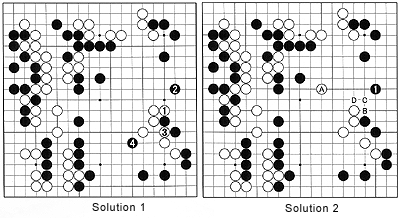
Solution 2 : After White (A), Black should play at 1 to take all the territory on the right. Alternatively, he could play at B. If White plays at C, the cut at D will seem like more than White can handle.
New Problems
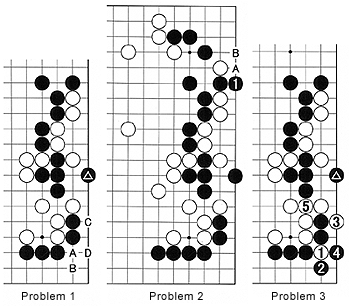
The problems here look like they are from a book, but they really happened in the game shown hereProblem 1 : Black played 19 in Diagram 3-this is the marked stone in this diagram. If we presume Black will answer white A, black B and white C by black D, how can White live ?
Problem 2 : White just played tsuke. In the game, Black played at A, which was followed by white B. However, what happens if Black is at one ?
Problem 3 : After Black played the marked stone, White could have exchanged one to four then connect at five. How does Black respond ?