
Rote memory vs calculation
With computers doing most of our memory work, we can devote ourselves to thinking. Although we can appreciate the ability of the computer to store information, let us not forget that individual skill, deception and dogged fighting spirit are essential in winning battles.These days the emphasis in go is on the opening game, or fuseki. For many years, the Japanese dictated how go was to be played. But in the last few years, South Korean and Chinese go players seem to have taken over. Why is this ? I believe that contemporary Japanese go relies too much on rote learning of the fuseki while forsaking the skills mentioned above. Lately, though, the tide seems to be turning.
Let us look at a game played more than 300 years ago that supposedly lacks insight into the fuseki but has all the other aspects of a good battle.
Appreciating the old masters
Honinbo Dosaku (1645-1702) changed his name from Yamazaki to Dosaku upon becoming head of the senior of the four famous go families: Honinbo, Yasui, Inoue and Hayashi. In 1678, he also became the fourth Meijin, a title awarded in former days to those who reached 9-dan. He was known as "Go Saint" because he was at least one stone stronger than anyone else. Meijin is the title of an annual tournament, but in bygone days it was an accolade bestowed only on the top player of the day. Dosaku is acknowledged as the best of the 10 players who have received the Meijin title.This is a game between Honinbo Dosaku (White) and Shunchi Yasui (Black, 2-stone handicap), played on Nov. 19, 1683, in Edo Castle.
Diagram 1: As the weaker player, Yasui always played Black in his games with Dosaku. But he also took a two-stone handicap in every third game.
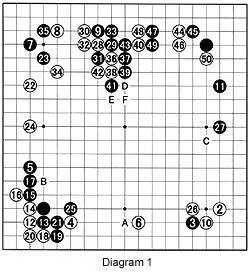 With 4 and 6, White ignores the empty upper lefthand corner. Nowadays, empty corners are occupied first, but in those days it was not rare to see games in which empty corners were ignored completely.
Black 5 is thought of as a weak move these days but was a standard move then. Nowadays, we would prefer pincering at A or defending with B.
Again with 10, White treats his stone at 8 as a kikashi, or favorable exchange, and switches elsewhere.
Black 15 should have been at 1 in Reference 1. The sequence to 11 gives Black a better shape.
Again ignoring 8, white 22 and 24 make a base and threaten to attack the black stones in the lower left corner, leaving Black with no choice but to defend with 25.
White gets sente to switch to 26.
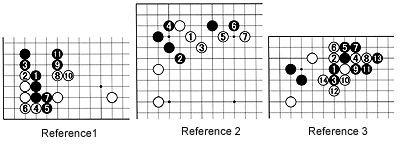
White 28 is a powerful fighting move. Instead of this, he could have opted for 1 and 3 in Reference 2. These are simple moves that make miai of sliding into the corner and, if Black defends with 4, pressing down with 5. If Black defends with 6, White would play 7, another fighting move.
Black 29 is a good quiet move. Cutting with 1 in Reference 3 would mean trouble. White would cut with 2. Black 3 is usually a good tactic in cases like this. But the result to 14 is bad for Black.
Instead of 31, Black should have played at 33.
After exchanging 34 for 35, cutting with white 36 is a powerful strategy.
Black 39 shows he is willing to sacrifice 31, but white 40 is an excellent counter-it is a declaration of war. If White plays at 41 instead, Black would keep on pushing at D, after which White virtually has to answer at E, followed by another Black push at F. As Black keeps pushing, it becomes more and more difficult for White to invade the upper right corner and to keep fighting in the center.
Black 45, 47 and 49 are strong moves that show that the skills of players 300 years ago were on a par with players nowadays. A fight erupts that leads to a huge ko.
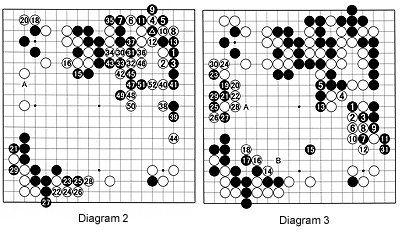
Black 21 has been the focus of a dispute for generations. Was it a brilliant move or a slip ? The brilliance of the move does not appear until about 50 moves later when Black plays at A, but few believe Yasui could have foreseen this so far ahead. Whatever the truth, White decided to spread confusion by switching to 22 and sacrificing his corner stones. Black 27 forces White to defend with 28, after wh ich Black captures the corner. White now has sente and starts a brilliant sequence with 30 to free his group in the upper right corner and eventually connect it to the lower right while making territory and building influence. White 48 is the noteworthy nose-tesuji and so is white 52.
Diagram 3: Black 1 and 3 enable the tesuji of 7 and 9. White is unable to resist by descending at 11 instead of 10. Black 11 forces white 12 and leaves 31 for later-a move that wraps up the game. After black 13, White could have switched to A to take any aji away, but Black would play at B building thickness. Black now strikes at 19, which is a very clever move. The book "Appreciating Famous Games" by Shuzo Ohira, 9-dan, looks at this situation in depth, spending some 10 lengthy diagrams on it. One of the variations contains a interesting puzzle (Problem 1). In the game, Black gets to play 31 and goes on to win by a mere one point. There is a custom nowadays to call a two-stone handicap game you lose by one point, your lifetime masterpiece-it comes from this game.
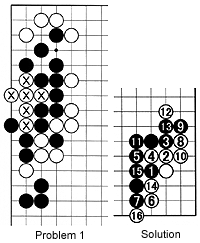 Problem 1: Black to play first and capture the marked white stones.