A Slip of the mind (**-*****)
When one begins to live by habit and by quotation, one has begun to stop living.(-James BaldwinU.S. author.)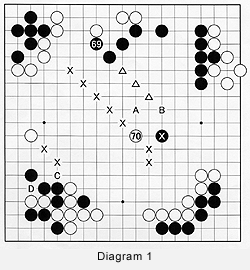 It is astonishing how well habits and automatic responses can help you. When walking or driving, you automatically stop in the face of danger. When you hear an unfamiliar noise, you automatically look in the direction where the sound originated. When crossing the road, you automatically look left, right, and left again. Hang on: in Japan this should be the other way around because traffic drives on the left side of the road.
This is just one instance in which your habits can play tricks on you. Especially in unfamiliar situations, the habits you have formed over the years and that are meant to protect you from danger, can become life-threatening in some cases. But in most cases, our habits only impair our ability to improve. In other words: If they are not useful in a specific situation, habits can be limiting.
Below is the second part of a game I played in which bad habits contributed to a loss. (White is Chang Hsu, 6-dan pro and 20 years old.)
Misguided conceptions II
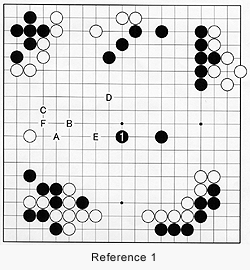 Diagram 1: Black 69 is a mistake. In itself, it is not a bad move, but the assumption behind it is wrong. During the game, I just took it for granted that White was going to answer the move locally because of the size of the threat. But when White plays at 70 (part A of the solution to last week's Problem 1), suddenly the landscape changes. With one move, the balance of power in the center shifts in White's favor. White can now exchange A for black B and C for black D. The borders of White's moyo (sphere of influence) now extend along the X's, while Black's moyo is limited to the triangles.
Compare this to black 1 (part B of the solution to last week's Problem 1) in Reference 1, in which Black takes control of the center, expanding his own center moyo while limiting White's potential in the lower left part of the center. If White now plays at A, black B is a good move, which again expands his own potential while limiting White's, while threatening C later. Alternatively White could play at D, which Black could answer by leisurely playing at E or more severely counter with a shoulder hit at F. Wherever White plays, it is evident that Black has the initiative.
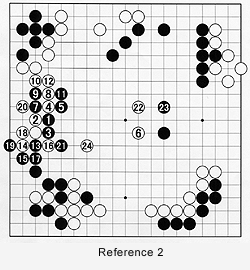 Reference 2: During the game I also had in mind the sequence black 1 to black 5, which I thought would be answered locally as well. But again white 6 appears to be the vital point. The moves to 21 seem to be the best Black can do, but exchanging white 22 for black 23, then playing around 24 look like a good counterstrategy for White.
Diagram 2: After making forcing moves with 71 and 73-worth at least 15 points, while enabling the cut at B-black 75 is a good move, but Black should have played 77 at 78. However, Black was too concerned with the threat of playing at A (cutting at B next is severe). Yet again Black takes for granted that White will answer at A-the same mistake as when he played 69. White 82 cannot be ignored (Black has to answer with 83) and White takes the vital point with 84. Black 85 was meant to strengthen the center to enable the combination of 89 and 91. But after White calmly 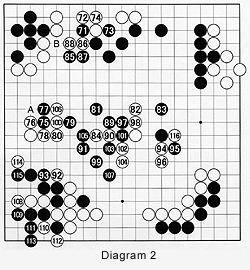 responded with 86 and 88 I had misgivings about this exchange, because the threat of A has now disappeared altogether. Black found a good combination in the center capturing two stones, but White 94 and 96 were large, too. When White captured two stones on the left side with 100 and 106, and then cut at 116, White was fairly sure of winning. In a complicated and hairy fight on the left side, Black managed to almost come back into the game but in the end Black's center group died.
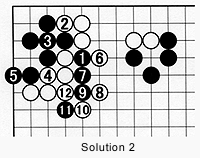
Solution to last week's Problem 2: If Black cuts at 1, White first exchanges 2 for 3, then threatens to kill Black's corner with 4, forcing Black to answer with 5. Finally, white 6 and 8 catch the black cutting stone in a geta (net).
Below are some more problems involving geta.
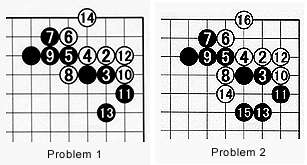
 Problem 1: Black has just played 1 somewhere else (not shown on the board) and White invades with 2. The sequence shown here is a common joseki. How does Black capture the white stone at 8 ?
Problem 2: Instead of immediately playing at 14, White can, depending on the local situation, sometimes, exchange 14 for 15 and then come back and defend the corner with 16. The question is, can Black catch the two white cutting stones 8 and 14 ?
Problem 3: If the answer is yes, White will lose two stones instead of one (as in Problem 1). Why would White then want to exchange white 14 for black 15?
Problem 4: If the answer is no, what are the best moves for both players ?