Mine is bigger than yours
Ever heard of get-rich-quick schemes in which you are promised hundredfold gains from minimum investments? What about risky high-leveraged investments? Since stock market crashes have been heard thundering around the world, most people have lost their appetite for high-risk, high-return games.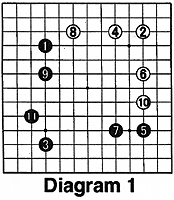
Would you say "no" to a get-rich-slowly approach ? It's more like real life. First, you get an education or a skill-a kind of base-on which to capitalize. Next you save some money, here and there, and put your savings into reasonably safe investments. Then you wait while you work and then wait some more, and voila you're on your way.
In go, the concept is similar-first you stake out base positions. Next, you use those positions to capitalize, and when you have a strong enough position you become conservative and protect; if not, you have to be less conservative and fight. But in general, go is a game where one gets rich, or poor, slowly in an extended series of battles that are going on simultaneously. But the battle is not purely for the purpose of fighting-although that is perfectly OK, too. And if you lose one battle, don't despair-just start another. But remember one thing: Before starting a battle, get into a position in which you can win.
The opening
Because there is very little space on a 9x9 board to practice the opening, let's go to the next level-a 13x13 board. Even though we will eventually play on a 19x19 board, this 13x13 board will help us get an understanding of strategy while not becoming overwhelmed by sheer space.Diagram 1 : Who is better off in this opening: Black or White ?
I hope you think it is Black because that makes the explanation a lot simpler.
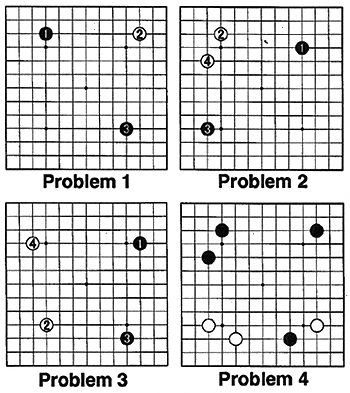
Problem 1 : Where should White play his next move? (There is more than one correct answer.)
Problem 2 : Where should Black play ? (There is more than one correct answer.)
Problem 3 : Where should Black play ? (There is more than one correct answer.)
Problem 4 : Where should White play ?

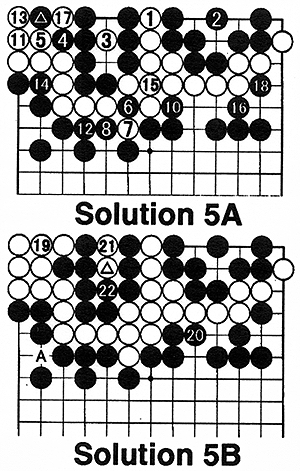
Problem 5 : This is a life and death problem. White's group is not alive yet as he has no eyes but Black has a weakness-where should White play next ?
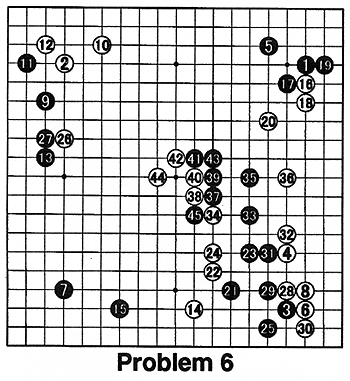
Problem 6 (Advanced players) : This is the third game from the match in which U Cho, who had just turned 21, challenged O Meien (White) for the Honinbo title as the youngest challenger ever. By winning this third game, U Cho took the lead 2-1. Look at the opening-usually the corners are occupied first, but O Meien immediately starts aggressive maneuvers with 4, then 6. Black keeps his cool and quietly takes the empty corner. Black 9 is the greatest distance between stones on the third or fourth line, so this is the biggest move. White 14 tries to capture 3 on a large scale. Black 15 keeps that scale limited and threatens to move out his stone at 3. White 16 to 20 again go for scale enlargement. Black 21 draws out his single stone while attacking white 14-now have another look at black 15. This move weakens white 14 in that this white stone cannot make a comfortable base on the edge. Up to white 44, White tries to establish hegemony in the center, but black 45 is a severe cut. How to answer this move ?
Solution 1 : Obviously, playing in the remaining empty corner is best, e.g. at 4, although A, B and (to a lesser extent), C are good moves too.
Solution 2 : Black wants to occupy the empty corner with 5 (or A through C).
Solution 3 : Black wants to make an approach to the upper-left corner for a variety of reasons:
A) It is an extension from the marked black stone
B) It limits the influence of the marked white stone
C) The distance between the opposing stones is the greatest on the board-seven spaces between the marked black and white stone-therefore this area is the largest.
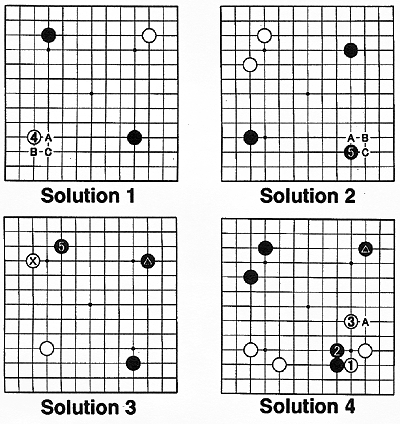
Solution 4 : White 1 is good because, while making a base for himself, White prevents Black from making a base in the corner. To prevent himself from being locked up and even captured, when Black sticks his head out into the center with 2. White then plays 3.
A) This move isolates Black's entire group from the marked black stone
B) It avoids being locked up in the corner
C) It attacks Black's two stones.
Solution 5A : White 1 splits Black's two surrounding groups. Now Black can either make two eyes with his group on the right or the one on the left. If he decides to save the group on the right by playing at 2, White can next kill the group on the left by playing at 3. Black 4 threatens to make an extra eye, but white 5 makes the eye false, i.e. eventually White can capture the marked black stone. Black 6 and 8 are a clever combination that takes away one extra liberty of the white group-White connects with 9 (not shown) at the point where black 6 was. The capturing race, or semeai, continues, but.......
Solution 5B : After first capturing the marked stone in the previous diagram with 17, he now has time to fill it with 19. Even if Black keeps attacking with 20, white 21 puts the black stones in atari, Black captures two stones with 22, but White comes back at the point where the marked white stone was. Black could also try to keep struggling by fighting the ko at 19 if he has ko threats, but White has at least one ko threat at A and will win any kind of ko fight.
But, of course, the best way to get better is still by practicing.