
Guidelines for explaining the game
A first impression often leads to a long-standing opinion on the person or the subject in question, and this is no different when demonstrating the game of go to someone for the first time. Easy as the rules are, it is difficult to give a straightforward explanation of them. Often people get bogged down in unimportant specifics and sidetracked by insignificant facts that have little to do with what the beginner needs to know.To keep things simple, do not offer too much information. You should start to explain a little more, only when asked specific questions. But even then, try to keep the explanation simple and explain only one new concept or idea at any one time. Ideally, one session should last between one and two hours.
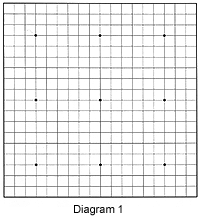 Go is usually played on a 19 x 19 grid, or board, resulting in 361 intersections on which the stones are placed.
Diagram 1 shows an empty 19 x 19 board. Note the nine marked points on the board. These points are called the "star points." They serve both as points of reference and as markers on which stones are placed in handicap games. Although most go games are played on a 19 x 19 board, beginners often learn the game on a 9 x 9 board with 81 intersections. After a few games they move up to the 13 x 13 board, before graduating to the standard 19 x 19 board.
Go is usually played on a 19 x 19 grid, or board, resulting in 361 intersections on which the stones are placed.
Diagram 1 shows an empty 19 x 19 board. Note the nine marked points on the board. These points are called the "star points." They serve both as points of reference and as markers on which stones are placed in handicap games. Although most go games are played on a 19 x 19 board, beginners often learn the game on a 9 x 9 board with 81 intersections. After a few games they move up to the 13 x 13 board, before graduating to the standard 19 x 19 board.
A standard go set contains 361 stones: 181 black stones and 180 white stones. The stones are kept in special bowls.
General rules
1. Go is played by two people, although games played by teams of one man and one woman have gained popularity lately.2. One side plays with the black stones, the other side with the white ones. The players take turns playing their moves, one at a time.
3. A move consists in placing a stone on a intersection of a board and possibly includes removing captured stones. Stones can also be placed on the edge and the corner points.
4. Once a stone is placed on a intersection, it cannot be moved (if a stone is captured it is removed from the board altogether).
5. Black plays the first move.
First technical rule
A stone, or group of stones, without liberties cannot exist.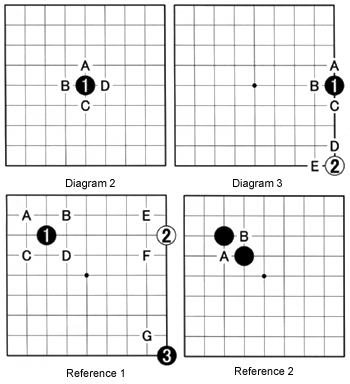
Diagram 3 : In this example, black 1 has three liberties, A, B and C. White 2 has only two liberties at D and E.
Reference 1 : Note carefully that the points A through D are not connected through the lines to black 1 and therefore are not liberties. In the same way, E and F are not liberties of white 2 while G is not a liberty of black 3.
Reference 2 : At first, beginners often believe these two black stones are connected. They are not. For example, if there was a white stone at A and one at B it would be easy to understand that both the black stones, as well as the white ones, were not connected.
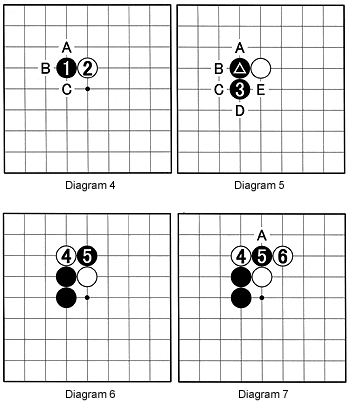
Diagram 5 : As a follow-up from Diagram 4, Black could now play at 3. Together with the marked stone, black 3 forms a "group," which has five liberties, A through E.
Diagram 6 : White could play at 4, but as Black plays 5, it becomes clear that White's stones are not connected-they do not form a group. Instead we say that black 5 "cuts" the white stones.
Diagram 7 : In the previous diagram, we argued that Black cut White. But by the same token, black 5 is cut off from Black's main group as well. If white 6 follows, black 5 is left with just a single liberty at A.
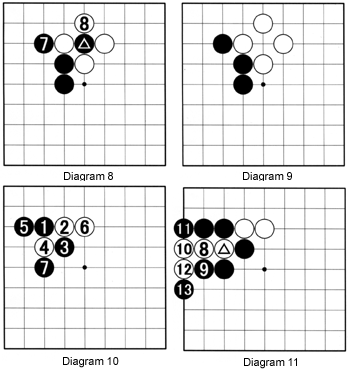
Now recall the first technical rule: A stone, or group of stones, without liberties cannot exist.
Diagram 9 : Therefore-and this is part of move white 8-the black stone is taken from the board.
When teaching a beginner the game of go, this much information is sufficient as a first step. The novice is now ready to play a game we could call "capturing go." This game prepares the beginner for the real game of go. The objective is simple:
capture one stone from your opponent.
Diagram 10 : In this game between two novices, White immediately attaches to black 1 with move 2 and cuts Black with move 4. Black's answer at 5 strengthens his weakest stone, black 1. When White reinforces with 6, Black tries to capture white 4 with move 7.
Diagram 11 : What happens when White tries to escape with move 8? Black skillfully pushes White against the edge with move 9, then captures White's group with moves 11 and 13 despite White's attempts to escape with moves 10 and 12.
Problems
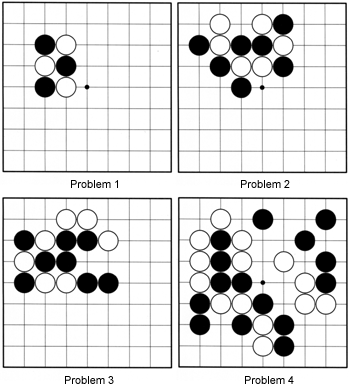
Problem 2 : White to play and capture two stones.
Problem 3 : White to play and capture some stones.
Problem 4 : White to play and capture some stones.