Aggressive players know boshi
In a study involving people characterized as optimists and pessimists, academic achievements were monitored over a one-year period. By the end of the study period, it was found that only 10 percent of the optimists had dropped out, while 40 percent of the pessimists had, even though on aggregate the scores of the pessimists were slightly better.Likewise, those who maintain a positive attitude in go have a better chance of mastering the game. Being positive gives go players a clear sense of the goal that they aiming for and the aggressiveness needed to employ such a tactic as boshi. Boshi (hat) in go means a capping move, and is useful in many situations.
Time to attack
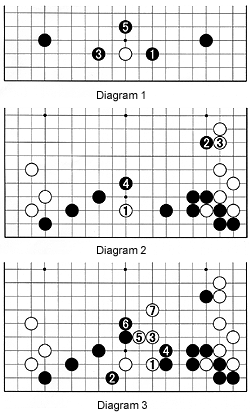
Diagram 1 : This situation is highly unlikely and would put White in a hazardous position. Here, White has played tenuki (elsewhere) with 2 and 4 and allowed Black to attack his stone from two sides and cut him off from the center.
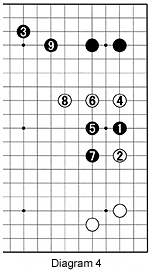 Diagram 2 : White 1 has deeply invaded black territory, so what can Black do about it ? Black 2 is motare (leaning attack) and is made in preparation for an attack on white 1. This is done with the boshi of black 4, which cuts off White's escape route.
Diagram 3 : In this follow-up to Diagram 2, White 1 is a good tsuke (attachment). Black 2 is necessary to prevent White from making two eyes.
Diagram 4 : This is part of a famous game played in 1853 between Honinbo Shusaku (White) and his great rival Ota Yuzo. Black 1 is a natural move to expand both his own position at the top and to put a stop to White's expansion at the bottom. White 2 makes the best of the situation, hoping Black will play at 5 right away. But when Black expands his position on the top as well, making an ideal double-wing formation, White is forced to invade with 4 before Black closes the door (with a move at 5). As it is essential not to get capped, jumping out to the center is natural. The same applies for White. Black then plays boshi with 7, simultaneously preventing a white tobi (jump) there. Ignoring all else, White 8 takes care of the important things first: not getting capped.
New problems

Problem 2 (intermediate): In response to the marked white move, Black invades at 1. What should White's next two moves be ?
Problem 3 (intermediate): If it is Black's move, he will try to cut off White's access to the center. What should White do in this situation ?
Solutions to last week's problems
 Solution 1 : White 1 is the correct (honte) move to capture three stones in the center while building real strength. Since White has built strength in the center, Black plays 2 to compensate with territory. White 3 tests Black's response. After black 4, White can capture the marked stones (see Problem 1).
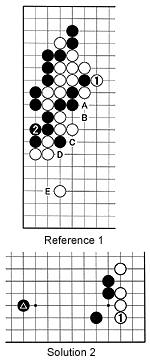
Reference 1 :White 1 is tempting but problems hover on the horizon. The move seems to make more points and thicken the center. However, Black will play at 2 and wait for an opportunity to pull out his three stones with a move at A or B. Alternatively, he could pull out his one stone with C or D, or try to complicate things with a move around E that is designed to combine with these other moves.
Solution 2 :After Black's marked move, white 1 is locally a perfect move. I say locally because although moves may be more urgent on the other side of the board, white 1 is excellent in a local sense. It may look passive, but it holds a lot of attacking potential.
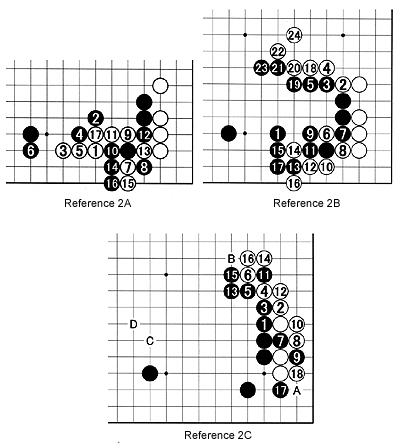
Reference 2A : If Black ignores White's move, White invades at 1, the vital point. Black's boshi at 2 and consequent attack to 6 accomplish nothing as White is able to connect with 7. If Black resists with 8 and the follow-up stones, they stones will be captured in the sequence to 17. (The 7-9 combination is a clever tesuji.)
Reference 2B : Even if Black defends with 1, White's sacrifice of 6 and then ensuring forcing moves (kikashi) to 22 before defending with 24 is a skillful maneuver.
Reference 2C : If White ignores the black marked stone in Solution 2, Black can force the sequence to 17 and then expand his influence further with a move around C or D. A move at B also is forceful. Note that a Black move at A will take all the corner territory. Black's stones are functioning well, while White's are flattened against the edge.