The Ing Memorial Cup in Europe (**-*****)
This year the annual Ing tournament was played in Helsinki. Even though there are long distances between cities in Finland, people are happy to travel 600 kilometers by car to play go for a weekend. It is because of this mentality that go has been making inroads in Finland and the Ing tournament, with the strongest field ever to play in the country, provided enough curiosity for national television to stop by and feature the game on the evening news.Ing Chang Ki, who passed away recently, was a business mogul from Taiwan and a go enthusiast, who wanted to combine his good fortune with sponsoring the game of go. His Ing Foundation provides sponsorship for tournaments, special bowls, stones and clocks that promote his view of the rules of go and the Chinese method for counting. This method emphasizes life stones and places less value on captured stones. Fortunately, in most cases the outcome is the same irrespective of the counting method used.
One feature of the Ing tournament is that foreigners living in Europe can play along with Europeans living in other parts of the world. This accounted for the fact that Lee Hyuk, a South Korean who lives in Russia, won the tournament with a perfect six wins out of six games. Second with only one loss was Aleksandr Dinerstein, a 19-year-old Russian, who has lived and studied in South Korea for three years as an insei, or professional pupil. Six players shared third place, among them a former professional and two former insei.
Semeai (capturing races)
 Last week, we talked about semeai and one can find them on the board in almost every game in some form or another.
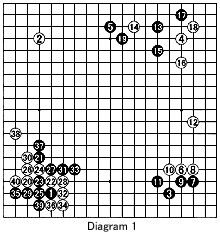
Diagram 1 shows one of the games during the tournament that involves a complicated variation of the Taisha joseki. Even top professionals do not know all variations completely. Problem 1 shows the corner position of that game. Can Black kill the marked white stones and win the semeai between the marked black and white stones? It is an extremely difficult problem that contains a series of tesuji (good local moves), which require a profound knowledge and reading skill at a professional level. We will try to solve this problem in the coming weeks by discussing a number of these tesuji.
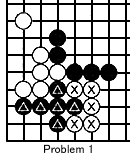 |  |
Diagram 2: The marked black and white groups each have four liberties. Therefore, the first player to play will win the capturing race, or semeai.
Diagram 3: If Black plays first, he wins in the sequence to 7. Note that he fills the outside liberties first and the inside one last.
Now let's have a look at the solutions to last week's problems.
 | 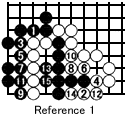 |
Now, have a look at Reference 1 in which Black just starts filling in White's liberties from the outside. Then after black 15, neither party can move and we get a seki.
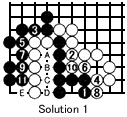
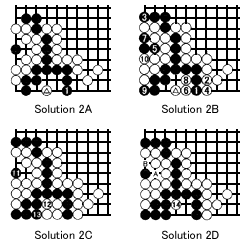 Solution 2A: After the marked white stone, black 1 is the correct answer. Solutions 2B through 2D show what happens next.
Solution 2D: White has only two liberties left at A and B and even if White plays 14 and a move next to it, Black does not need to respond. Black has a comfortable lead in liberties. This is the situation in which one side has a bigger eye than the other. So there are three general rules:
1. Start filling liberties from the outside.
2. When there are enough mutual liberties, make an eye if possible.
3. Try to make the biggest eye possible, meaning that it will take many moves to gradually reduce the size of the eye.
Sometimes it is also possible to increase one's liberties or the number of approach moves.
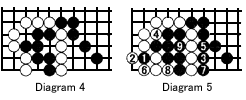 Diagram 4 shows a semeai with Black having three and White four liberties.
Diagram 5: Black first plays 1 and White answers with 2. Now Black starts the capturing race. Notice that White has to capture with 6 before he can play 8, This is the reason why White needs to make an extra approach move and Black wins the race.
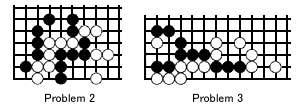
Problems 2 and 3: White to play and win the semeai.