
The master player (*-**)
Of all English-language publications about go, there is no doubt that Invincible, The Games of Shusaku, compiled by John Power, is the most profound. This classic first appeared in 1982 to detail the life and the games of the foremost go prodigy the world has ever known: Kuwahara Shusaku (1829-62).Shusaku was the outstanding player in the golden age of classical go in Japan. By setting a record of 19 straight wins in the games played periodically at Edo Castle, he firmly established his preeminence. It was thanks to the government patronage that the game enjoyed in the Edo period that Japan forged ahead of the other go-playing countries (principally China, where go is believed to have originated, and Korea), and the supremacy that Japan enjoyed until quite recently can be traced to the progress made in the Edo period.
Even today his games are studied by all serious students of the game. Shusaku's greatest contributions to go were his whole board approach and the development of the basics of the fuseki, or beginning moves.

Shusaku's fuseki
The term "Shusaku-style fuseki" refers to the 1-3-5 configuration in Diagram 1. Shusaku did not invent this pattern but he developed it systematically, refined it and added his own variations, so that the pattern became synonymous with his name. After White makes approaches with 4 and 6, Black plays 7 to set up moves at A through D. What makes these moves so good ?Diagram 2: Let's suppose White ignores black 7 and plays 8 to prevent Black from closing off the lower left corner. When Black plays 9, this is an extension from his marked stones as well as a pincer of white's marked stone. White 10 is natural now as there is no room for a two-space jump to set up a base. But black 11 defends while also limiting the direction in which white 8 can develop. After playing at 10, White wants to counterpincer black 9 with a move around A. However, due to the presence of the marked black stones, this would look more like an invasion than an attack and create a weak group.

 but building a moyo on the lower left with 16 is a feasible way of playing. Black 17 does not entirely capture the upper right corner, but Black is building a strong position.
These days though, instead of making a kosumi, often Black will play a pincer around 7 (Diagram 4). Depending on White's response, Black can now naturally develop his stones to attack white 6. For example, the moves 7 to 11 are a joseki, or standard corner exchange, but black 11 now fulfills two roles as both an extension of his two stones 1 and 9 on the one hand and a pincer against white 6 on the other.
Many variations and improvements have been developed, but Shusaku's fuseki still forms a cornerstone of modern go.
Solution to last week's problem.
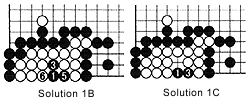
 Solution 1A: Black 1 is the vital point. It may not be evident immediately that the white stones are lost, but it is impossible for White to make two eyes. Therefore, White plays elsewhere while, if need be, Black can play the moves to 7, at which point White will have to capture the four black stones.
Solution 1B: 1 is again the vital point.
Solution 1C: Here, it becomes clear that White is at a loss and his group will die.
 The point of this capture is the large number of moves it takes to complete. As a rule we can say that one eye is better than no eye and that the bigger the eye, the more liberties. Please make use of these pieces of wisdom to solve the problems below.
Problem 1: Black to play and capture the marked stones.
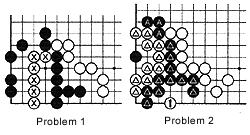 Problem 2: White has just played 1. Now, both the white and black marked stones are dead. Black can capture the white stones, though. How should he proceed? (Note: the black stones marked with A's are alive.