
War or peace ? ** - ***
There is a world of difference between a standoff and symbiosis. A standoff suggests two forces or parties neutralizing or counterbalancing each other, while symbiosis describes a situation in which two organisms live together in harmony.This reminds me of a theme that runs through Kaze no Tani no Nausicaa (Warriors of the Wind), a movie directed by Hayao Miyazaki that is set in a fantasy world 1,000 years in the future. In the film, people live together with omu, a species similar to a gigantic dangomushi (wood louse). In contrast to most people, the heroine, Nausicaa (Princess Zandra), believes that mankind should strive for a balance with nature, including omu, instead of trying to destroy the "enemy." In her refusal to make such value judgments, Nausicaa's attitude has a Buddhist quality.
Would it be possible for a game with a history of more than 3,000 years to reflect these values? Indeed, go does precisely this by including a situation called seki.
Seki
One kind of seki is shown in Diagram 1 where neither White nor Black can play at A or B to resolve the position of the marked stones.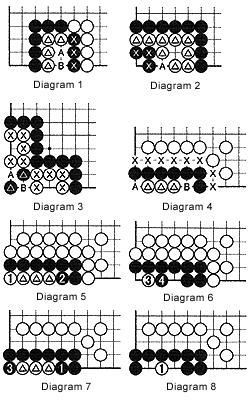 Diagram 2 presents another type of seki in which each of the marked groups has an eye, but neither side can capture the other by playing at A.
In Diagram 3, the marked black stones do not have eyes, but White's two marked groups do. Even though White's groups have one eye each. White cannot capture the marked black stones at A or B as this would be suicide.
Diagram 4: Black can capture White but not vice versa. But if White fills in all the liberties marked by crosses first and then plays at A or B what will happen then ?
Diagram 5 follows this game plan and Diagram 6 is the result. If white 3 then black 4 and vice versa. That means Black stays alive, while White's four stones in the lower lefthand corner of Diagram 5 are captured.
Diagram 7: Black can capture the three marked stones with 1, White plays tenuki (elsewhere) and Black takes with 3. But White would immediately play inside Black's territory (Diagram 8) to kill the whole black group. Therefore, if Black moves to capture the three marked stones in Diagram 5, he ends up the loser.
Diagrams 5 to 8 explain why the situation in Diagram 4 is really a seki in which the party moving first loses points.
Solutions to last week's problems
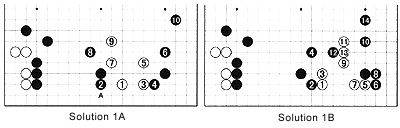
Solution 1A: After White 1, forestalling a slide by White at A is imperative. Black 2 does the job. In the sequence to 10 Black defends his territory on the left with 2 and 8, while making new territory on the right with 4, 6 and 10. Even after 9, the White group is not completely free from future harassment.Solution 1B: White 1 and 3 is a more aggressive approach. In the sequence to 14, White more or less settles himself while Black, again, gets territory on both sides.
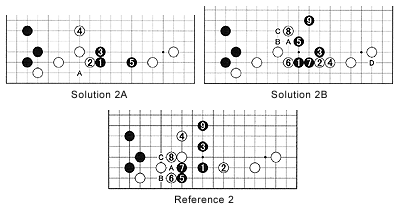
Solution 2B: The above result is too good for Black. Therefore, White tries a different approach by pincering at 2 first. After Black has escaped into the center, defending with 6 becomes paramount in securing a base and stopping Black from making eyes on the lower side. In the sequence to 9, Black manages to move away, leaving behind a threatening cut at Black A, White B, Black C. After strengthening his position, Black can aim at a move around D.
Problems
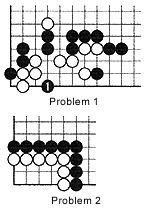 Problem 1: I set this problem two weeks ago. With the above information you might be able to solve it. Black has just played 1. How can White ensure survival ?
Problem 2: Black cannot kill the white stones, but how can he force a seki ?