
Games people play (**-*****)
Games are played for a variety of reasons. One of the most obvious is the competition involved. But in many cases it is to establish a position that often has social significance, depending on the cultural importance of the event or the particular game played. Children's games, such as hide-and-seek and tag, also play an important role in social interaction among youngsters.Games that are played by oneself, such as computer games, are equally important because they are intended primarily to prepare oneself for situations in real life. For example, flight simulation games are used extensively by airline companies to improve the skills of their pilots.
It is often possible for a player to "read" a partner's of opponent's mind because many people have difficulty in keeping their intentions to themselves no matter how hard they try.
Those who want to try to "read" the minds of others should visit a board game festival to be held on June 3 at the Shinjuku Post Office building near the west exit of JR Shinjuku Station in Tokyo. The festival features more than 30 different games, such as go, chess and checkers. Demonstrations of these and more uncommon games will be offered. More than 300 people are expected to turn up. For further information, please e-mail me at zaphod@wics.com.
Murder in the corner
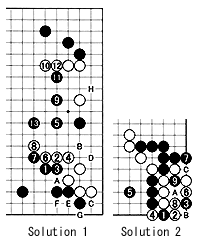 Here are the solutions to last week's problems.
Solution 1: Black 1, rather than playing at A, is a move that offers more resilience and gives little for White to hold onto. If White wants to attack the solitary stone on the right, white 2 is one way. But black 3 is the vital point because it takes away White's eye-shape. The moves to 13 are natural now, but in no event will Black be in trouble. The sequence that follows would be black B, white C, black D, white E, black F, white G, after which Black can launch a tesuji at H to make eyes.
Solution 2: The combination of black 1 and 3 kills the white group. After white 6, black 7 looks a little standoffish but after white 8, black 9 is a brilliant tesuji that makes use of the damezumari created by black 3. White can now play at A or B, but black C finishes off the corner.
 Reference 1: Black should not play at 1 right away. If he does, White can squeeze in a hane at 2 that has to be answered at 3 (or thereabouts). After white 4, black 5 is answered by white 6, ensuring White's survival.
Reference 2: If black 1 kills the white corner group, then why would White want to play in the corner ? Well, White made a mistake during his defense. He should have played a sagari (stretching downward to the side) at 1. Now, Black can start a ko with the moves to 6. But White does not need to start the ko (with white 7 and black 8) right away. He can try to capture Black's outside stones first. And that is exactly where the danger lies and why Black usually will capture the marked white stone by playing at A, rather than starting the ko.
Life & death
On the go board, we usually try to kill by first restricting space and then spearing the vital point. Sounds logical, doesn't it ?Try out this theory with these problems.

Reference 3: Black 1 does strike at the heart of the white group, but he has violated the first principle.
Reference 4: After white 6, white has made two eyes, one at A and the other at B.
 Problem 2: Black to play and kill the white corner.
Reference 5: Black 1 does reduce White's space up to a point but after white 6, A and B have become miai (Black plays one, White plays the other). Again Black has violated the first principle.
Problem 3: Black to play and kill the white corner.
Reference 6: Black 1 and 3 are a good tesuji combination, but when White plays sente (moves that Black must answer) to 8, then expands his space and finally occupies the vital point with 12, Black has allowed his prey to escape.
Problem 4: Black to play and kill the white corner.
Reference 7: Black 1 limits White's space somewhat, but white 2 and 4 are a clever combination, and in the sequence to 8, white has managed to make two eyes at A and B.