Get out of that groove (**-*****)
Sometimes you hear stories of famous people who, when asked how they became famous, mention some event that changed their lives. Mother Teresa, for example, apparently saw the light and began working with the destitute in the Calcutta slums after one such incident. The story goes that she found a poor, sick man lying near the door of her house. She took him to one hospital after another but they refused to admit him. So she gave up and started to treat the man herself. Despite her ministrations, the man died. Fortunately for destitute Indians, Mother Teresa saw where her real purpose in life lay.Most of us do not need such an event to come along to change our lives. We can start right now by challenging our basic values. For instance, instead of driving to the supermarket, we can walk there instead. Or we can put aside our usual newspaper or magazine and read something that we probably would never have thought of reading before. To refresh the mind and meet the challenges of today, we can take up a new hobby or strike up a conversation with a stranger from a different age group or ethnic background. A fresh mind is precisely what you need to meet the challenges of go.
A new perspective
We have already discussed the kosumi before. But let's go one step farther by using the kosumi as a complementary move to another one you are thinking about. Most of us have been in a situation where nothing is accomplished no matter how much you push.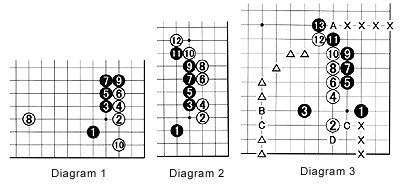
Diagram 2: White wants to get ahead of Black as quickly as he can, so he plays. 6. White now is able to challenge Black by playing a hane (bend-around move) at 10, and even play a double-hane at 12. The rest of the moves of this joseki are of no interest for us at present as they involve technique. The point we are interested in is how a power struggle for influence is fought, and how we can change our mind-set about it.
Diagram 3: This is another example, but the shoe is on the other foot. This time, White is pushing with 6 to 10. But Black stays one step behind and counters with 11 and 13. This is known as "Pushing the cart," implying the pusher is exerting enormous power to help his opponent-and in most cases this is not a good idea. Even if White later plays at B, Black will get secure territory with borders at or around the X's totaling about 30 points, while the triangles indicate what appears to be the border of White's territory, with a value of about 35 points. That seems like a good result for White, but the stone at 3 is not nearly as dead as it appears. It has so much aji (e.g. Black at C or D), that in reality it will be hard for White to get more than 20 points.
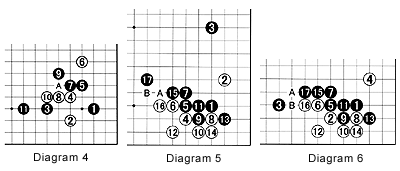
Diagram 5: This joseki is another example of fresh thinking. After the joseki moves to 15, Black could play at A, but this would accomplish nothing as white would respond by playing at B. Black 17 avoids the pitfalls of playing at A.
Diagram 6: This situation is similar to that of the previous diagram, except for the presence of black 3. Black 17 is the correct move. He does not need to fear that White would counter at A, as cutting at B would give a good result. A black move at B later (without white A) is a good move anyway as it provides thickness.
Solutions to problems set on April 29
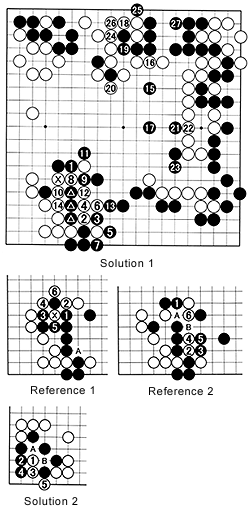 Solution 1: White has just played the marked stone. Black resists with 1. When White cuts at 2, Black has no choice but to play at 3 and 5. With the combination of 6, 8 and 10, White makes miai (leaving two possibilities), allowing black to either sacrifice the three marked black stones or extend at 11. Black chooses to build influence in the center with 11, effectively capturing one white stone in a geta (net). White 12 upsets the geta, but black 15 sets up a ladder. Black goes on to use his center thickness to attack the white wall on the right. But because of White's success in the lower left, he wins the game by 1-1/2 points.
Reference 1: Black 1 looks like a simple solution against the threat at A. But the tesuji combination (good local moves) of 2, 4 and 6 gives White tremendous influence in the center.
Reference 2: Black 3 and 5 seem to solve the problem easily, but white 6 making miai of A and B puts him on the spot.
Solution 2: White 1 exploits the aji of the two cuts at A and B. Black 2 and 4 are pointless as his group is dead after white 5. White should not cut at A or B immediately after black 2.
Problems
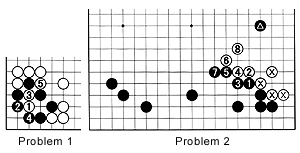
Problem 1: If you cut immediately with 3, black 4 becomes sente and White has to play at 5. Now Black can live. How does he do that ?Problem 2: Black plays 1 to build up his moyo on the lower side, but after white 8, the marked black stone has become weak while the marked white stones have become very strong. Can you find a better move than 1 ?