
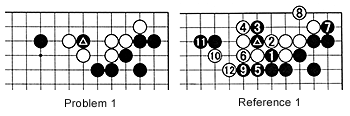
Problem 1: Black to use the marked stone and get the best result.
Reference 1: Black can exchange 1 for 2 and 3 for 4, followed by the sente moves of 5 and 7. After black 9, the sequence to 12 shown here may be followed. But the result is not good for Black.
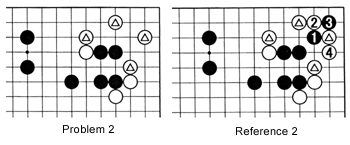
Reference 2: Black 1 will not lead anywhere because White will counter by playing at 2. Black 3 is answered by 4, and Black just loses points.
Next some life and death and semeai problems:
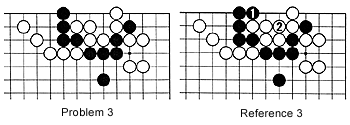
Reference 3: Black 1 is a mistake. When White answers with 2, Black has no answer. Of course, the savvy reader will know what to do.
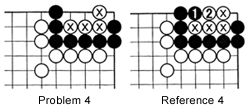 Problem 4: The Black group is in trouble. He needs to capture the marked four stones to live. What should he do ?
Reference 4: Black 1 tries to capture the four stones, but White immediately responds with 2. Even if Black captures all five stones, he is dead.
The next two problems are endgame problems. Before we can solve them we need to study a bit about the endgame.
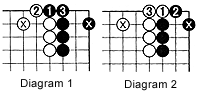 Diagrams 1 & 2: Black can play 1 and 3 to enlarge his territory by one point and decrease White's territory by one point at the same time. White can do the same in diagram 2. The difference between these two diagrams is two points. What this means is that either player can invest one move to win two points.
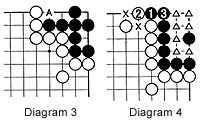 Diagram 3: If Black plays at A, he can make one point, whereas if White plays there, he does not gain any points for himself, but he prevents Black winning a potential point. Thus, playing here is worth one point in gote (a move that does not have to be answered).
Diagram 4: If Black plays 1 and 3 in gote, his territory amounts to seven points, while White gets the two points at the X's. Now compare this with the next diagram.
Diagram 5: If White gets to play first, he can play 1 and 3 in sente and instead of two points he gets three, while Black's territory is five points instead of seven. The difference is three points.
We think of points scored in sente as twice as valuable as those scored through a gote move. So the true value of white 1 and 3 in Diagram 5 is not three points but six. Black 1 and 3 in Diagram 4 prevent White from playing here in sente. This is called reverse sente, and again it is valued at six points. So the most important thing you should remember about the endgame is sente and gote.
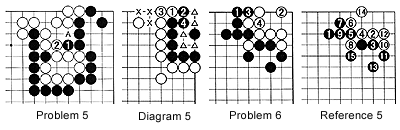
Problem 6: Black can play at 1, which is then answered by 2. All that is left then is to exchange 3 for 4. But Black has a far better combination than that. This diagram already contains a hint.
Reference 5: This is how the problem above comes into existence. It is a very common joseki.