
O Meien becomes new Honinbo
Last week, we discussed the possibility that a new Honinbo king would be crowned soon. And indeed, O Meien of Taiwan managed to dethrone Cho Sonjin, who only took the title himself a year ago. Let's have a look at how O Meien, who won by 10-1/2 points, did it. In the following game, Cho Sonjin plays with the white stones.
Kiai rules
As mentioned last week, O Meien does not have a particular style-he plays a powerful all-round go and has an abundance of kiai. What is kiai? The term is used in business, martial arts and go and is usually translated as "fighting spirit." But this is rather simplistic in regards to go, as kiai can refer to a situation where a player lays in wait for 30 or 50 moves before dealing a decisive blow. Kiai also entails having a plan and upsetting the plans of the opponent.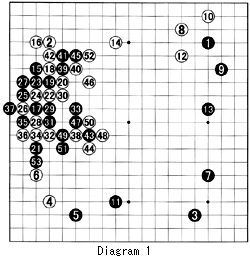 Diagram 1: Black reveals his strategy with 7, but White ignores this move and plays 8 and 10. Ignoring one's opponent is another kind of kiai. Instead of 10, White could have played at 11, but this would have been exactly what Black was looking for: a fight.
White 12 is a good move that forces Black to defend with 13. White 14 is a good follow-up. In response to black 15, 16 is the only move for White. White's strategy is to turn the space between 16 and 14 into solid territory. Black, naturally, wants to prevent that from happening, unless he can make White defend so that he can grab a piece of territory somewhere else.
Black 21 is the first move that is not "Commonsensical." It would be common sense to extend to 22. What happens after that is anybody's guess, but since White was probably expecting Black to play at 22, this might have been enough reason for Black to switch to 21. In other words, he is challenging White to prove that he was wrong in not using "Common sense."
White has to do something, so he employs the natural combination of 22, 24 and 26. But now what? White 28 induces black 29, and White is forced to answer with 30, which is a good move. This kind of strategy is a kind of kiai, too. But what is White's plan here ?
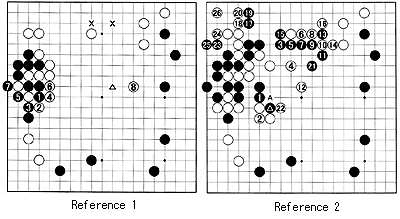
Reference 2: Black 47 in Diagram 1 is another challenge. Will White carry out an atari with 48? If he just defends with 2, Black will bolster his weak group at the top by playing at 3. White can now put pressure on the two black groups with 4 and 12, but Black will strengthen his stones with 13 through 19 and then connect them to the outside world with 21. Even if White strikes with 22, black 23 and 25 ensure life. As White has to answer with 26, Black gets sente to attack White's stones in the center or invade the lower left corner. If Black had connected his marked stone by first playing at A instead, White would have been given the initiative.
Returning to Diagram 1, we see that white 48 is forced, and so is black 49. After black 51, White cannot defend his stones on the left, as he has to captures with 52. But when Black plays at 53, White seems to be behind in territory while his lower left corner is in danger.
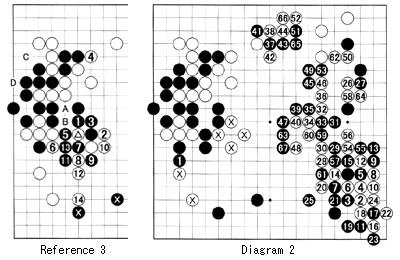
Diagram 2: After Black 1 (53 in Diagram 1), White had to do something. He decides to invade at 2. This works, but in exchange for eking out a little life in the corner, Black's center thickness will become overwhelming. That probably was the reason White decided to connect with 10, instead of following the joseki (see Problem 1). After Black hits the corner's weak spot at 11, a confused battle erupts. (see Reference 4.)
White 32 is the vital point in Black's shape, but it may well be an overplay. Black hits hard with 33 and 35 and a second great battle begins. Black 37 and 41 also are strong moves. But White does not give in and in response to 49, counters with 50. Black ignores this and concentrates on the center, where he captures White's original cutting stones 28 and 30. This is a painful development for White especially because his marked stones in the center are in danger of getting cut off while his marked stones in the corner are isolated.
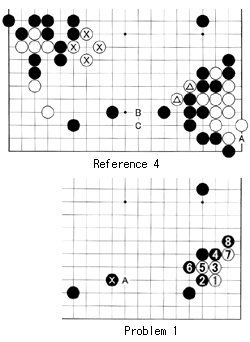 Reference 4: White has a real problem. He wants to invade at B or C, but if he does, he will lose the stones marked with triangles. Furthermore, if Black gets too strong in the center the stones marked with X's will come under fire. The ko at A is another problem White must face.
Problem 1: This is the situation following black 61 (black 9 in Diagram 2). White connected his stones at 7. What should he do according to the joseki? Note that the marked stone is at the right spot once White invades. A move at A is possible, but leaves weaknesses at two places. The marked stone leaves a greater weakness on the right side but it is Black's strategy to force White to eliminate this bad potential (aji).