
This week we will continue our discussions of ko diversion techniques by introducing as many problems as possible.
sol1,2,refe1

Answers to last week's problems

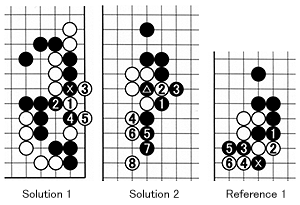
Solution 1 : A ko out of the blue. After Black plays the marked stone, White should play hane at 1. When Black cuts at 2, the combination of 3 and 5 creates a huge hanami-ko (flower-viewing ko) for White as he has little to lose, while Black may lose all his territory.

Solution 2 : Black builds influence. Black should play at 1, allowing the marked stone to be captured. The moves to 8 would be a likely follow-up. Black does not need to capture white 2 quickly by moving where the marked stone is.

Reference 1 : This is an example of a disastrous sequence for Black. If Black defends his single stone, his marked stone will be cut off. Black 3 and 5 are useless as these stones cannot avoid capture.

Other types of ko

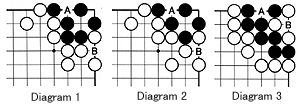
Diagram 1 : Black is alive. This is a double ko. If White captures with A, Black captures with B. So the Black group is alive, but there is one catch: If there is a ko (worth less than 15 points), this is a indefinite source of ko threats.
dia1,2,3
Diagram 2 : Black is dead. This is a double ko. If Black captures with B, White captures with A. So the Black group is dead, but there is one catch: If there is a ko (worth less than eight points), this is a indefinite source of ko threats. Why only eight points? Comparing the situations when Black is dead (as it stands now) to when he is alive, we get a grand total of 17 points for this corner. But even if Black plays at A as a ko threat and White ignores it, Black still has to win the ko at B. So he still needs two moves (after A) to keep his corner alive.

Diagram 3 : Black is alive. Even if White captures at A, Black can capture at B. White will run out of ko threats eventually. At that point, Black can always capture the White stones inside his group with a move at B.
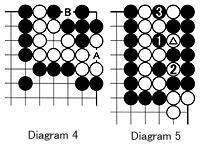
Diagram4,5 Diagram 4 : This is a situation with two ko fights that cannot be won by either player. If Black plays at A, then White will play at B. So both groups are alive. When the groups do not have two eyes but cannot kill one another, they are both alive in a situation called seki.

Diagram 5 : Triple ko that leads to jigo (draw). Very rarely, a situation arises that involves three interdependent ko battles. If Black plays at 1, White has to play at 2, after which Black is in atari again. Therefore, he needs to play at 3. White is then in atari and has to play where the marked stone is. This could go on forever, however. According to the Japanese rules that prevail throughout most of the world, this situation cannot be solved and the game is ruled a nongame (mushobu) and needs to be replayed.

Problems
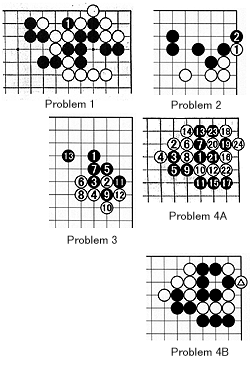
problem1,2,3,4A,4B These problems all involve ko.
Problem 1 : Black has just put White in atari with 1. What should White do ?

Problem 2 : This is a situation that arises frequently-a kind of middle-game joseki. If White plays at 1, black 2 could be a mistake. How can White profit from this ?

Problem 3 : This is a joseki with a ko. After Black captures with 11, White must not hesitate to put Black in atari at 12. Black should play at 13, rather than starting the ko by cutting below 12. Now try to answer the following questions. What kind of ko (direct, multistep, multistage, flower-viewing, etc.) is this? Who will start the ko and when will it start ? What will be the end result? How much is it worth ?

Problems 4A and 4B : In Problem 4A, the moves to 7 form a joseki. White 8 is an overplay. But after white 14, the corner becomes a ko. Problem 4B shows the result of the previous diagram. White has just played the marked stone. How should Black respond? Hint: Remember to evaluate the situation (value of the ko) coolly and then decide what is important.

By Richard Bozulich

By Rob van Zeijst

  1. How to teach go
  2. The last rule--ko
  3. Basic strategy of go
  4. Go as a second language
  5. Building castles
  6. The secrets of the lazy
  7. Don't mistake movement for action !
  8. Madmen and common sense
  9. Breaking down the borders
  10. Go the 4th R in school curriculum
  11. Go an educational tool
  12. Mixed-doubles go
  13. Problems and answers
  14. The answer is in the doing
  15. Upsetting common sense
  16. Believing is winning
  17. The art of tenuki
  18. Classification and association
  19. Being in good shape
  20. Keeping in shape
  21. Games of Culture
  22. Deduction and Induction
  23. Asking the right questions
  24. War or peace ?
  25. Avoid simple solutions
  26. The master player
  27. The Ing Memorial Cup in Europe
  28. new ruler on the Kisei Throne
  29. Expectations and reality
  30. Quantity or quality ?
  31. Fujitsu Cup
  32. A Slip of the mind
  33. Losing your bonus
  34. Get out of that groove
  35. New lease on life
  36. Games people play
  37. Changing your mind
  38. Pick your fight
  39. Sanrensei-Part II
  40. Invasion tactics
  41. sanrensei strategy
  42. JAL Cup World Amateur Go Championship
  43. The Honinbo Title: Up for grabs
  44. O Meien becomes new Honinbo
  45. Rote memory vs calculation
  46. The problem with go
  47. The art of stealth
  48. Keep your options open
  49. Where Zen and go meet
  50. Think globally, sacrifice locally
  51. Yamashita the new Gosei king
  52. Toughing it out
  53. The leaning technique
  54. Learning by example
  55. Proverbs guide your hand
  56. Yoda, the new hero
  57. Young turk wars
  58. Evolving game
  59. Solution to last week's problem
  60. Every move is a new board situation
  61. King of ko
  62. Get stronger at ko
  63. Solutions to last week's problems
  64. Answers to last week's problems
  65. Go Training in Europe
  66. Kikashi and Nozoki
  67. Tips from the Pros
  68. Applying the theory
  69. Answers to last week's problems
  70. More on honte
  71. Aggressive players know boshi
  72. Boshi-old hat for go-getters
  73. Boshi-erasing influence
  74. Rui Naiwei-top woman player
  75. last week's problems
  76. Making the connection
  77. More connections
  78. professionals use connections
  79. Solutions to last week's problems
  80. Sometimes a person might wonder
  81. Solutions to last week's problems
  82. Solutions to last week's problems
  83. Guidelines for explaining the game
  84. Handicap in golf and go
  85. Atari-The last liberty
  86. The second technical rule
  87. Concept of territory
  88. The Concept of Life
  89. Mine is bigger than yours
  90. Third line vs fourth line
  91. How low can we go ?
  92. Wariuchi
  93. Changing your perspective
  94. Solution to last week's problems
  95. O Meien defends Honinbo title
  96. O Meien retains his title
  97. Thickness-a hard issue
  98. Upping the ante
  99. Look and understand-cutting is zilch
  100. Bad style vs good style
  101. Solutions and references
  102. In go, most people have,,,,
  103. Two eyes