
Changing your perspective
Our perspective is usually connected to our very ego. Not that our perspective necessarily reflects reality, but it reflects the way we believe reality is. Maybe we don't want to know the truth. Or, more likely, we simply don't see or recognize the truth as such, even if it hits us in the face.This is very apparent when it involves fear. I remember one morning when I was still an infant. All the kids at kindergarten had gathered in the courtyard and were talking about a man with a bloodhound who liked hunting little kids-we were scared ! And no matter what our parents or teachers said, we wouldn't go to school alone anymore. From an adult's point of view this story sounds incredible, but children are apt to believe just about anything. Fortunately, a little education and logical thinking go a long way.
Extending and invading
For the past couple of weeks we have talked about using extensions to make a base, and the wariuchi, or invasion that makes a base. When I talk about extensions and establishing a base, most people are afraid of being invaded.Diagram 1 : This is your basic base: the two-space extension.
Diagram 2 : This is a three-space extension. Of course, there is an inherent weakness in this position, namely at A. If the circumstances and the timing are right, White could invade here, possibly causing considerable havoc.
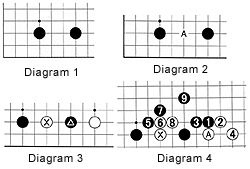 Diagram 3 : Now look here-who is the invader and who the "invadee?" Both the marked black and the marked white stone could have been the last move, or the invader. From the position alone, you cannot tell who is in the most trouble. But I can tell you one thing: if there are no other stones in the neighborhood, the invader is in trouble, because he just played the last move. Automatically that means it's the defender's turn.
Diagram 4 : For example, to attack the marked stone, Black could first lean on the white stone A. If White doesn't defend with 2 and 4, he loses that stone. Therefore, Black then gains the initiative to attack with 5 through 9-White collapses.
In other words, yes, an extension greater than two spaces is invadable and that is scary, but in general, the invader should be even more scared.
Diagram 5 : A strategy that makes full use of both the physical and mental aspects of this fear of invading and the lack of extension space, is the so-called san-ren-sei opening (= three star-points in a row). Black uses his first three moves to make this formation. Sure White can invade with 1 but Black skillfully prevents White from making a base with 2 and 6. Black 4 foils a white attack from that direction which would isolate the black corner and make further attack impossible. Finally black 8 keeps up the pressure by taking away its potential eyes in the center while building up a wall. Incidentally, the exchange black 2 for white 4 is not meant to turn the upper-right corner into black territory. It is played to prevent White from making a base.
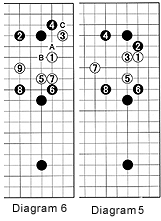 Diagram 6 : Without the exchange black A/white B, White would slide into the corner with 3, then play 5 (or 7) to make a base. If Black plays at 6, White just defends his base with 7. White answers a black move at 8 with 9, or alternatively with a move at C, which completes his base and makes two eyes.
Solution to last week's problems
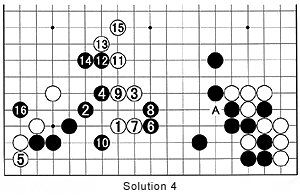
After having gained a basic understanding of bases and how to limit their space, let's have a look at last week's problem 4 and 5.Solution 4 : This is what happened in the game. White invaded at 1. Black needs to play 2 to prevent White from playing there and linking up all his stones. White 3 is fine to escape but white 5, although important eye-space for both White and Black, is premature. Black 6 and 8 kill any potential that White has around A. Finally black 10 takes away a potential black base. While White runs away into the center, Black builds up strength on the left side, which he uses to attack at 16. Instead of 5, White should have followed Reference 1.
Reference 1 : After 3, White should have tried to make at least the beginning of a base with 5. Black needs to play at 6 and 8 to prevent White from expanding his base in that direction. Next white 9 runs away. Notice that White can still try to cut at A later.
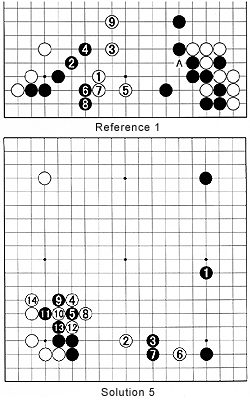 Solution 5 : Black plays at 1 instead of extending around 2, and in effect challenges White to invade. With 2, White picks up the gauntlet. Black 3 naturally prevents White from setting up base there, while extending from his lower right stone at the same time. Now White cannot make a base anymore. Of course, he can jump away into the center, but simply running away is not Cho's style. White 4 is a splendid move that puts pressure on Black's stones instead. After black 5, white 6 is the move only a genius can play. Black is forced to keep the two white stones separated with 7. But this sets off a time bomb in the lower-right corner. Next White comes back to 8 to capture a stone up to 12, then strengthens his corner with 14. Black is in trouble. And later, thanks to the exchange 6 for 7, White goes on to destroy the lower right corner.
New Problems
Problem 1 : This formation looks a little like the san-ren-sei opening. Black uses his first three moves to play in the corners first, then in the middle on the fourth line or on the third line at A. Look at diagram 5 to get a hint of how White should invade and find out the answer next week.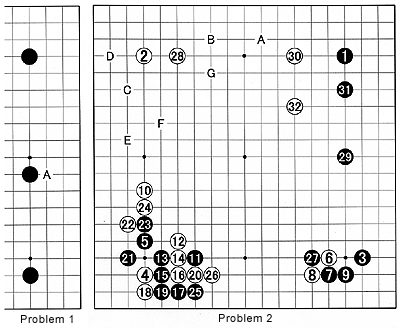
Problem 2 : These are the first 32 moves from a recent game played between Koichi Kobayashi (Black) and Keigo Yamashita. Last year, Yamashita, at just 21 years old, took away Kobayashi's title in spectacular fashion with an unusual center-oriented style. This is the first game of their best-of-five Gosei title match this year.
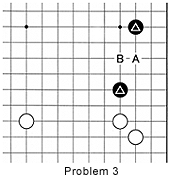 The moves from 12 on in the lower-left corner are unusual in important games as Black gets a lot of territory, while White's outside thickness is not complete since there is a hole in the middle. Black 25 is unusual as the exchange with 26 is deemed a loss for Black, but it definitely strengthens the corner in sente (= he keeps the initiative). Then Black switches to 27 to make up for White's extra thickness. White 28 is an interesting move-it dares Black to invade on the left side, or alternatively, if Black plays an extension from his upper-right corner somewhere around 30, White will play a wariuchi at 29. Black 29 indicates self-confidence. White 30 and 32 are typical moves of the Yamashita style-they build up thickness and invite an invasion. Next, the fight is on, but where? Should Black next invade at A, B, C, D, or E or play a light reduction move at F or G ? Where would you play and why ?
Problem 3 : Black's marked stones form a three-space extension. If he doesn't reinforce, White may invade at A or B. How should Black reinforce his position ?