
Because of this, the question "What is the best move in this situation ?" often does not lead to the desired answer. It does not necessarily depend on a difference in strength, but on a difference in style. So the question to ask might be "What should I be thinking here ?" or "What should I see as my goal ?" "Then you can plan a strategy with an end in mind.
Diagrams
Diagram 1 : Black 1 might be the most popular opening move these days. Not necessarily because it is the best move but because it is representative of today's style, which shies away from long joseki variations.
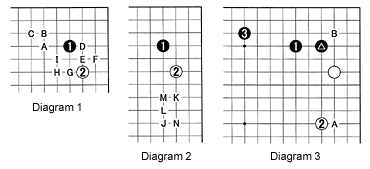
White 2 is a standard kakari (corner approach). Now Black has a range of options. If you decide your priority is to defend black 1, the moves A to I (in approximate order of popularity) are all standard moves. In this situation there is no best move, it really depends on the moves played after that. One thing to keep in mind is that the 3-3 point is still open to invasion and, therefore, the corner is not black territory.
Diagram 2 :
In addition, Black might want to be more aggressive and pincer White by choosing between the moves J to N (in order of popularity). Note that when I use the word popularity, it does not necessarily denote the quality of the move.
So how do you choose between the moves A through N and tenuki (playing elsewhere)-for a total of 15 different choices? Most people, including professionals, wouldn't consider most of these. Usually the selection process breaks down into two or more phases. Some questions to ask in making your decision are:
1. Playing in the neighborhood of black 1 may not be urgent.
What part of the board is important/urgent ?
2. In what direction do I want to develop? Or, in what direction does the opponent want to develop ?
3. Am I doing well or am I lagging behind ? Even after you think you have found an answer to these questions, the thing to remember is that often there is not a perfect move. Therefore, the most effective plan is one that involves a number of moves.
Diagram 3 :
Let's assume you want to defend the marked stone and develop on the upper side. Then black 1 is a good move. Usually, White will develop on the right side by extending to 2 or A. Next, Black can achieve his goal of developing on the upper side. Once again, note that the corner is still invadable at B, the 3-3 point.
Diagram 4 :
Black 1 is a variation if you want to strengthen the marked stone but not develop on the upper side by playing at 3. White may now choose a different joseki-the moves 2 to 4. Note that black 1 is a little defensive and doesn't have a great impact on White's marked stone. Therefore, White might consider playing tenuki. On the other hand, since Black's marked stone is already stronger than before, Black might play tenuki after white 2, or possibly attack at A.
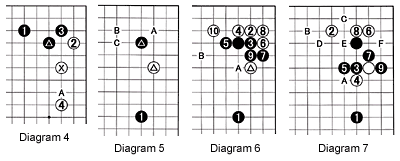
Diagram 5 :
If you don't need to defend the marked black stone and want to attack the marked white stone, or when you want to develop on the right side, you should consider pincering at 1. White will usually answer with the moves A through C, depending on his priorities and style.
Diagram 6 :
White 2 is a good move if your style is territory-oriented. White gets a comfortable corner while Black develops on the right side. After white 10, Black may play tenuki or play at A to get a good grip on White's marked stone, or at B to increase the scale of his moyo (framework). Note that the marked stone has plenty of potential for revival.
Diagram 7 :
White could also play a double kakari at 2. Although not always true in the past, these days black 3 is pretty much the standard response. The moves to 9 (or 9 at A) are a joseki. Next, Black can aim at B which threatens a placement (oki) at C. White, therefore, has to reinforce with D or E. Alternatively, black F is a large move that threatens to take away White's base in the corner.
Problems
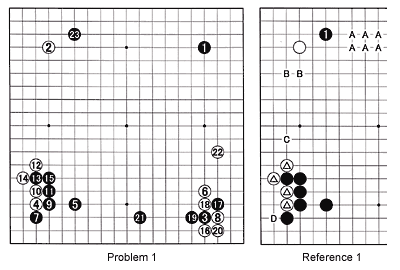
Problem 1 :This is a recent game played between two top pros. The two joseki in the lower right and the lower left are rare. Black seems to prefer thickness while White seems to go for territory and quick development. Black 23 is the point where the game gets interesting. How should this move be answered ?
Reference 1 :
If White pincers around A, Black will play a double kakari around B. If Black gets strong in that area (for example around C) during the ensuing fight, he can play at D, endangering the marked white stones. White has two weak groups and can't afford to fight.
Reference 2 :
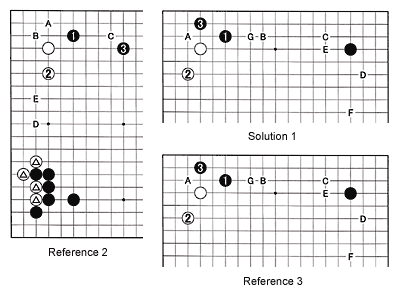
White 2 helps his stone in the upper left, but after black 3 (or alternatively black A, white B, black C), White needs to defend around D to prevent a future black attack at E. However, a move at D is not an effective defense for White's marked stones.
Solution 1 :
White 2 is the solution. Strengthening his stone in the upper left, White doesn't leave behind dangerous weaknesses on the left side. Black 3 next hopes for white A, black B. It will be difficult to develop around the upper side with C because Black is strong on the upper left. On the other hand, playing at D instead of at C would make Black answer with E. Next, White needs reinforcement around F, but this creates bad balance.
 Reference 3 :
This might happen if White just follows the joseki in the upper-left corner. He wants to invade the upper side, but after the moves to 15, Black has developed both in the upper left and the upper right while making territory. White has to reinforce his position with 16. Black's development is faster.
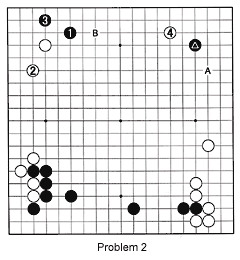
Problem 2 : To prevent the situation in Reference 3, White approaches at 4 first. If Black responds like White in the upper-left corner-at A-White will extend to B. How should Black respond in this case ?