
Games of Culture (*****)
The chess pieces are the block alphabet which shapes thoughts; and these thoughts, although making a visual design on the chess board, express their beauty abstractly, like a poem....I have come to the personal conclusion that while all artists are not chess players, all chess players are artists.
-Marcel Duchamp (1887-1968), French artist. In an address on Aug. 30, 1952, at the New York State Chess Association.
There has always been an intimate connection between chess and culture in the West. A good chess player is by definition a cultured person and an indication of his or her social and intellectual status. Many novels include references to chess, likening spying to a chess game with the individuals playing the part of chess pieces, or drawing parallels between the game and diplomatic moves between nations.
In similar fashion, go was developed by Chinese literati, who discovered intellectual and moral values in it. The following anecdote is recorded of the scholar and statesman Tu Yu (A.D. 222-284). Tu Yu, who was regarded as the most skillful player in China at the time, was accused of idling away his time. Tu Yu replied, " If I must give an explanation, it is that it serves as a great help to the sacred teachings. "
Shape follows function
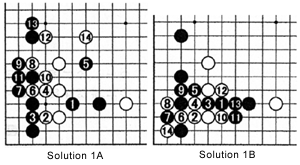
Before entering new territory, it may be a good idea to review last week's material. We can do that by providing solutions to problems 1-6 that were carried. After black 1 in Solution 1A, white 2 and 4 make an effective bamboo shape. White 6 to 10, and 12 are forcing moves to prepare for 14, a move that blocks Black's path to the center while opening up space for the white group. Solution 1B shows Black decides to ignore White's threat. White takes the corner (which in itself is worth more than 20 points), while Black has to struggle as it will not be easy to capture the white stone in the center.
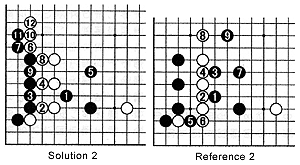
Solution 2: Again White builds a bamboo connection to 4. Even though Black gets sente to take the initiative in the center, White makes his second bamboo shape using the standard combination 6 and 8. After 12, White is thick in the center, while Black's three stones are still weak and liable to face attack. Reference 2: If White connects, Black takes the initiative in the center and instead of having thickness, White just has a pile of stones without eyes.
Solution 3: The sequence to 7 is a joseki, or standard corner exchange. Some people believe one has to learn joseki just like a list of new vocabulary in French. But I believe that getting a grasp of the logic behind the moves is the fastest way to learn go.
Solution 4A: As we saw last week, if White strikes at 1, Black is forced to defend in an ugly, inefficient way. Therefore defending at 1 is the proper move. Some people would play at A, B or C, thinking this would increase efficiency. But black 1 is really the only move.
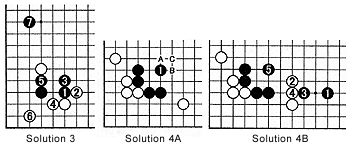
Solution 4B: Improving on the previous diagram, Black may play at 1 and 3 first, to make 5 a more natural move. This technique, called induction, is correct but there is no guarantee that White will supinely put up with Black's plans. The least Black needs is a stone in the lower right corner to back up 1 and 3.
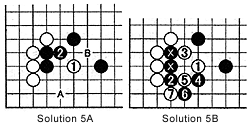 Solution 5A: White 1 strikes at the vital point. If Black makes an empty triangle by playing at 2, White can either connect his stone by playing at A or he can pull out with B, tearing the Black position apart.
Solution 5B: If Black resists, he will get into trouble. This diagram is only one example and shows Black's marked stones being captured. In other variations, Black will have more trouble than White.
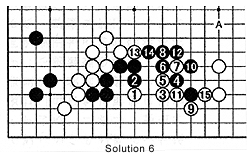
Solution 6: Once again White strikes at the vital point. This kind of action has to be backed up by reading the board. Understanding the sequence to 15 looks like a difficult task, but the decisive move is 7, after which the other moves follow. Note the exchange of 13 for 14. Black is forced into a bad shape because his stone at 8 is now unnecessary. White 15 is a move that secures a lot of territory in the corner. Of course, if White were behind or more aggressive, playing at A is feasible.
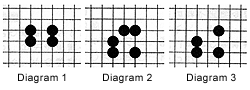
 What we have learnt here is that the bamboo connection in Diagram 1 and the shape in Diagram 2 are effective. We can combine these shapes to make Diagram 3. This shape is often more effective than the plain bamboo.
Here are some new problems to help you get an even better grip on the shape of things.
Problem 1: After black 13, if White plays tenuki (somewhere else), where is the vital point for Black to attack White's shape ?
Problem 3: White to play and make a good shape.
Problem 4: Where should Wite play to kill the black group ?
