
Learning by example (***)
In general, Westerners are relatively better off when it comes to logic. But sometimes logic alone is not enough to analyze certain situations. The more intuitive, Oriental approach-including turning to precedence, examples or anecdotes given by teachers-comes handy. This week we will again use some professional game situations to illustrate how the concept of leaning is applied to specific situations.
More leaning
Last week, there were two problems involving the leaning, or motare, technique. Here are the solutions.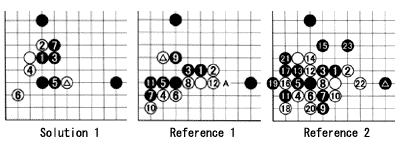
Reference 1 : Instead, Black can also attach a stone to the marked stone in Solution 1 by playing at 1. Of course, this strengthens White as well as Black. In the sequence to 12 (which could have been played at A), White builds up a comfortable position while Black captures the marked white stone. Note that not all of Black's stones are working together and his position is cut into two. In other words, this is not an ideal result. It is therefore of great consequence which stone to attack and in order to this, which one to attach a stone to.
Reference 2 : The moves given here form a complicated joseki. But as hard as Black has worked, the result remains the same-Black's position is split and the marked stone is not contributing to Black's overall strategy.
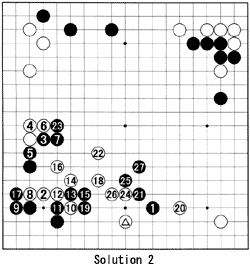 Solution 2 :
White has just played the marked stone. Since his position on the lower left is strong, Black invades at 1. White 2 uses the principle of the leaning attack to strengthen himself on the left in order to attack black 1 on the right. The problem was where to play next. Black 3 uses the principles White tries to employ and leans on a stronger white stone to attack white 2. This allows White to play 8 in sente, but after the cut from 11 to 15, White has to defend at 16. Black connects his stones with 17, allowing White to occupy the focal point of 18. Black 19 is honte (proper move). White finally comes around to play 20 to attack black 1. Black 23 was too much-Black should have played at the star point on top of the marked white stone to immobilize that stone. That would have given Black a great advantage. In the game, White manages to connect all his stones with 24 and 26 and goes on to win the game.
Solution 2 :
White has just played the marked stone. Since his position on the lower left is strong, Black invades at 1. White 2 uses the principle of the leaning attack to strengthen himself on the left in order to attack black 1 on the right. The problem was where to play next. Black 3 uses the principles White tries to employ and leans on a stronger white stone to attack white 2. This allows White to play 8 in sente, but after the cut from 11 to 15, White has to defend at 16. Black connects his stones with 17, allowing White to occupy the focal point of 18. Black 19 is honte (proper move). White finally comes around to play 20 to attack black 1. Black 23 was too much-Black should have played at the star point on top of the marked white stone to immobilize that stone. That would have given Black a great advantage. In the game, White manages to connect all his stones with 24 and 26 and goes on to win the game.
Regardless of the end result, both white 2 and black 3 are marvelous moves that fully display the power of the leaning technique.
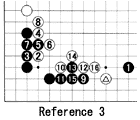 Reference 3 : The worst thing for Black to do is defend his territory passively with 3, 5, and 7, and again with 9 through 13. Sure he makes about five more points in the lower left corner, but White gets a strong wall and black is left out in the cold.
Diagram 1 : White just played the marked stone, threatening to attack Black's marked stones. Where should Black play next? Making some territory and assuring eye-space, black 1 is a possibility. But white 2 is a splendid move that secures a base and makes territory. With four black stones on the left side and just one white stone, this is a mediocre result for Black.
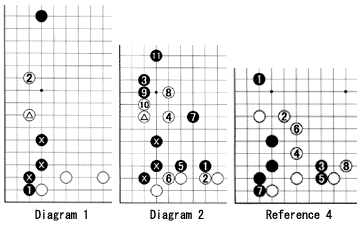
Reference 4 : Reversing the order of the moves, playing black 1 first followed by black 3 is a risky strategy. White may counter with 4 and 6. After white 8, it is Black who is being chased.
What we have learned through these examples is that the leaning attack is employed to strengthen your own stones first in order to attack on the other side.
Problems
Problem 1 : In this game, played in 1974 between Cho Chikun on White and Shiyoichi Takagi on Black, in response to the marked white stone, which should probably have been at A, Takagi launched a furious attack with 1. Applying the principle outlined here, how should White answer? (White has overwhelming influence in the lower left corner.)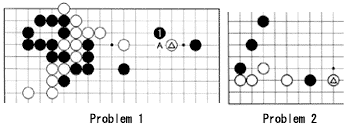
(The number of h indicated the difficulty level with one representing beginner and five the most advanced.)