
Go as a second language
Last week, I wrote that fewer stones were needed in the corner than at the sides to enclose an equal number of points, but most stones were required to encircle the same number of points in the center.
 Do we really need seven stones (Diagram 1) to claim nine points of territory in the corner? Probably two are enough as Diagram 2 demonstrates. Even if White threatens with 1 and 3, Black can fight back with 2 and 4 and eventually kill the invaders in the sequence to 12. For all his efforts, White is not able to create enough space to assure two eyes.
Beginners are often overwhelmed when they see strong players place their stones on the board like this. Some of them probably feel like giving up there and then. However, after playing for six months, you will comprehend many permutations simultaneously and be regarded with awe by a neophyte at go.
Making progress in go is basically the same as learning a language. You learn new words, determine their usage and the grammatical rules that apply, and then put them together in a sentence. But two correct sentences in a row do not guarantee a coherent entity.
The same holds true for go--you first learn different individual moves in the corners and on the sides, then reinforce those stones with additional moves. Sometimes, a stone that was originally intended as a base on which to build territory, is rendered useless, forcing you to consider if the stone can be used in another way.
Tip: If you are a novice, always play out all the sequences on a go board to understand what is going on. A language student does not start out remembering complete, complex sentences.
 |

|
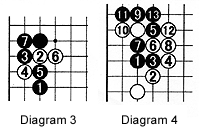
In Diagram 4, White has a three-space extension and Black attacks in the middle. Now it becomes more difficult to capture the invader. The sequence shown here is an example of White's failure to stop his opponent.
In Diagram 5, White manages to connect his stones but at the heavy cost of relinquishing a stone in the center. As you can see, a three-space extension on the third line builds a larger framework, but the structure's inherent weakness can cause it to collapse.
In Diagram 6, White links up by sacrificing a stone and positioning himself on the outside. This is about the best White can expect to do.
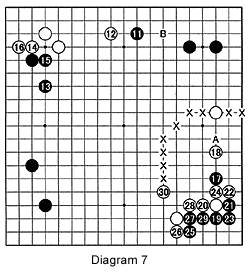
As White has strengthened himself, black 13 becomes indispensable. White 14 and 16 secure the corner and prepare for an attack around B. With the combination of 17 and 19, Black invades the white sphere of influence, or moyo, on the right side. White 18 is unavoidable as a black extension at A would be ideal.
In the sequence to 30, Black sacrifices his initial invasion stone at 17 to take away the corner from White in sente, meaning that he has an advantage in making the next move. You might think that as he has managed to conquer the original white-dominated corner, Black has succeeded. Nothing is further from the truth. White lays claim to at least the territory indicated by the x's, severely limiting Black's ability to make a comeback.
Improving your reading of the board is the easiest way to become stronger at go. Reading (or calculation) is done through visualization of the position and thinking ahead. Professionals in almost any field are good at this. With go professionals this visualization process is the product of years of daily training, with top professionals often starting as young as 3 or 4 years of age. Because of this training, top pros can often master other intellectual games in which this skill is required, e.g. chess, shogi and mah-jongg and bridge. In sports, visualization techniques are used to overcome fear, habitual mistakes and other mental blocks.
I believe go can be of help in sports as well as in any other area in which concentration, mental discipline and evaluation skills are required.
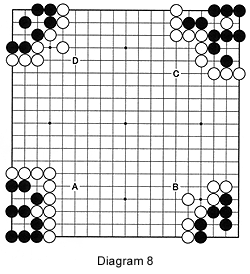
Below are a few more problems to increase your ability to think ahead. In Diagram 8, White kills Black in problems A, B and C. Refer to the snapback technique I explained two weeks ago. Problem D becomes a ko.
A Go course for beginners in English is being given at Ben's Cafe in Takadanobaba, Tokyo (Tel. 03-3202-2445) every Sunday from 11 a.m. to 1 p.m. The lessons are free for beginners. (Japanese included), so come and join the fun!